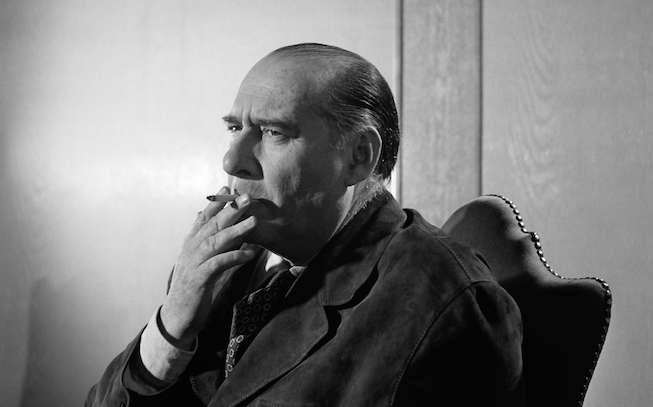
It’s the 25th anniversary of “Open Roads,” Film at Lincoln Center’s annual festival of new films from Italy. The 14 New York premieres in the series include two biopics and a documentary about one of Italy’s most renowned directors.
The fest coincides with the 120th birthday of Roberto Rossellini (1906-1977), a pioneer of Italy’s Neorealism movement. “Open Roads” is showing one of his masterpieces, Paisan, along with the documentary Roberto Rossellini, Living Without a Script by Ilaria de Laurentiis, Raffaele Brunetti, and Andrea Paolo Massara. Comprised entirely of archival footage, the doc focuses on the later years of Rossellini’s career, after his 1940s classics and his collaborations with his wife, Ingrid Bergman, that received a mixed response. In 1956, after Bergman returned to Hollywood against her husband’s wishes, Rossellini was invited by Prime Minister Nehru to make a documentary about modern India. There, the director commenced an affair with Sonali Dasgupta, the wife of a noted Indian director, The resulting scandal prompted the Indian government to confiscate Rossellini’s footage—which, ironically, was released thanks to Bergman’s intervention. The couple soon divorced.
The documentary, India Matri Bhumi, was well-received at the 1959 Cannes Film Festival, and Rossellini made a comeback of sorts that same year with the drama General Della Rovere, starring fellow Neorealist auteur Vittorio De Sica. But Rossellini dismissed the latter success, insisting that “any idiot” could make a commercial hit. Indeed, Rossellini believed all his great successes “belong to the past.” Ever the contrarian, he embraced television, proclaiming that “cinema is dead.” He produced his films independently and became increasingly absorbed by scientific research.
Living Without a Script offers a bonanza of never-before-seen, intimate footage, complemented by excerpts from Rossellini’s writing voiced by the actor Sergio Castellitto. It’s a fascinating look at an incredibly complex artist whose work continues to challenge.
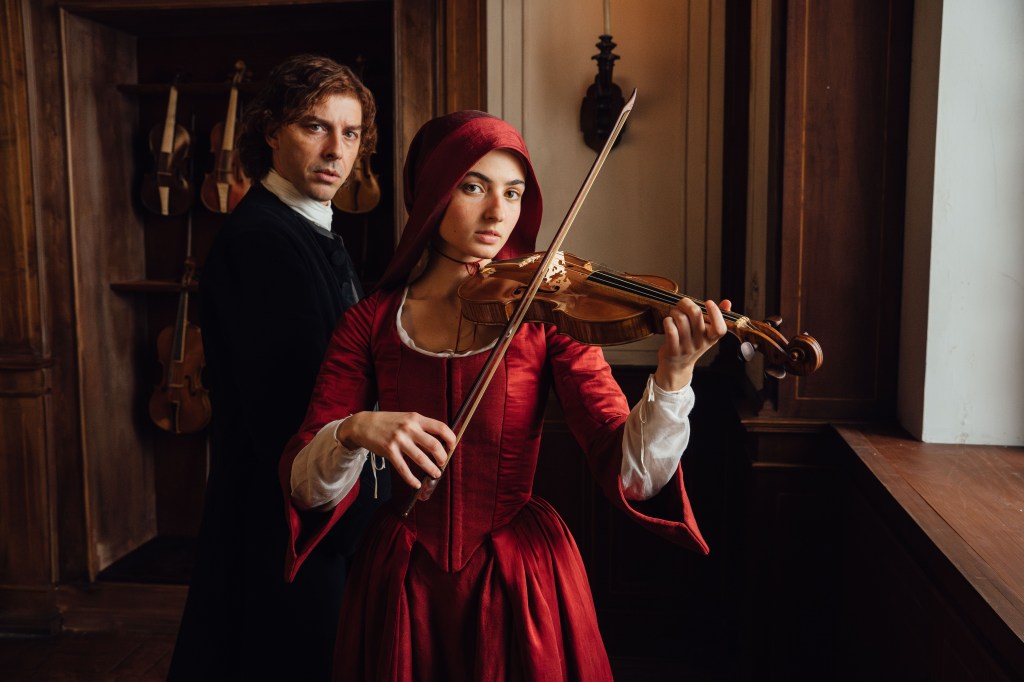
Michele Riondino and Tecla Insolia in Primavera
I must confess that before watching Primavera I knew virtually nothing about the composer and violinist Antonio Vivaldi apart from his celebrated “Four Seasons” and other compositions. I didn’t realize he was a priest and that he taught for decades at the Ospedale della Pietà orphanage for abandoned teenage girls, many of whom became acclaimed touring musicians. I also didn’t know that Vivaldi, who fell victim to changing tastes, died in poverty and was rediscovered in the 20th century.
Vivaldi’s time at that orphanage is the jumping-off point for Primavera’s fictional story of Cecilia (Tecla Insolia), a gifted violinist whose talent is immediately recognized by the composer, played by Michele Riondino. Casting a shadow on Cecilia’s auspicious future is the fact that she’s been promised to a military man once he’s back from war. Vivaldi is actually the secondary character in this feminist tale that visualizes the constricted lives of the young women he tutored, who must perform masked or behind a grille. Ludovica Rampoldi’s screenplay, based on a novel by Tiziano Scarpa, offers a couple of startling plot twists amidst all that exquisite music. Acclaimed opera director Damiano Michieletto makes his feature directing debut with this lush period production.
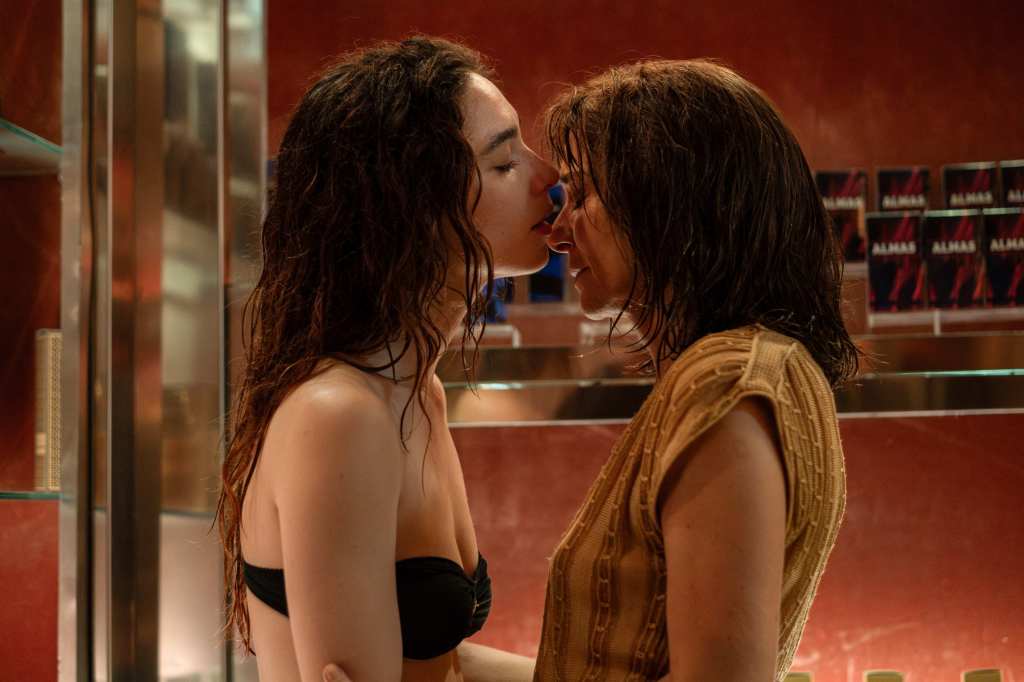
Matilda de Angelis and Valeria Golino in Fuori
I’d never heard of Goliarda Sapienza, the subject of Mario Martone’s Fuori (Outside), but in Italy and France she’s regarded as one of the continent’s greatest writers. (Her acclaimed magnum opus, The Art of Joy, was published in 1998, two years after her death.) Fuori takes place in 1980, when Sapienza, unable to secure a publisher, went to prison for five days for stealing a friend’s jewelry. The film follows her post-prison friendship with two much younger fellow inmates, Roberta, an uninhibited heroin addict, and Barbara, who now runs a perfume shop. That bond liberates Sapienza, who finds her prison buddies more stimulating than the intellectual milieu that has shunned her. Martone and Ippolita di Majo’s script is a series of episodes that don’t gather much dramatic momentum, but the performances make the film worth seeing. Veteran actress Valeria Golino (Rain Man) vividly conveys Sapienza’s frustration and rebellious spirit, and Matilda de Angelis is compelling as the volatile Roberta.
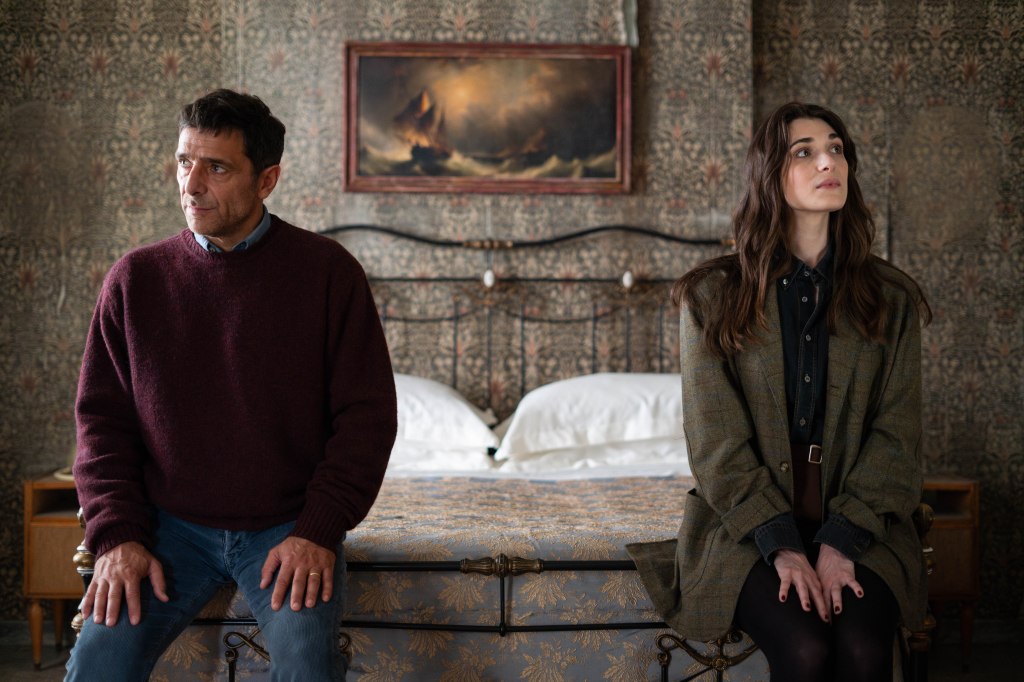
Adriano Giannini and Pilar Fogliati in A Brief Affair
Golino appears again (and in a third “Open Roads” entry, La Gioia) in A Brief Affair, a crowd-pleasing comedy with the cheekiness of a Hollywood pre-Code classic. The film marks the directing debut of Ludovica Rampoldi, whose screenwriting credits include Marco Bellocchio’s The Traitor, the TV series “Gomorrah,” and “Open Roads” standout Primavera. Rampoldi’s screenplay immediately piques your curiosity as seismologist Rocco (Adriano Giannini) competes in the bizarre (but real) sport known as chessboxing (yes, a round of chess followed by a bout in the ring). Nursing his wounds at a nearby bar, Rocco encounters the forlorn, slightly drunk Lea (Pilar Fogliati), who shares a chaste kiss after he helps her find her car and drives her home. Lea is married to Andrea (Andrea Carpenzano), a popular TV actor, and Rocco is wed to Cecilia (Golino), an urbane psychiatrist—but that doesn’t stop Lea and Rocco from finally acting on their attraction. There’s more to this “brief affair” than initially meets the eye—the plot machinations are worthy of the great Ernst Lubitsch and the four leads are primed for mischief.
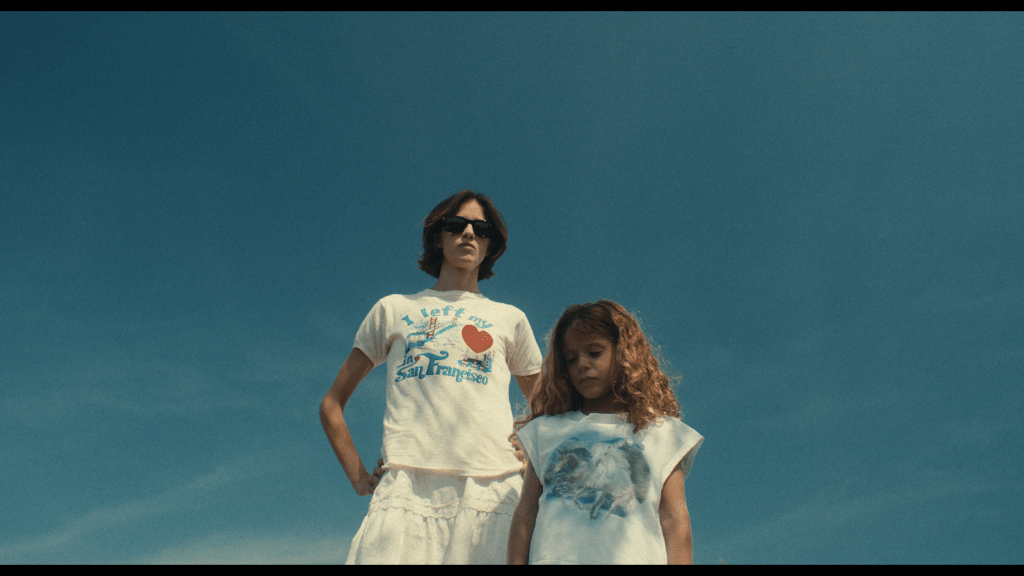
Benedetta Porcaroli & Lucrezia Guglielmino in The Kidnapping of Arabella
Alas, I was not nearly as charmed by the series’ opening-night attraction, The Kidnapping of Arabella. Writer-director Carolina Cavalli’s film gets off to a promising start with an unrecognizable Chris Pine (speaking Italian!) as Oreste, a celebrated writer speaking at a gala ceremony and being constantly interrupted by his bratty seven-year-old daughter, Arabella (Lucrezia Guglielmino). (She keeps taunting him with the name of his apparent arch-rival, Jonathan Franzen, and demands a meal at Taco King.) Oreste tells his limo driver to take the girl to the taco restaurant, and while the driver takes the order Arabella encounters a distraught young woman named Holly (Benedetta Porcaroli), who is somehow convinced that Arabella is the incarnation of her younger self and invites her into her car. The ensuing road trip is as eccentric as that premise, as Holly seeks out the aged dance instructor she feels is the key to her salvation and raises cash by hiring out Arabella as a flower girl at weddings. The self-conscious quirkiness becomes increasingly irritating.
“Open Roads: New Italian Cinema” runs May 28 through June 4 at the Walter Reade Theater, to be followed by the decades-spanning series “History, Italian Style” (June 4-25).
Pictured at top: Roberto Rossellini. All photos courtesy of Film at Lincoln Center.


Leave a Reply