
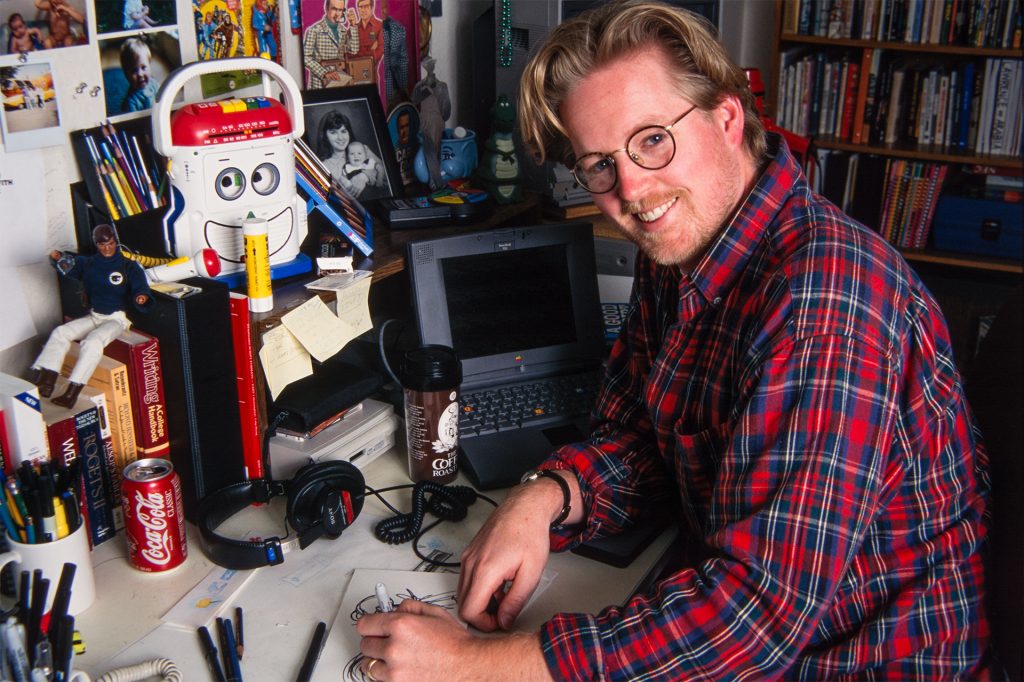
Pixar’s Toy Story 5 just posted the biggest opening of 2026, with $160 million in North America, a franchise record. Writer-director Andrew Stanton has been with this beloved series of films since the first Toy Story premiered in 1995. I interviewed Stanton in 2003 to discuss another Pixar blockbuster, Finding Nemo, his first sole directing credit, and his feelings about how the original Toy Story—the first computer-animated feature—was holding up. Since that time, Stanton directed another Pixar masterpiece, Wall-E, and the Nemo sequel Finding Dory, as well as co-writing the brilliant, Oscar-winning Toy Story 3 and 2019’s Toy Story 4 and directing episodes of “Stranger Things,” “Better Call Saul,” “Legion,” and “For All Mankind.” On Toy Story 5, he shares directing credit with McKenna Harris. As this profile attests, Stanton’s contribution to the enduring success of Pixar is invaluable.
Andrew Stanton may be the most successful filmmaker you’ve never heard of. As co-writer of Pixar’s Toy Story, Toy Story 2, and Monsters, Inc. and co-writer/co-director of A Bug’s Life, Stanton shares responsibility for a string of computer-animated blockbusters which together have generated more than $1.7 billion in worldwide box office. Stanton now takes the Pixar spotlight as sole writer and director of the delightful Finding Nemo, the story of a clownfish named Marlin in search of his missing son, Nemo. Albert Brooks, Ellen DeGeneres, Willem Dafoe, Geoffrey Rush, and young Alexander Gould supply the lead voices for this exquisitely designed underwater adventure.
Stanton says he’d been trying to cook up a fish tale since the days of Toy Story, but the core idea finally came to him during a walk with his young son. “I was just coming out of A Bug’s Life and going on to Toy Story 2, and I hadn’t seen him much and wanted to spend some time with him. And I was so overprotective in our walk—don’t get too close to the curb, don’t pick up that pointy stick, don’t run too fast—that I caught myself and realized that I was just pissing away the moment. I wasn’t allowing myself to enjoy what I had right there. It really got my brain going about the dilemma that even the most best-intentioned parent can have. It got me on the whole issue of fear, and how you have to get over your own fears of life in order to be present with your loved ones. I manifested that in a father-son relationship, which is something that I felt I had never seen before in an animated movie. I’d never seen a movie from the parent’s point of view.”
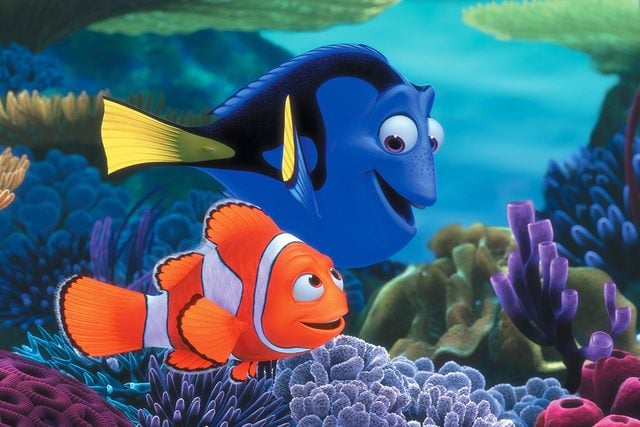
Finding Nemo
In Finding Nemo, the title character becomes separated from his father in the Great Barrier Reef and winds up in a fish tank in a dentist’s office overlooking Sydney Harbor. To bring life to the anxious dad, Stanton turned to a master of comic neurosis, Albert Brooks. “I learned the hard way that you cannot make somebody overprotective and neurotic very easily without putting off the audience,” the director notes. “Albert has this amazing ability to be neurotic and absolutely appealing at the same time. I think it’s the fact that he’s aware of it and embraces it. That casting was essential to making the character appealing. He was even surprised at how endearing his character came across. He said, ‘It takes for me to be a fish for people to like me.’”
Ellen DeGeneres plays Marlin’s traveling companion Dory, a gentle fish with major short-term memory problems. “She was a real find,” Stanton enthuses. “Years back, when I was thinking of an angel/guide fish to help bring the father through this journey, in my stupid, single-minded maleness I thought it would be a guy character. As I was making my notes, one night my wife was watching Ellen’s show and I heard her switch subjects five times in one sentence, and I went, ‘Oh my God, that’s it. That’s exactly how I would play short-term memory.’ Then I couldn’t get her out of my head, and it became so easy to write the character. I like to think of actors when I’m writing, but you don’t want to get too in love with them because you may not get them. I totally broke that rule with her. So by the time I was done and sent her the script, I said, ‘I wrote this for you, and I’m screwed if you don’t take it.’ And she said, ‘Well, then I better do it.’”
Unlike some past Pixar projects, Finding Nemo features distinctive comic personalities rather than big marquee names. “People don’t want to believe this, but we never go for the big names intentionally,” Stanton says. “We love it when we can get them, but it’s not a criterion. When we went for Tom Hanks for Toy Story, he wasn’t the Tom Hanks we all know—he had just come out of A League of Their Own and he was very well known, but he wasn’t the biggest megastar ever. Once he signed on, movies from Philadelphia all the way to Apollo 13 came out while we worked on that movie, and we were just thanking the stars that we now had a megastar.
“Everybody on Nemo was my first choice. The more films we got under our belt, the more our phone calls got returned. And this time, everybody I wanted made it in. We spend a lot of time sampling people’s work from other movies and making sure it fits. There have been a lot of big names we’ve thrown around for our movies, and they just don’t match. It’s amazing how when you separate someone’s voice from their face, who stays and who goes.”
Along with its entertaining vocal performances, Finding Nemo boasts arguably the most dazzling designs in Pixar history. Creating an animated movie set almost entirely underwater presented its own unique challenges. “Water is very difficult to mimic,” Stanton explains, “because it’s so organic and changes shape constantly. But that turned out not to be that difficult—it was more brain power and the right casting of people who can solve that kind of stuff. The more gnarly thing for us to solve was the look of being underwater. Surprisingly, that wasn’t so much technical as procedural. It turned out that there are several elements which, when combined, make you believe that you are underwater—you believe that there is actually some substance between the camera lens and the character you’re looking at. It’s not just air. It’s fog beams; caustic lighting, which is that patterned lighting that you see at the bottom of the pool; diffusion, which is a fancy word for things disappearing, things going monochromatic as they go away; surge and swell, and what I like to call elegantly ‘crap in the water,’ or particulate. There’s always little bits of stuff floating around. When you put all that together and adjust it right, you just believe it.”
With the phenomenal success Pixar has enjoyed since the debut of Toy Story in November 1995, does Stanton feel extraordinary pressure as Finding Nemo approaches its release date? “That’s turning out to be the number-one question I keep getting. Yes and no. Yes, it is a lot of pressure. You’d have to be an idiot not to realize the streak you’ve got going. But every one of our movies has had that pressure. It’s a little easier in one sense, because every one of our movies, economically, was going to take down the studio if it didn’t do well. When your ratio of development to production is one to one, there is no room for error. So all I’ve ever known in my experience of making movies is that kind of pressure. I actually kind of worry sometimes about how I’ll do without that kind of pressure.
“Toy Story will always in some sense be the easiest movie we had to make, because we were so young and stupid, and so excited just to be making a movie, that even when it was going south, we were still psyched to come to work. We never thought there would be more past that. Everything ever since has been an exercise in how do you trick your brain into thinking that you’re getting to make a movie for the first time all over again.”
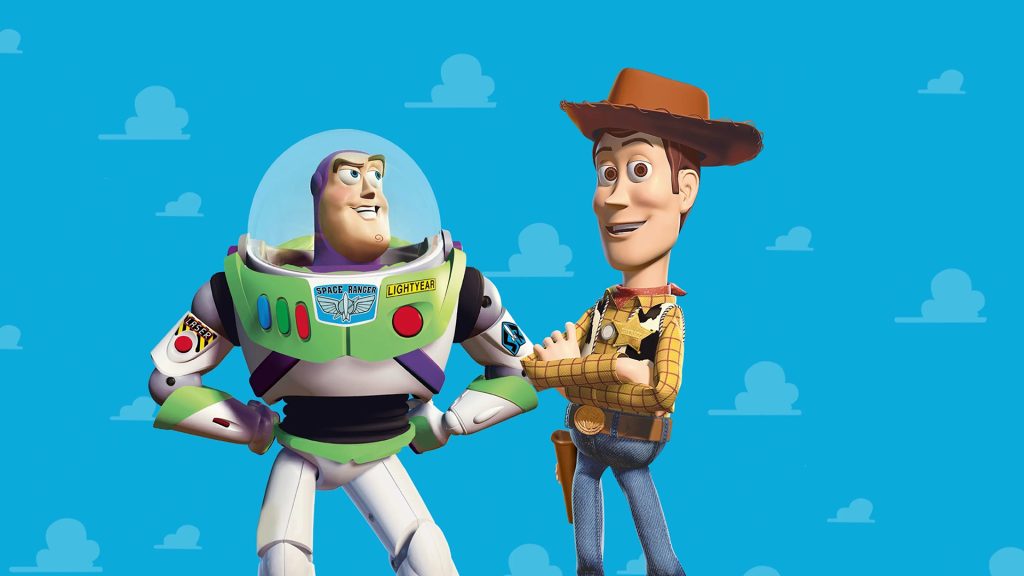
Toy Story heroes Buzz and Woody
With all the advancements in Pixar technology since their first feature, how does Stanton feel the original Toy Story stands up today? “Story-wise and entertainment-wise, I’m very proud of it. Technically, we even said before we started: Let’s just mentally prepare ourselves that this is going to be the ugliest movie we ever make. Because technology is not on our side, it’s going to advance faster than you think, and before you know it there’s going to be a movie that looks so organic and real you won’t know how it was made. At the time, we said: What are the movies we still watch that technically are showing their strings? We pointed to Snow White and The Wizard of Oz and Star Wars. And we realized that, okay, if we put all our eggs into content, we should be pretty safe. We’ve pretty much tried to keep that methodology. So when I get a compliment about how great a film looks, it’s a nice additional perk, because that’s not where all our focus was.”
At top: Andrew Stanton. Photos courtesy of The Walt Disney Company.


Leave a comment