Sandra Hüller is having a moment. An Oscar nominee for her riveting, multilingual performance in Anatomy of a Fall (Was her character guilty or innocent? We still don’t know), Hüller scored a big Hollywood success this past spring, starring opposite Ryan Gosling in the popular outer-space adventure Project Hail Mary. Currently, she’s appearing opposite Tom Cruise in Alejandro G. Iñárritu’s eccentric satire Digger. Huller also stars in two acclaimed European films featured at the New York Film Festival: Rose, for which she won the Silver Bear at the Berlin Film Festival, and Fatherland. The performances couldn’t be more different.
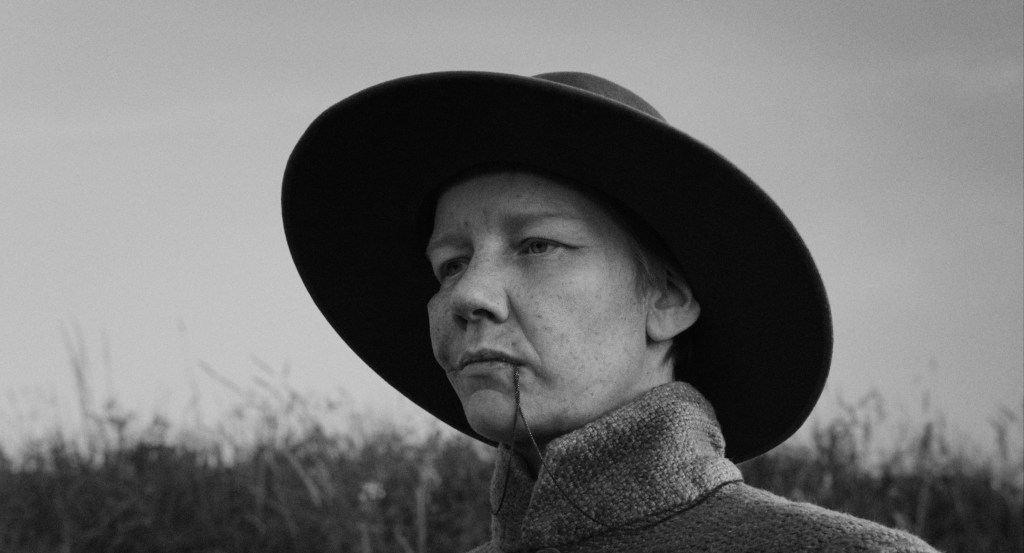
Rose writer-director Markus Schleinzer was inspired by stories of women in past centuries posing as men for a variety of reasons, from a desire for autonomy to avoiding forced marriages to a passion to exist as the opposite gender. His lead character is a fictional composite, a woman who has fought as a soldier in the seventeenth century’s Thirty Years’ War and arrived in a rural German village claiming to be the heir to a rundown farmstead. The unnamed soldier hires workers, restores the farm, and earns the awed respect of the community after killing a bear. Things take an unexpected turn when the soldier tries to buy land from a neighboring farmer and, as part of the deal, agrees to marry one of his five daughters. For a while, the marriage remains unconsummated, with the soldier vowing to respect bride Suzanna’s purity, eventually resorting to a strap-on to satisfy her desire. Then Suzanna announces she’s pregnant. Suzanna, who obviously has her own secrets, eventually learns the truth about her husband but conspires to maintain their domestic situation. Ultimately, the charade is exposed, leading to a dark resolution that sadly would ring true even today.
Hüller’s performance is free of vanity (Rose has a scar on the side of her mouth from a bullet wound), but she doesn’t go out of her way to appear masculine; being unfeminine and assertive is enough to convince her neighbors. She’s a subtle, precise actress, but also capable of startlingly explosive moments. Matching her is Caro Braun as Suzanna, in a performance that morphs from hapless comic relief to surprising assertiveness. The black-and-white photography by Gerald Kerkletz is stunning, and the production design by Olivier Meidinger looks remarkably authentic. Ultimately, what you take away from Rose is admiration for the lead character, no matter how they identify, and their quest to live a life with the same freedom, authority, and abandon as any man.
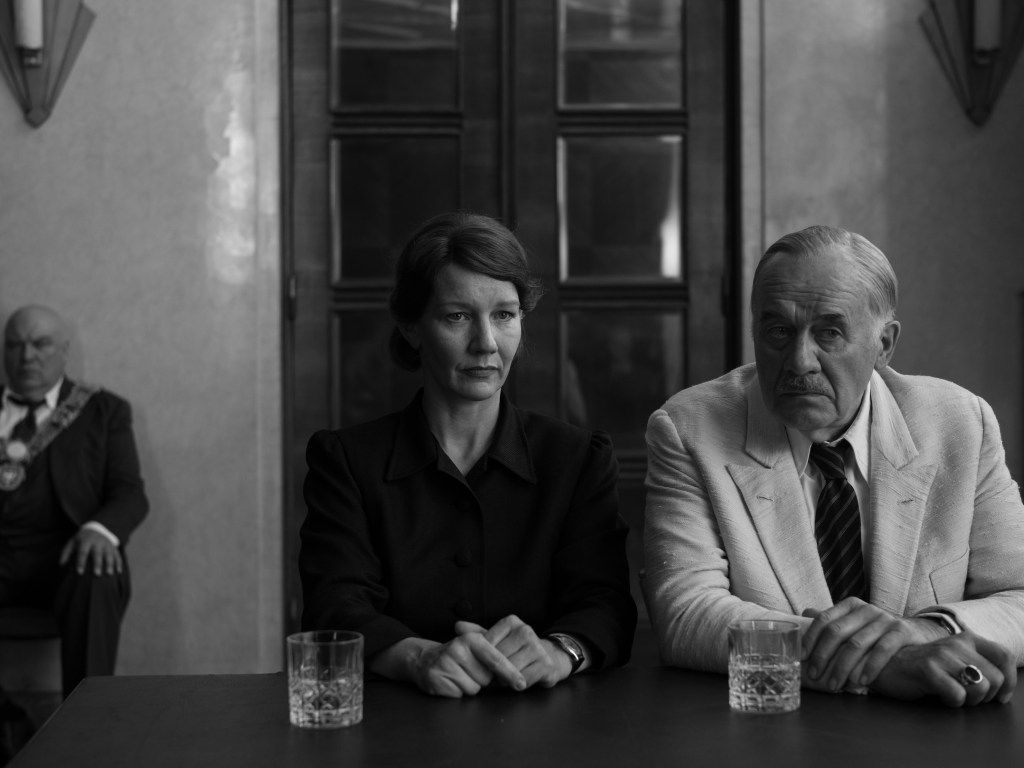
Sandra Hüller and Hanns Zischler in Fatherland
Hüller performs in a different key in Fatherland, playing Erika Mann, the daughter of celebrated German writer Thomas Mann (Hanns Zischler). Pawel Pawlikowski’s film takes place in 1949, as Erika accompanies her father on his auspicious return to Germany after fleeing to Switzerland in 1933 and then California in 1939. To Erika’s dismay, Thomas agrees to be feted in both West Germany and Communist East Germany. At a celebration in Frankfurt, Erika has a fraught encounter with her ex-husband, an actor who collaborated with the Nazis; in another corner of the room, Thomas bluntly tells Richard Wagner’s grandsons that the Bayreuth theater should be burned to the ground. But that’s a rare moment of candor—in most instances, Thomas is circumspect and diplomatic with his hosts, perhaps blinded by nostalgia for the Germany he used to know. Erika, frustrated by her father’s decision to remain apolitical, abandons him in the middle of his idealistic Weimar address.
The film begins with an extended take as Erika’s cynical brother Klaus (August Diehl), also an acclaimed writer, sits naked on the floor of his Cannes hotel room, listening on the phone as Erika pleads with him to join her in Germany. In the middle of the tour, Erika learns that Klaus has committed suicide—but Thomas is determined to continue as planned.
Pawlikowski won the Best Director prize at Cannes for his first film in eight years. Fans of his previous films Ida and Cold War will recognize his trademark style: gorgeous black-and-white cinematography by Lukasz Zal, square Academy ratio, and a mostly static camera capturing precise compositions. Production designers Marcel Slawinski and Katarzyna Sobanska’s evocation of place and period, including the recreation of decimated neighborhoods, is remarkable. The film’s visual mastery is matched by the smart, literate, and witty script by Pawlikowsi and Henk Handloegten. And holding it all together is another complex and mesmerizing performance by Sandra Hüller.
A personal note: It was gratifying to watch Hanns Zischler’s commanding performance as Thomas Mann. Fifty years ago, as a handsome young actor he co-starred in Wim Wenders’s Kings of the Road. At the time, I worked for a struggling film distribution company that handled all of Wenders’s early films. We renamed the film for an American audience—the far less catchy German title was In the Course of Time—and opened it at the Embassy 72nd Street Theatre on the Upper West Side of Manhattan. The film flopped—a New York Times pan was the death knell for a three-hour, black-and-white German film. Today, the film has a devoted following and is considered a classic of the New German Cinema movement.
At top: Sandra Hüller in Rose. All photos courtesy of Film at Lincoln Center.


Leave a comment