The New York Film Festival lineup includes many eclectic international films that may never see the light of NYC projectors again. But naturally, the fest also features higher-profile films with marquee names attached, movies heading to commercial theaters in the coming weeks and months. Here’s a roundup of a few of those big titles.
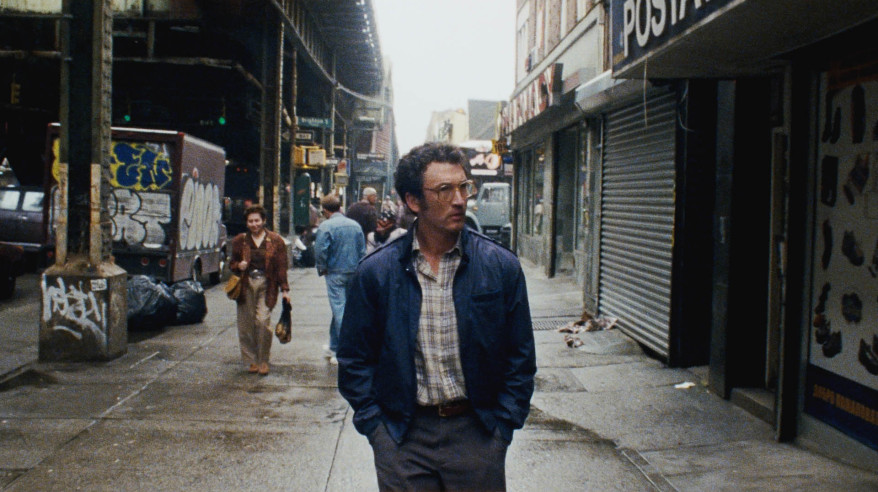
The opening-night attraction was writer-director James Gray’s Paper Tiger, a 1980s New York-based thriller starring Adam Driver, Miles Teller, and Scarlett Johansson. Gray’s earlier films Little Odessa, The Yards, and We Own the Night all dealt with New York’s criminal element, and he’s returned to that turf with arguably his best outing yet. It’s also his most personal, a semi-autobiographical account of a man whose quest to elevate his family’s financial standing has terrible consequences. Irwin Pearl (Teller) is an engineer living in a modest house in Queens with his wife Hester (Johansson) and teenage sons Scott (Gavin Goudey) and Ben (Roman Engel). Irwin is decidedly overshadowed by his brother Gary (Driver), an ex-cop who treats the family to a catered dinner from Peter Luger’s Steakhouse as he makes a business proposal to Irwin to join him on a project to clean up Brooklyn’s notoriously polluted Gowanus Canal. They meet with the Russian in charge of the operation and sell him on the merits of Irwin’s expertise and Gary’s connections—a deal that could be very lucrative for the brothers. Then Irwin makes the foolhardy decision to bring his sons along on a nighttime visit to the site. When he tries to warn the Russians of a safety hazard, all hell breaks loose.
From that moment on, Paper Tiger is unbearably suspenseful. Irwin and his family are targeted by the Russians and cocksure Gary recklessly makes it his mission to fix the mess his brother has created. Meanwhile, Hester privately faces her own dire crisis.
The melding of crime drama and family saga is potent, and it has personal resonance for Gray: The three lead characters are all loosely based on his father, mother, and uncle. (His dad was a convicted felon and his mother succumbed to brain cancer.) Though set in 1986, the film has the feel of those gritty classics of the 1970s, partly because it was shot on 35mm by Gray’s frequent cinematographer Joaquín Baca-Asay. Above all, this is one of the best-acted films in the festival, with extraordinarily intense work by Driver, Teller, and Johansson.
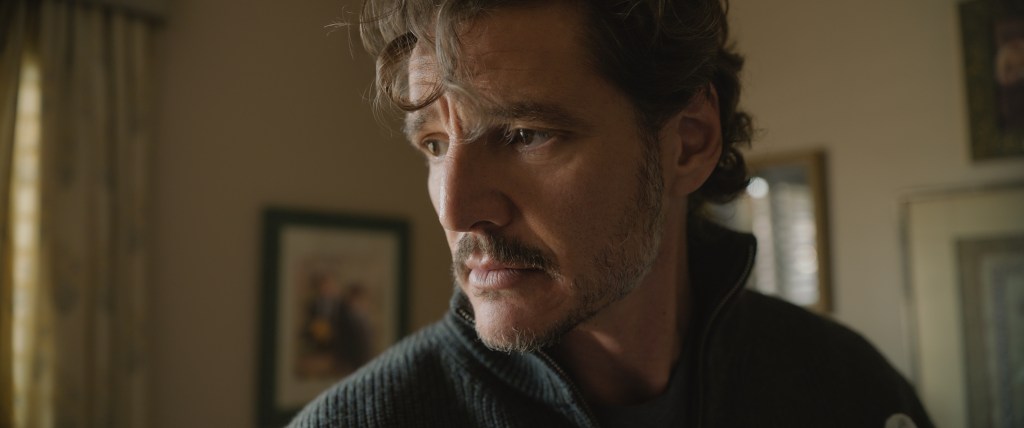
The fest’s “Centerpiece” honor was given to the world premiere of writer-director Tony Gilroy’s Behemoth!, his first feature since The Bourne Legacy in 2012. (He’s been busy as the creator and showrunner of the acclaimed Marvel series “Andor.”) It’s the very impressionistic portrait of a classical cellist—so impressionistic that it takes about half the movie to get your bearings. The film begins inside a fascinating workplace—the Barbra Streisand Scoring Stage on the Sony Pictures lot in Los Angeles. There, cellist Alex Serian (Pedro Pascal) has returned after various gigs with world-class symphony orchestras, ostensibly to help care for his dementia-stricken mother (JoBeth Williams). As the orchestra rehearses its first movie music cues, Gilroy cuts to the real circumstances of Alex’s sudden flight from Chicago—to escape Carol (Olivia Wilde), the pathologically possessive wife of one of the Chicago orchestra’s wealthy benefactors. Alex’s frantic getaway in a snowstorm ends in a serious taxi accident that he (but not his cello) miraculously survives. Gilroy continually returns to the scoring stage, where the music cues trigger other major episodes in Alex’s life, including his brief affair in Dallas with gifted violinist Nadia (Eva Victor), who winds up marrying a billionaire and dies at a tragically young age. Gradually, we piece together Alex’s biography: He was a child prodigy who appeared at age six on Johnny Carson’s “Tonight Show.” His brother Andy (Will Arnett) left behind the viola to form a rock band and now hosts a podcast devoted to the film, TV, and cartoon scores of their late father Peter (Hank Azaria, seen only in videos)—the occasion for a funny sight gag set to that cartoon music.
At Nadia’s memorial service, Alex is struck by the talent of another prodigy, Nadia’s young daughter Viviana. Years later, the girl, now 15, evolves into a celebrated performer and composer Alex avidly follows. Alex’s questions about her paternity compel him to embark on a personal espionage mission that’s scored like a movie thriller. It all comes full circle when Viviana is hired to replace the irascible composer on a big-budget film (code name: Behemoth!) and conduct the ensemble that includes Alex.
Pedro Pascal’s star has risen incrementally in the last decade, from high-profile TV series “Game of Thrones,” “Narcos,” “The Last of Us,” and “The Mandalorian” to leading roles in films like Gladiator II and The Fantastic Four. Alex is his most substantial role to date, though his character, a genius from a very dysfunctional family, is often emotionally distant and taciturn. (At the press conference, Gilroy likened Pascal’s assignment to that of Marcello Mastroianni in the Fellini classics. Not incidentally, Pascal also had to learn to play the cello.) It’s a subtle, unshowy performance, but riveting nonetheless—and quite moving in the final scenes.
Music, of course, plays a key role in the film: Gilroy, a former musician himself, hired no fewer than nine composers, including Hollywood heavyweights James Newton Howard, Michael Giacchino, and Alan Silvestri, to work on the varied score. Behemoth! is a big swing that requires your full attention, but ultimately its kaleidoscopic approach rewards the effort.
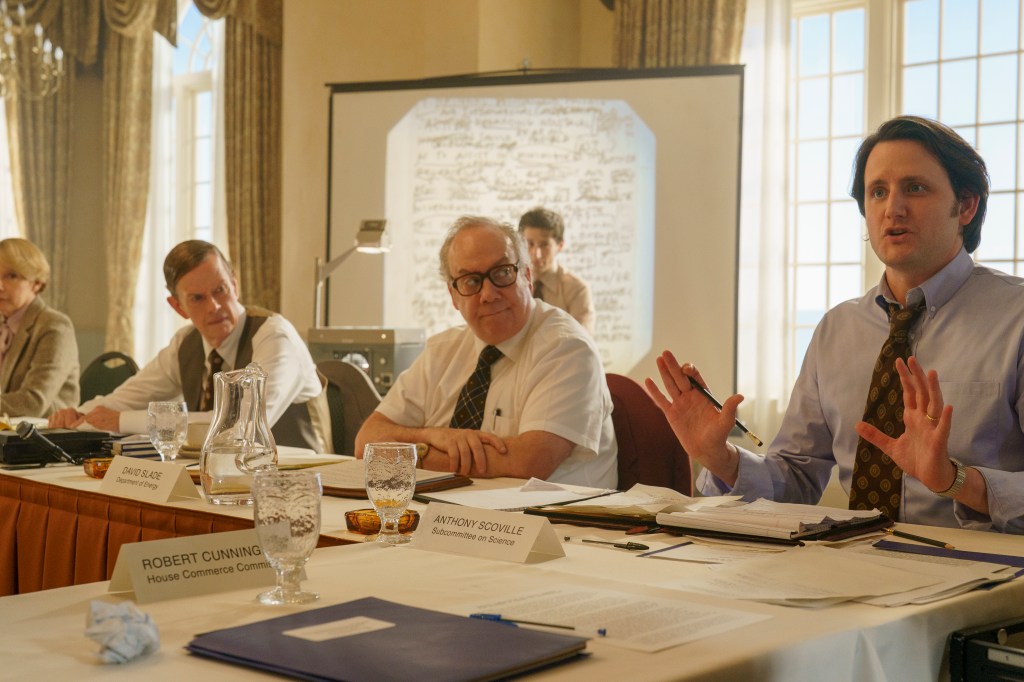
Amy Ryan, Dylan Baker, Paul Giamatti, Noah Robbins and Zach Woods in A Statement
Another big swing is A Statement, the new film from Tom McCarthy, who directed the Oscar-winning Spotlight and the excellent The Visitor and The Station Agent. It’s an audacious undertaking, using the verbatim transcripts of a 1980 gathering of twenty scientists, academics, activists, and bureaucrats at a St. Petersburg, Florida hotel, tasked with submitting a recommendation to the U.S. Congress on how to deal with an issue gaining global attention: the impact of carbon dioxide emissions on the climate. The film, written by McCarthy, Noé Debré, and Thomas Bidegain, is based on a chapter in Nathaniel Rich’s 2019 book about climate science, Losing Earth: A Recent History. The real-life characters depicted represent a range of viewpoints, from the urgency felt by Friends of the Earth activist Rafe Pomerance (Evan Peters) to the more cavalier response of meteorologist John Perry (Jason Clarke), who believes there’s plenty of time for humanity to relocate; from the cynicism about humanity’s capacity to change of M.I.T. nuclear engineer David Rose (John Turturro) to the pragmatism of David Slade (Paul Giamatti), director of the Department of Energy’s Office of Carbon Dioxide Effects. The reliance on their verbatim exchanges sometimes results in arcanely dry patches, but the powerhouse ensemble (which also includes Paul Rudd as conference moderator Tom Jorling, Amy Ryan as public-health scholar Annemarie Crocetti, Tatiana Maslany as contentious Georgetown law professor Edith Brown Weiss, and Nina Arianda as the session’s personable stenographer Bernadette) fuels your interest in this high-stakes conclave. The writers wisely break away from the conference with fictionalized scenes set during lunch breaks and even a hotel wedding reception some of the participants crash—moments that reveal the private vulnerabilities of this brainy group.
Ryan’s Annemarie, who sometimes feels like she’s in over her head, gets the last word, in a potent monologue reminding the panel that’s there’s a human cost to their theoretical musings. Ultimately, issues like the role of nuclear power and the responsibility of the rest of the world result in a stalemate, not a statement. For the modern audience, seeing daily news reports on the devastation wrought by climate change, the film is a harsh reflection of more than four decades of lost opportunities.
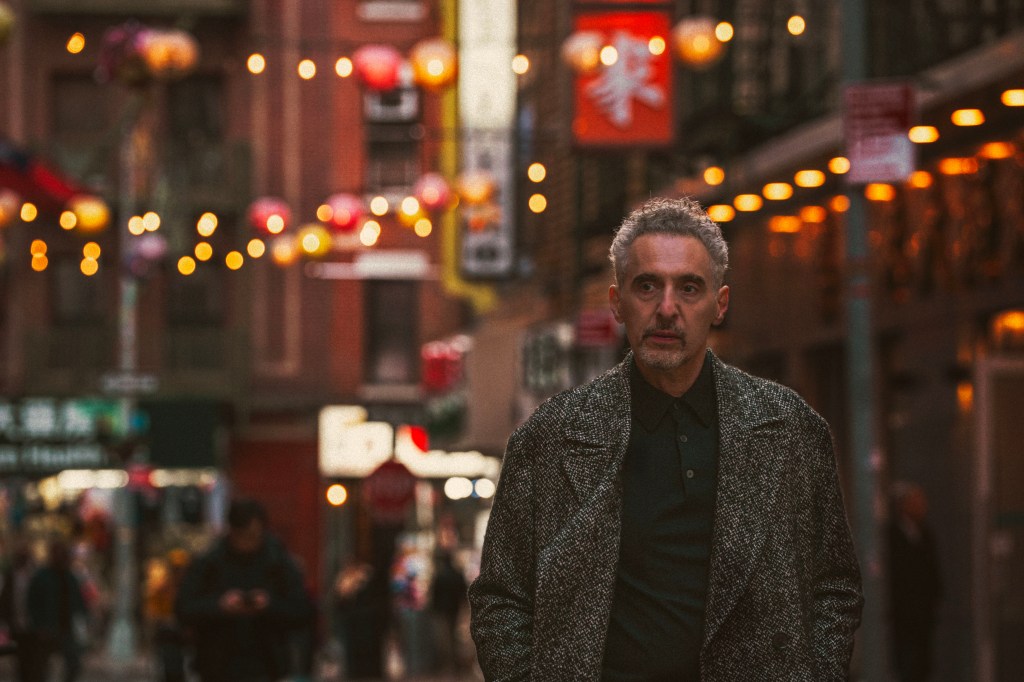
John Turturro in The Only Living Pickpocket in New York
John Turturro is a standout in A Statement, but the true festival showcase of his acting chops is The Only Living Pickpocket in New York. Writer-director Noah Segan is an actor who has appeared regularly in the films of Rian Johnson, and he’s clearly learned something about intricate narratives from the man behind the Knives Out movies. Turturro plays Harry Lehman, an aging, old-school master pickpocket we first see plying his trade on a crowded subway car. But Harry makes the dire mistake of ripping off Dylan Diamond (Will Price), an arrogant young jerk from a crime family, stealing a gym bag from his car that holds an expensive watch and a mysterious USB card. Harry’s regular fence, Ben (the always welcome Steve Buscemi), is also puzzled by the gizmo, so Harry takes it to a more knowledgeable fence in Chinatown (Kelvin Han Lee). Tech-savvy Dylan tracks down Harry and invades his apartment, where he lives with his adored, severely disabled wife Rosie (Karina Arroyave). He gives Harry until the end of the day to retrieve the USB card, which contains a fortune in cryptocurrency. Harry’s desperate odyssey takes him to all five boroughs, including a poignant reunion with his estranged daughter Kelly in Queens, powerfully portrayed by Turturro’s A Statement co-star Tatiana Maslany. Harry’s gifts as a seasoned thief play a key role in the twists that come in the fatalistic final act, which includes an encounter with Dylan’s crime-boss grandmother (a surprise cameo by an Oscar-winning star).
From its opening use of LCD Soundsystem’s “New York, I Love You But You’re Bringing Me Down” to Bobby Short’s closing rendition of Cole Porter’s “I Happen to Like New York,” Pickpocket is as New York as it gets, with marvelous location work photographed by Sam Levy, against an aptly funky music score by Gary Lionelli. And fans of great New York films will savor the Do the Right Thing reunion of Turturro with Giancarlo Esposito, playing a veteran New York police detective who’s also baffled by today’s technology. Clocking in at a brisk 88 minutes, Pickpocket is one of the year’s most engaging and flavorful movies.
In brief, here are some more highlights of the 64th New York Film Festival:
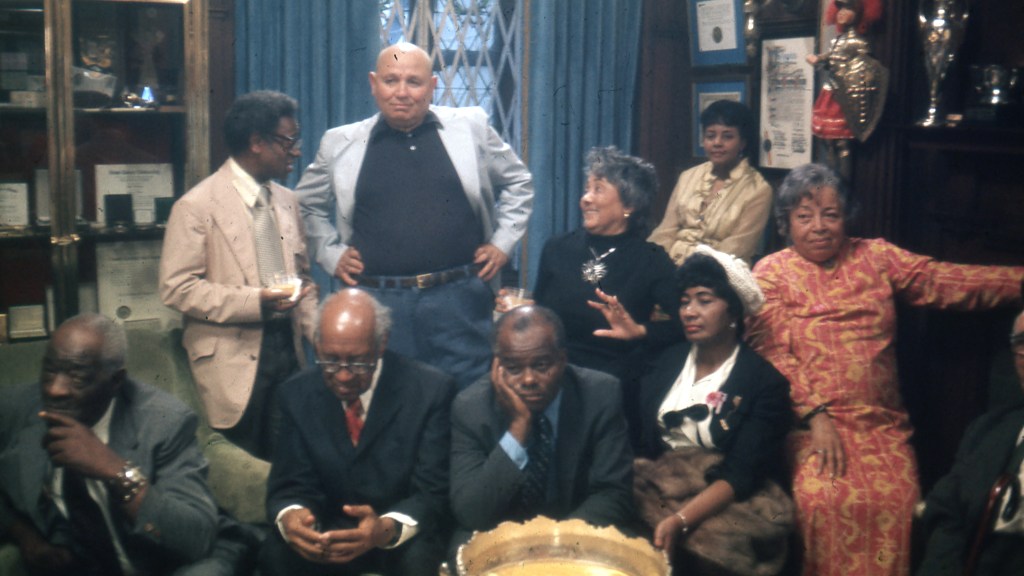
Once Upon a Time in Harlem
In 1972, filmmaker William Greaves gathered more than two dozen veterans of the Harlem Renaissance for a cocktail party at Duke Ellington’s townhouse in Harlem. The participants included noted painters Richard Bruce Nugent, Romare Bearden, and Aaron Douglas, pioneering actor Leigh Whipper, legendary ragtime pianist Eubie Blake, bandleader Noble Sissle, and Vanguard Club founder Louise Patterson. Greaves died in 2014, and now his son David has assembled the footage from that event into a remarkable documentary, Once Upon a Time in Harlem. What father and son have created is a magical journey back in time. What a privilege to eavesdrop on these lively, stimulating, and formidable artists.
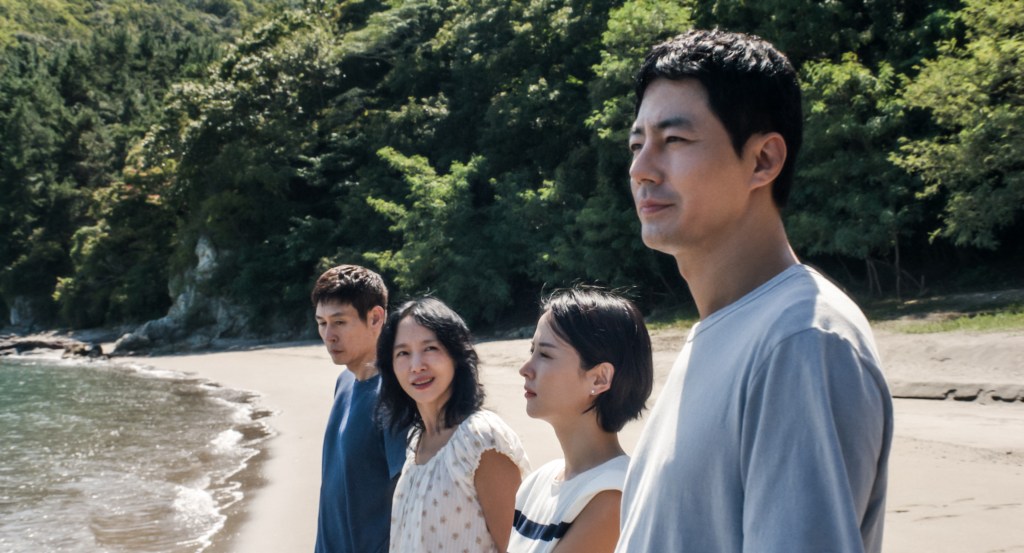
Possible Love is Korean director Lee Chang-dong’s first feature since 2018’s acclaimed Burning. It tells the intersecting stories of two very different couples. Ye-ji (Cho Yeo-jeong) is an aspiring documentary filmmaker married to a wealthy entrepreneur, Sang-woo (Zo In-sung). Ye-ji is making a film about the changing labor market in Korea and strikes up a friendship with the affable Mi-ok (Jeon Do-yeon), who works in a paper manufacturing plant. But Ye-ji realizes the more compelling story is that of Mi-ok’s brooding husband, Ho-seok (Sul Kyung-gu), who lost his job at a factory and suffers PTSD from a brutal beating he received during a strike. When Mi-ok invites the working-class couple for a relaxing weekend at her lush coastal vacation home, the unspoken tensions in their still-evolving friendship rise to the surface. At 164 minutes, the film is long but consistently intriguing. It debuts on Netflix on November 6.
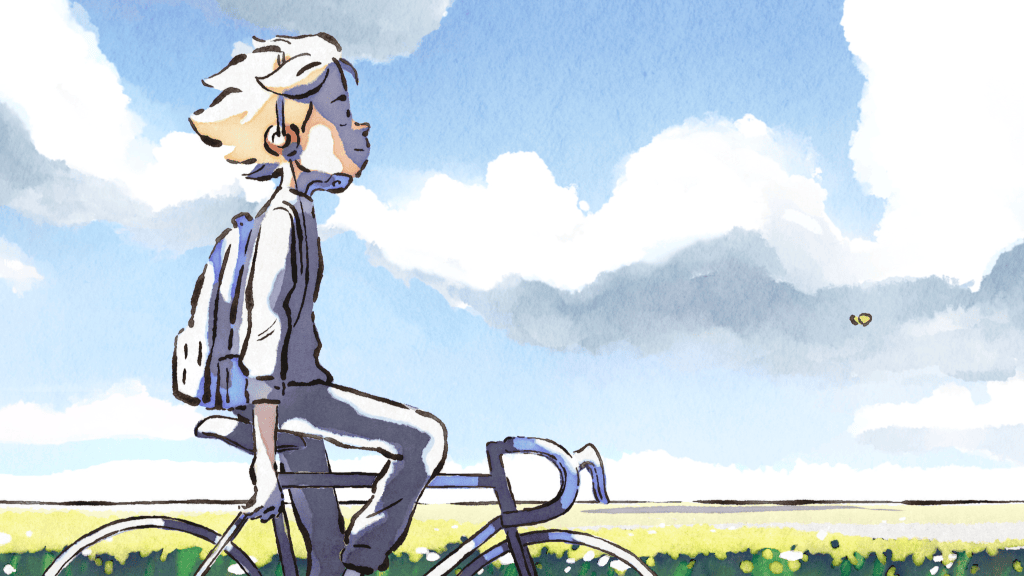
Iron Boy
Winner of the Un Certain Regard Grand Jury Prize at Cannes, director Louis Clichy’s Iron Boy (Le Corset) uses spare, stylized hand-drawn animation to tell a vivid story of life in rural France. The title character is Christophe, a young boy with an odd spinal condition that prevents him from standing up straight. (The funny opening sequence is a class-photo shoot that fails to capture an upright picture of the boy.) Christophe is forced to wear a cumbersome body brace day and night that makes him even more of an outcast. His salvation is the church organist, who takes him on as a page turner and teaches him how to play the instrument. Christophe also finds romance of sorts with Clara, a rebellious girl in his swimming class who uses the boy to shoplift—his brace makes a convenient cover when the metal detectors go off. Clichy was an animator on the Pixar films Up and Wall-E, and his lively, lyrical and artful directing debut shows he learned Pixar’s storytelling skills well.
The New York Film Festival runs through October 12. At top, Miles Teller in Paper Tiger. All photos courtesy of Film at Lincoln Center.


Leave a comment