Film at Lincoln Center is once again providing a welcome New York showcase for new Italian films with its 23rd annual “Open Roads” series, running May 30 to June 6, 2024. Thirteen films will be screened, and I’ve had the chance to preview four of them.
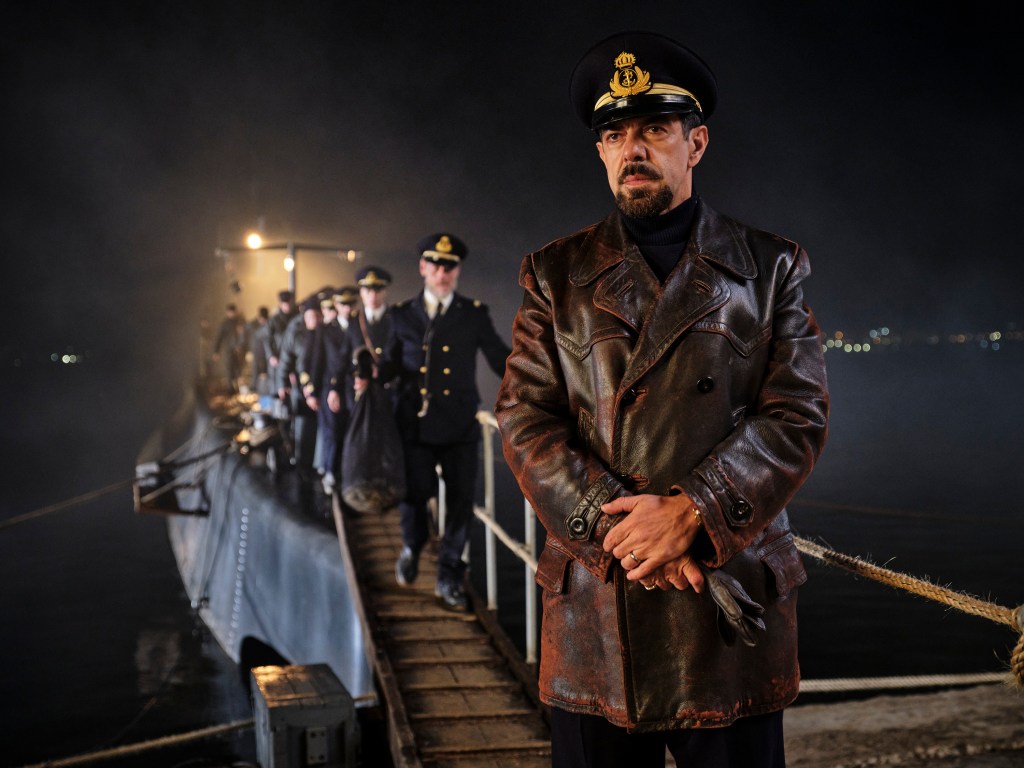
The opening-night attraction, Comandante (aka The War Machine), tells the fascinating true story of an Italian submarine crew during the early years of World War II. Pierfrancesco Favino, the magnetic star of Marco Bellocchio’s excellent crime drama The Traitor, plays Salvatore Todaro, formidable commander of the submarine Cappellini. It’s 1940, and Todaro—who wears a back brace due to a nearly crippling injury—and his men are well aware of how treacherous their mission is. That’s proved early in the film, when one of Todaro’s young crewmembers knowingly sacrifices his life to free the sub from a web of mines.
The raison d’être for this film occurs at midpoint, as the Cappellini encounters the Belgian freighter Kabalo, which fires on the sub despite Belgium’s declared neutrality. The Cappellini destroys the vessel, which we eventually learn was carrying aircraft parts for the British. Todaro, despite regulations and the protests of his second-in-command, takes mercy on the 26 survivors and brings them aboard. But because space is so tight, some of the Kabalo’s crew must stay in the conning tower—which means the Cappellini can’t submerge or it will drown them, making it an easy target for enemy aircraft. Todaro ultimately negotiates safe passage to the nearest port—a bold decision that brings a brief respite from the conflict.
Edoardo de Angelis’s film gingerly addresses the historical fact that these Italians were fighting on the side of the Nazis, emphasizing Todaro’s maverick spirit and implying that his magnanimous action was part and parcel with the Italian character (a self-congratulatory sentiment surely welcomed by the natives in the film’s Venice Film Festival world-premiere audience). But, hey, Das Boot had us rooting for the Germans, didn’t it?
The movie’s “brotherhood of man” message is most charmingly conveyed in a sequence in which the Belgians teach the sub’s Italian cook how to make French fries. “We Neapolitans fry everything—how have we never thought of this?” the cook exclaims. In the film’s postscript, we learn that Todaro was killed in his sleep by enemy gunfire two years later.
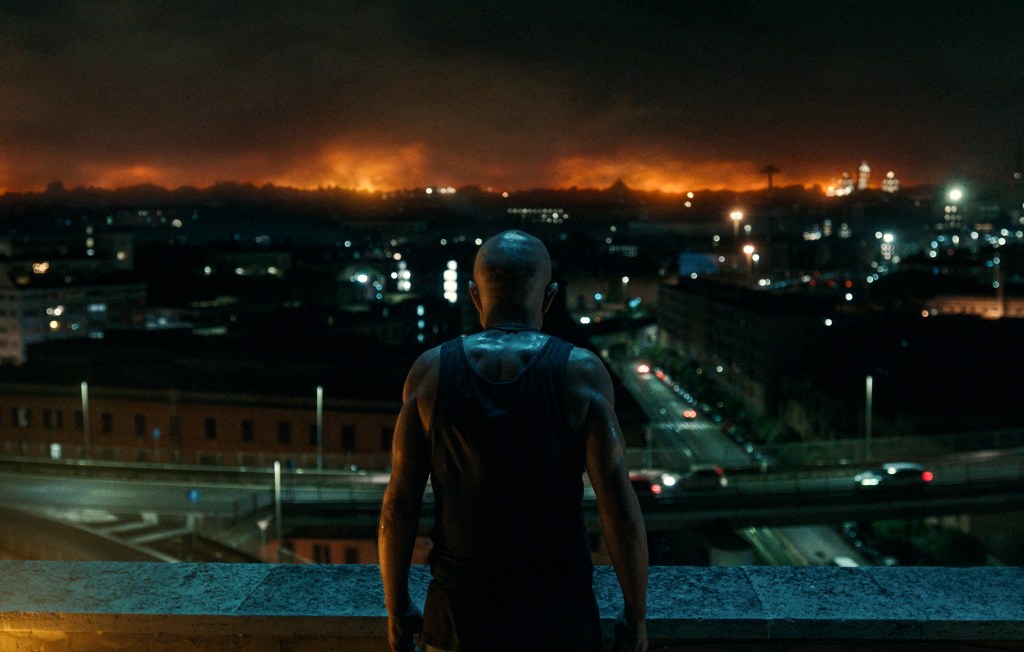
With his bald skull, shaved eyebrows, and absent mustache and beard, Favino is unrecognizable in Stefano Sollima’s crime drama Adagio. The busy actor plays Romeo, a cancer-ridden onetime criminal recently released from prison after 12 years. At the center of the story is Manuel (Gianmarco Franchini), an aspiring teen rapper who is tasked by corrupt police with infiltrating a gay nightclub and getting incriminating video evidence against a high-ranking politician. (The reason the boy has been recruited is revealed late in the film.) When Manuel realizes he himself has been recorded by surveillance cameras, he flees the scene—making him the target of a police manhunt.
Manuel at first seeks refuge with the blind Polniuman (Valeria Mastandrea), an old associate of his former crime kingpin father Daytona (the great Toni Servillo), who’s now battling Alzheimer’s. Polniuman sends the boy to Romeo, not an ideal situation since Romeo blames Daytona for his prison time—and the death of his own son.
Sollima is celebrated as the director of two acclaimed Italian TV crime series, Romanzo criminale and Gomorrah, and has made two English-language films, Sicario: Day of the Soldado and Without Remorse. Back on home turf, he portrays modern-day Rome as a hellscape: The remarkable opening aerial shot shows nighttime traffic flowing through the city while fires blaze in the distant hills, causing constant blackouts. The aging criminals in the movie are plagued by cancer, blindness, and senility, and the cops we encounter are ruthless and amoral. As the story proceeds, we feel more and more protective of the vulnerable Manuel—as does Romeo.
It’s not a very inviting portrait of today’s Italy, but Adagio offers an opportunity to watch two of the country’s top stars—Favino and Servillo—stretch their acting muscles. By the way, the film is currently available on Netflix.
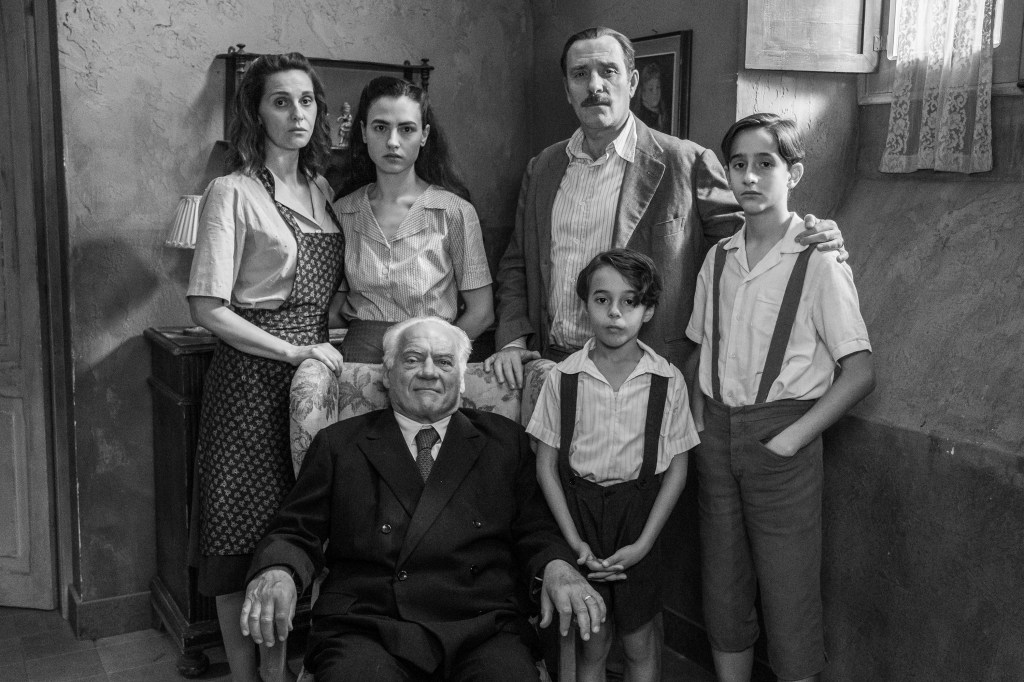
There’s Still Tomorrow was a huge box-office hit in Italy, and on a superficial level it’s easy to see why: Filmed in black-and-white and set in the post-war period, it evokes the classic Italian comedies of the 1960s that featured the likes of Sophia Loren, Marcello Mastroianni, and Alberto Sordi. The star, Paola Cortellesi, is a popular TV comedian making her feature directing debut with a script she co-wrote, and her film is lively and stylish. And yet…the movie offers a queasy mix from its opening seconds, as a middle-aged couple wake up in bed and the husband, with no discernible motive, promptly slaps his wife. Within the first minutes, it’s clear that this is no anomaly: Cortellesi’s Delia is in an abusive relationship with a boorish, short-tempered bully. The setup has all the makings of an intense neorealist drama; trouble is, the prevailing tone is comedy. Cortellesi seems well aware that an overly graphic depiction of the violence in this marriage would be a deal-breaker, but in her biggest directorial misstep, she turns one of the husband’s beatings into a stylized dance, a punishing pas de deux.
The film comes closest to its forebears in a truly funny sequence in which Delia and her husband Ivano host the well-to-do parents and sister of their daughter Marcella’s fiancé. Despite her admonitions, Delia’s young sons can’t refrain from cursing around her snobbish guests and, oh yes, they’ve forgotten to lock her bedridden, cantankerous father-in-law in his room. The lunch ends disastrously, prelude to yet another stylized beating.
Throughout, Delia—who works several odd jobs to support the household—sees glimpses of a better, sweeter life: a Black American G.I. who gives her chocolate and voices concern about the bruises on her arms and shoulders; an old flame who works at a gas station and never lost his ardor for her. Marcella’s pending marriage seems like a solution to the family’s economic struggles, but when the girl’s initially courtly fiancé shows signs of macho possessiveness just like Ivano, Delia takes drastic action.
Cortellesi also indulges in some narrative sleight-of-hand: Delia treasures a piece of paper that remains a mystery until the final scene. Is it the key to her escape from this nightmare marriage? Not quite. Instead, it’s a device that suddenly opens up the picture to a broader view of women’s status in post-war Italy. The twist comes out of nowhere, but it gives the film a historical context that could have been the subject of a better film.
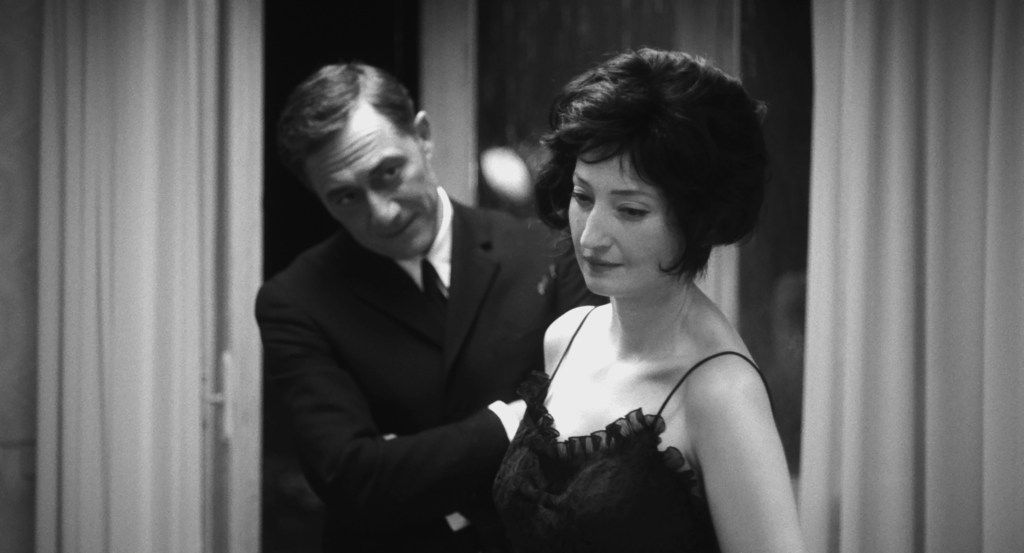
In the Mirror is writer-director Roberta Torre’s well-meaning homage to the iconic Italian actress Monica Vitti. The muse of the great Michelangelo Antonioni in the classics L’Avventura, La Notte, L’Eclisse, and Red Desert, she was celebrated for her haunted intensity in those symbolic dramas, but she also had a thriving career as a comedian. She made her final film in 1992 and disappeared from public view for three decades; in 2011 it was revealed she was suffering from dementia.
Torre’s approach to the Vitti legend is to tell the fictional story of another woman named Monica, who’s suffering from a memory-sapping disease called Korsakoff syndrome. One day, the fictional Monica hears Vitti complaining “I feel as though I am forgetting something every day” in the film La Notte, and she begins to fully identify with the screen star, living her various incarnations. My sense is that Torre is trying to evoke what Vitti’s final years in her fading mind may have been like, with glimmers of her past triumphs. Alba Rohrwacher is compelling in this difficult role, and Torre’s film represents a nervy attempt to step outside the boundaries of the traditional biopic. But I still would have preferred a documentary wholly devoted to Vitti’s art and life.
Pictured at top: Pierfrancesco Favino in Comandante. All photos courtesy of Film at Lincoln Center.

 Kevin Lally on Film
Leave a reply to Edoardo de Angelis’s ‘Comandante’ Tells an Epic Tale of WWII Humanism – Kevin Lally on Film Cancel reply