Agnieszka Holland’s Green Border is more than a movie—it’s a soul-shaking experience. It may be the most important and eye-opening film playing at the 61st New York Film Festival—in fact, I’d call it one of the most important films of this decade.
Holland, the veteran Polish director of Europa Europa, Washington Square and other fine films, was spurred by the horrific crisis at the Poland/Belarus border that began in the fall of 2021, when Belarus president Aleksandr Lukashenko’s wily propaganda convinced desperate refugees from the Middle East and Africa that Belarus was an easy pathway to freedom in the European Union. Right-wing Polish authorities saw through Lukashenko’s diabolical ruse, but treated these innocent victims as subhuman “missiles” of chaos to be rounded up and tossed back across the border.
Holland’s film, co-written by Maciej Pisuk and Gabriela Lazarkiewicz-Sieczko and directed in collaboration with Kamila Tarabura and Katarzyna Warzecha, observes this dilemma from three vantage points: a Syrian family of six hoping to connect with a relative in Sweden; a conflicted young border guard; and a bold group of activists and a new recruit to their humanitarian cause.
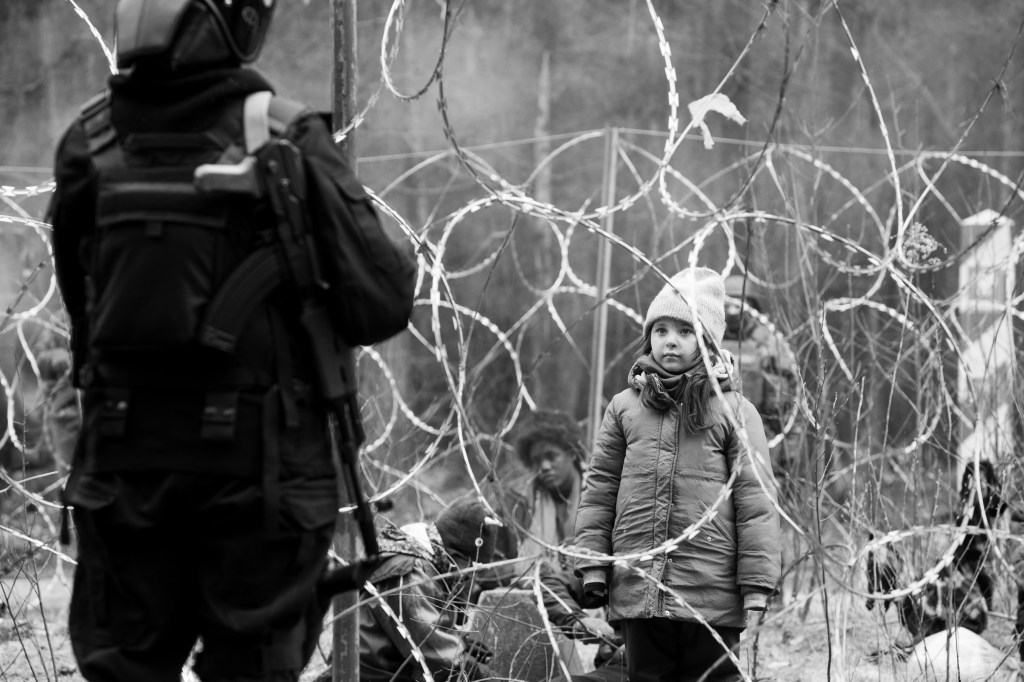
The opening scene on a plane flying into Belarus immediately bonds us with the story’s main refugees: a couple and their three children (including an infant), the kids’ grandfather, and an Afghan woman who joins the van ostensibly taking them safely into Poland. The illusion is short-lived: Gunshots ring out, and the refugees are urged to run for the shelter of the forest. Holland follows their increasingly difficult efforts to survive and claim asylum, before they are cruelly sent back to the brutes of Belarus.
The film then cuts to a guards’ training session, where their commander sums up the sort of riffraff they’ll be dealing with: knowing tools of Lukashenko, terrorists and perverts. We meet one of those guards, young Jan (Tomasz Wlosok), under pressure to finish construction on a new home before his wife gives birth to their first child.
The third chapter brings welcome temporary relief. The Syrians had been given a number to call while attempting to re-enter Poland, and they rendezvous with a group of defiant activists who provide food, water, fresh clothes, and medical aid.
But that relief is sadly temporary. The seven refugees we’ve gotten to know so well face more trials, and not everyone survives. The film then turns its focus to Julia (Maja Ostaszewska), a psychologist whose fateful encounter with one of the refugees inspires her to join the activists’ cause.
The late Roger Ebert once called motion pictures “a machine that generates empathy,” and I can think of no film that fulfills that role better. From the very first minutes, you’re instantly charmed by the refugees on that plane (the adults beautifully portrayed by Jalal Altawil and Dalis Naous as the mother and father, Mohamed Al Rashi as the grandfather, and Behi Djanati Atai as the caring Afghan woman), and you fear for them as their naïve expectations are crushed and they’re plunged into a hellish struggle for survival. I found myself shaking with anxiety and moved to tears.
Despite the several tragedies that ensue, there’s inspiration in the courage, compassion, and political savvy of the movie’s band of activists, including two sisters of different temperaments and strategies who are constantly bickering. And thankfully, there’s a side plot involving some African boys that has a delightful and touching conclusion.
The film concludes with an epilogue set in 2022, as Poland welcomes the hordes of refugees fleeing Vladimir Putin’s evil invasion of Ukraine. Yes, Holland concurs, this is Poland at its best, but the heinous treatment of other refugees crossing over from Belarus—refugees of a darker hue—continues.
Holland has taken tremendous heat from right-wing politicians in Poland, some laughably comparing Green Border to Nazi propaganda (highly ironic, since Holland’s Jewish father lost his parents to the Holocaust). But the film is a box-office hit in its native country. (Predictably, the Polish powers-that-be chose another film for the Oscar race this year.) As of this writing, the film does not have a U.S. distributor, but that must change. Green Border is timely, powerful, devastating, and one of the best films of this young century.
Photo courtesy of Film at Lincoln Center.

 Kevin Lally on Film
Leave a reply to A Film from 1961 Leads My 2023 Ten Best List – Kevin Lally on Film Cancel reply