Robert Duvall, one of the greatest actors of his generation, died on February 15, 2026, at the age of 95. What many people don’t know is that he was also a formidable and adventurous film director. I had the good fortune to interview Duvall in 1997 to discuss one of his acting and directing triumphs, The Apostle. As predicted below, he did indeed earn another Oscar Best Actor nomination for that film, followed by Supporting Actor nominations for A Civil Action and The Judge.
Since his film debut in 1962 as Boo Radley in To Kill a Mockingbird, Robert Duvall has assembled a portfolio of indelible movie performances to rival any actor of his generation—among them, the uptight Major Frank Burns in M*A*S*H, the quietly efficient consigliere Tom Hagen in the Godfather films, the ruthless network boss in Network, batty Vietnam warrior Kilgore in Apocalypse Now, the bullying military father in The Great Santini, haunted country-music singer Mac Sledge in Tender Mercies, and the Georgia husband aroused by Rambling Rose.
A four-time Oscar nominee (and winner for Tender Mercies), Duvall makes a strong bid for another Best Actor nomination with The Apostle, the story of a philandering Pentecostal minister’s quest for redemption after he brutally assaults his wife’s lover. The performance is a tour de force, as is Duvall’s behind-the-scenes role as writer, director, and executive producer of this refreshingly unbiased and fascinating portrait of an American subculture.
The naturalism, truthfulness, and complexity of Duvall’s portrayal of charismatic preacher Sonny Dewey reflect his overall approach to the craft of film directing. His first directing effort, 1977’s We’re Not the Jet Set, was a documentary on a colorful Nebraska rodeo family, and both of his subsequent films have combined narrative with strong documentary elements. In 1983, he wrote and directed Angelo, My Love, a revealing look inside New York’s Roma community starring a brash 11-year-old real-life Roma boy and his extended family. With The Apostle, Duvall trains the same journalistic eye on the impassioned world of Southern Pentecostal churches, in his most satisfying blend of drama and documentary insight.
Interviewed by phone at his home in Virginia just after Thanksgiving weekend, Duvall is friendly and unpretentious—qualities that no doubt help him establish a warm rapport with his movie subjects. Part of his impulse in writing The Apostle was to present a truer picture of fundamentalist preachers than what he regards as the patronizing, caricatured view favored by movies like Elmer Gantry. “So many movies, especially about this subject matter, you don’t even have to go see,” he argues. “Because you know what they’re going to be like and what they’re about. All by the numbers. I like to get real stuff from people, turn it around so it comes from them.”
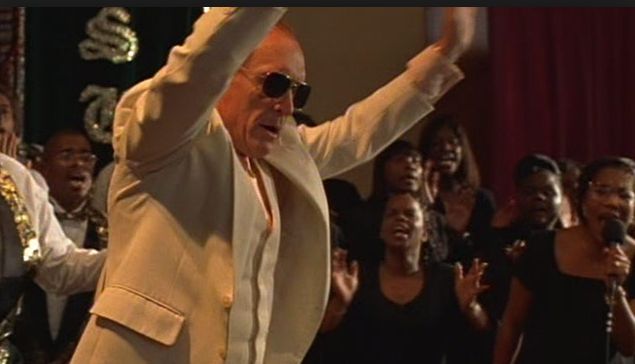
Alongside established actors like Duvall, Farrah Fawcett, Miranda Richardson, and Billy Bob Thornton, The Apostle utilizes many nonprofessional actors recruited from Southern churches. “We went to the Church of God of Prophecy, a Black organization out of Memphis,” he explains. “We went to the state convention in Louisiana and just hung around and picked people like the heavy lady you see at the end. We used the whole choir. We tried to mix actors with non-actors who knew the subject matter well. I tried to set the tone of: Let’s just make this like a line rehearsal, no acting. I’m tired of words like energy and pace that directors tend to throw out arbitrarily. If these people are talented, they’re going to get the right sense of energy anyway. I just said: Let’s keep everything offhand, nothing’s precious, throw it away, change it if you want. I had a little apprehension directing Miranda Richardson, because she’s so talented. But that’s the way I directed the actors and the non-actors, to set the tone. Then, when it was all set up, I just had to put on the camera.”
The Apostle has its roots in an unrealized project about preachers called The Kingdom, which Duvall was planning to star in for director Sidney Lumet. “It was a pretty good script, as I remember. The head of Paramount felt I wasn’t right for the part, even though I was doing all this research. And after it fell through, the two writers told Horton Foote that they wrote it for me.” By that point, Duvall had become so stimulated by his months of research in rural Southern communities, he decided to embark on his own script. In the ensuing 13 years, he tried unsuccessfully to get studio backing for the project, and eventually decided to finance the picture with $5 million of his own money. “It’s tough to get independent projects off the ground anyway,” he notes, “so it’s hard to tell if the religious theme made it harder—though I think maybe it did.”
How did Duvall take to the challenge of playing a demanding role like Sonny Dewey while directing an often-unschooled cast on a limited budget? “I thought about it in the back of my mind for so many years before I ever got to do it. I was a little apprehensive, to say the least, to direct and to be in it too… But we had a good team of people around us—Robbie Carliner the producer, the two cameramen, excellent sound men from Lafayette, Louisiana. Once we started, it went much more harmoniously than I thought. We finished every day about four or five, and of the seven weeks three were five-day work weeks and the rest six, and we finished one day early.”
Having lived with Sonny for 13 years, “I knew the character pretty well,” Duvall says. Still, extra preparation was needed for the climactic scene, Sonny’s lengthy farewell sermon to his congregation as the police wait outside to take him away. “The last week, I said to the sound man. ‘Give me a microphone and a sound box to take home.’ Suddenly that day was going to be upon me—we took two nights to shoot it—and I said, ‘I won’t be ready!’ I really had to get myself ready for that, in particular.”
Duvall reveals something of the actor’s process as he describes his feelings and fears while studying real-life preachers. “It worried me when I did my research—I would go to all these churches and sit in the back, and I was always detached, I was always objective. I said: Gee, I’m not getting caught up in this. But I figured as an actor, I’ve done it enough, I’m pretty sure I’m going to get caught up when I do it. I do remember one church up in Harlem—I went to six churches in one morning—they sang the song ‘What a Friend We Have in Jesus’ and I had a nice experience, I must say. One preacher said, ‘You’d do a better job if you were born again, if you were one of us.” But I could have counted that experience as my moment of conversion—which I don’t, but I could have, very easily. But most of the time I felt detachment, which I guess was okay, because I had to observe, observe, observe. And by the time I did it, I didn’t think that much about what to do, I just went with it.”
With The Apostle, Duvall hopes to reveal the human side of Protestant fundamentalists, a group he feels has been often unfairly maligned in the media. “All I say about these guys is, their aim and their outlook is no different than any archbishop in the Roman Catholic Church or any practicing rabbi. It’s the same. Maybe it’s more obvious with these people, because so many of them get on television and they’re introduced to a certain nouveau-riche-ness and they become contaminated.”
Conversely, Duvall had to contend with the objections of devout Christians to his portrait of a deeply flawed minister. “We had a Roman Catholic church lined up in Lafayette, and it just didn’t seem right. Then, one of the location people found a Baptist church to film the big church scene. They told us we could do it, but at the last minute I had to go down and talk to a small portion of the church who wanted to know about Sonny’s womanizing. Killing a guy was okay! The way I answer it now, David in the Bible did something Sonny would never do—he sent a man off to his death so he could lie with his wife. He’s one of the great guys in the Bible, and my guy would never do anything that bad.”
Duvall recently screened The Apostle for a religious audience in Nashville, where he’s putting together a soundtrack album to accompany the film. “The people there responded very positively. Dolly Parton’s written a song for it, the Judds saw it and liked it. So did Bill Gaither, who’s the top guy in gospel. A woman who puts out a big Christian magazine with 18 million readers interviewed me over the phone and she really liked the movie, she didn’t feel we put them down. Maybe this is a new kind of movie—a crossover between the religious and the secular, which is rare. Some movies that would be accepted by them can sometimes be a little corny, a little obvious, and I tried not to do that.”
The Apostle is available to stream on Prime Video.
 Kevin Lally on Film
Leave a comment