In 2023, I went against the grain and named a film from 1961, Dino Risi’s Una Vita Difficile, which had never before been released in America, as the best picture of the year. Well, my contrarian impulse has surfaced again. This year I’m placing a film from 2019, Roman Polanski’s An Officer and a Spy, at the top of my list. Sadly, the film is very difficult to see. New York City’s Film Forum hosted the American premiere for a limited run and sparked a cause célèbre for daring to present a work by such a disreputable filmmaker. (Despite the protests, the screenings were often sold out.) Whatever your feelings about the man, An Officer and a Spy is one of this masterful director’s greatest films, and it’s absurd that American audiences are being denied the opportunity to experience it and judge for themselves. In any event, here’s my personal list of the year’s outstanding films, in order of preference.
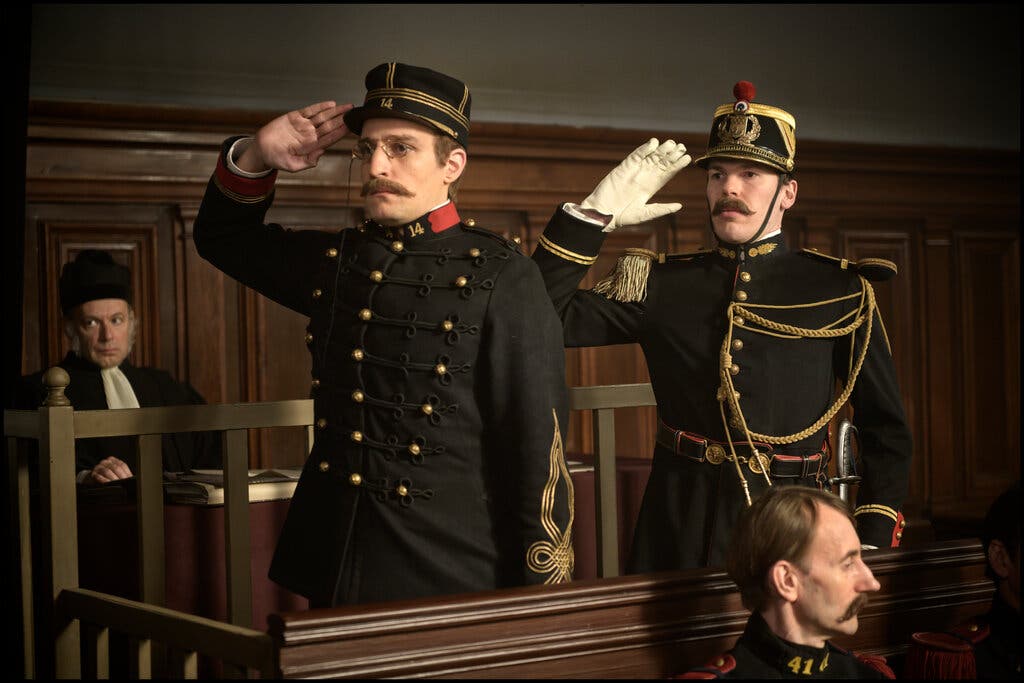
An Officer and a Spy: In this beautifully rendered historical drama, Polanski and screenwriter Robert Harris explore the infamous 1895 conviction on espionage charges of French army captain Alfred Dreyfus (Louis Garrel), mainly from the point of view of Lt. Col. Georges Picquart (The Artist Oscar winner Jean Dujardin), an intelligence officer who becomes convinced that the Jewish Dreyfus has been framed. Picquart was never a fan of Dreyfus (or Jews), but he’s a man of principle who finds himself in a fierce battle against a corrupt system. Harris’s script, with its many twists and turns, is gripping, the evocation of the period is immersive, and the ensemble cast (including French stars Mathieu Amalric, Melvil Poupaud, and Polanski’s wife Emmanuelle Seigner as Picquart’s married mistress) is uniformly strong. Polanski took some (additional) flak in 2019 for comparing his own legal plight as a convicted sex offender to that of Dreyfus, but his film stands on its own as a restrained and powerful portrait of injustice.
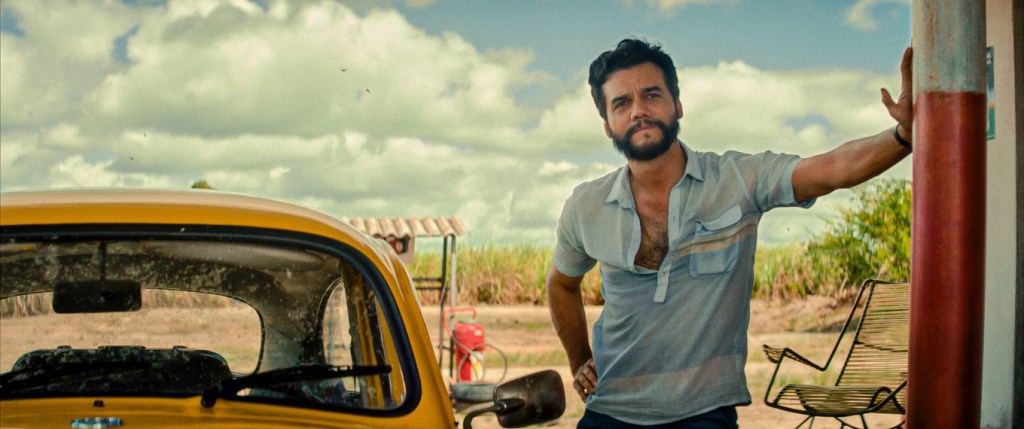
Wagner Moura in The Secret Agent. Photo: New York Film Festival.
The Secret Agent: Three of the films on this year’s list were screened at the 2025 New York Film Festival, and my favorite was this brilliant drama from Brazil. As I said back in September, I had the pleasure of interviewing Brazilian director Kleber Mendonça Filho for Boxoffice magazine in 2020 about his wild social satire, Bacurau. Mendonça has upped his game with his latest, The Secret Agent, deservedly winning the Best Director award at Cannes. Mendonça’s script is incredibly multi-layered, evoking in sometimes surreal fashion the fraught, justifiably paranoid 1970s in his country, and more specifically his hometown of Recife. The film centers around Marcelo (charismatic Cannes Best Actor winner Wagner Moura), a former university technology researcher and widower who arrives in Recife during Carnival week to reunite with his young son and plot his escape from the country. Marcelo eventually learns that he’s the target of hit men hired by a corrupt federal official he refused to bow down to. The story is peopled with an Altmanesque gallery of memorable characters, including Dona Sebastiana (Tânia Maria), the feisty elderly woman who provides shelter and aid to various outcasts; Marcelo’s father-in-law Alexandre (Carlos Francisco), the projectionist at the local cinema where a woman watching The Omen thinks she’s been possessed by the Devil; and Elza (Maria Fernanda Candido), the bold resistance leader facilitating Marcelo’s escape. The film works beautifully as a thriller, but there are numerous brazen detours, most notably Mendonça’s B-movie-style depiction of the dreaded “hairy leg,” a real-life urban legend meant to explain the murders and disappearances plaguing Recife at the time. As Bacurau proved, there’s no one making films quite like Mendonça; with The Secret Agent, his disparate influences have produced an immensely satisfying—and haunting—drama.
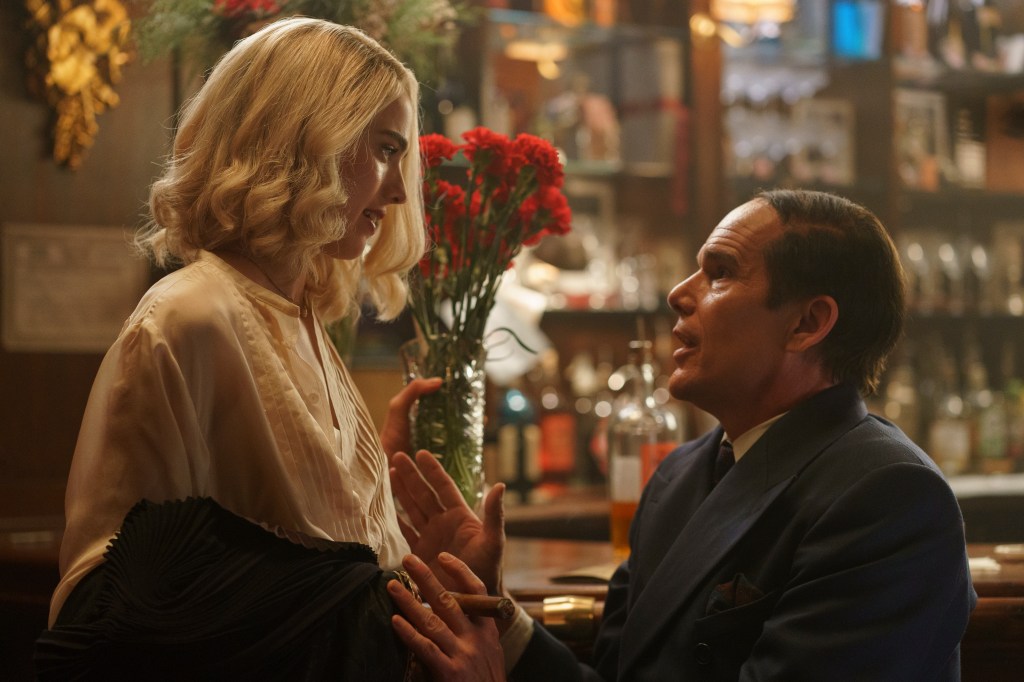
Margaret Qualley and Ethan Hawke in Blue Moon. Photo: NY Film Fest.
Blue Moon: Director Richard Linklater’s delightful film features a tour-de-force performance from frequent Linklater collaborator Ethan Hawke as famed lyricist Lorenz Hart. The entire film takes place on the opening night of Rodgers and Hammerstein’s landmark musical Oklahoma! in 1943, with Hart arriving early at Sardi’s before the celebratory crowd streams in. Richard Rodgers and Hart had been one of the most successful songwriting teams in musical theater history, with such hits as Pal Joey, Babes in Arms, and On Your Toes and standards like “Isn’t It Romantic?,” “My Funny Valentine,” “The Lady Is a Tramp,” and, yes, “Blue Moon.” The partnership broke up due to Hart’s alcoholism, and this night would mark the first triumph in Rodgers’s new alliance with Oscar Hammerstein II that would produce Carousel, South Pacific, The King and I, and The Sound of Music.
Hawke, nearly unrecognizable with an unflattering combover and camera trickery to replicate Hart’s five-foot height, gives a true character performance, nailing every witty, acerbic line in Robert Kaplow’s script and channeling Hart’s jealousy, bitter melancholy, and feelings of abandonment by his longtime creative partner. Hart was a closeted homosexual (but not so closeted in his bawdy conversations with the bartender played by Bobby Cannavale), yet the film also dwells on his obsession with a college student named Elizabeth, played by a charming Margaret Qualley. (Hart really did have an ongoing correspondence with a young woman named Elizabeth.)
Nearly all the dialogue-heavy story takes place inside Sardi’s (recreated on a set in Ireland), but Linklater and cinematographer Shane F. Kelly manage to keep the film visually lively. The supporting cast, all excellent, includes Andrew Scott as a very dapper Richard Rodgers; Patrick Kennedy as famed essayist E.B. White (who finds inspiration in one of Hart’s odd anecdotes); Jonah Lees as the house pianist, a soldier on leave; and Cillian Sullivan as a precocious boy theater nerds will recognize as the young Stephen Sondheim. The sad postscript of the film is that Hart died of pneumonia just eight months after this evening takes place, at age 48. (Available to rent on Prime Video).
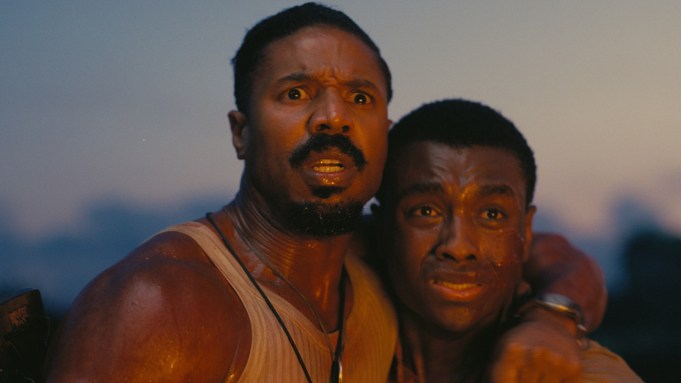
Michael B. Jordan and Miles Caton in Sinners. Photo: Warner Bros.
Sinners: It may take place in 1930s Mississippi, but writer-director Ryan Coogler’s highly original box-office hit is the movie equivalent of a New Orleans gumbo, bursting with a wild mix of genre ingredients. Coogler’s go-to collaborator Michael B. Jordan stars as identical twins Smoke and Stack, Chicago hucksters who return to their Southern hometown with plans to open a juke joint. The first half of the movie follows their progress, including the fortuitous hiring of their cousin Sammie (electric newcomer Miles Caton), a wildly gifted blues guitarist and singer. Along the way, both Smoke and Stack reunite with old flames—Stack with Mary (Hailee Steinfeld), a mixed-race woman who’s hiding her racial identity from her rich white husband, and Smoke with the formidable Annie (Wunmi Mosaku). Their club, which comes together with lightning speed, is a hit—but then the film takes a sharp turn into genre territory when some Irish troubadours ask to be invited inside…the way vampires do. And those vampires posit a truly thorny question: Would their black neighbors prefer a life of oppression in the Jim Crow South or the egalitarian freedom of a vampire’s eternal life?
Coogler, who scored a massive success with Marvel’s marvelous Black Panther films, swings for the fences here, with a tour-de-force fantasy musical sequence (in one remarkable take) that anachronistically traces the history of black music from Africa to the blues to jazz, Jimi Hendrix and hip-hop. And the bloody climax generates bone-chilling tension to rival a John Carpenter horror classic, with the metaphorical subtext of modern master Jordan Peele. Handsomely produced for big-screen impact, Sinners is the studio movie of the year. (Streaming on Prime Video and HBO Max).

Anna Nemzer in My Undesirable Friends. Photo: Julia Loktev.
My Undesirable Friends: Part I—Last Air in Moscow: Russian-born American Julia Loktev’s documentary is nearly five and a half hours long, but you won’t regret the extended time you’ve spent with the subjects of her film: young, mostly female journalists striving to report the truth in Russia in late 2021 and early 2022, just before the invasion of Ukraine. Filming with her iPhone, Loktev provides an extraordinarily intimate portrait of the professional and personal lives of these brave, smart, and sardonic reporters, who’ve been branded “foreign agents” for simply telling it like it is. Chief among them is Anna Nemzer, the disarming host of a talk show on TV Rain, who is credited here as co-director. Another is Ksenia Mironova, whose journalist fiancé is in prison, charged with treason. Alesya Marokhovskaya is an engaging lesbian, whose partner’s face is obscured in their domestic scenes. What none of them know (at least definitively) is that Russia is about to declare war on Ukraine; the final, gripping hour shows all these intrepid TV reporters still working to communicate the reality behind Russia’s “special military operation.” In a chilling sequence, the staff at TV Rain learns that the station is about to be raided and they hurriedly flee into the night. Loktev is currently working on Part II, which follows her subjects’ lives in exile.
My Undesirable Friends is chilling for another reason, with its obvious parallels to the current, unthinkable attacks on the free press here in the democratic United States. With powerful players like Brendan Carr, David Ellison, Bari Weiss, Jeff Bezos, and Patrick Soon-Shiong chipping away at the Fourth Estate, Loktev’s marathon diary becomes an essential cautionary tale.

It Was Just an Accident. Photo: New York Film Festival.
It Was Just an Accident: Winner of the Cannes Film Festival’s top prize, the Palme d’Or, It Was Just an Accident is the remarkably brave and thought-provoking new film from Iranian writer-director Jafar Panahi. This veteran auteur’s courage is the stuff of legend: Banned from filmmaking for 20 years, he shot one feature on his iPhone (This Is Not a Film), made another at home behind blacked-out windows (Closed Curtain), and shot another on the dashcam of a taxi he drove (Taxi). In 2022, he was sent to prison (for the second time) and released after seven months following international protests. It Was Just an Accident was inspired by his prison experience, often blindfolded for hours while being interrogated. The film was shot guerrilla-style with mostly nonprofessional actors and edited on a MacBook Air without access to the internet.
The lead character, Vahid (Vahid Mobasseri), works at a garage and is startled by a squeaking sound he associates with the former prison interrogator he never saw, the one called “Peg Leg.” Vahid follows the man, whose real name is Eghbal, and kidnaps him, fully prepared to bury him alive in the desert. But Eghbal’s desperate cries of innocence raise doubts in Vahid, and he rounds up three of his fellow ex-prisoners to verify his identity.
The cast’s lack of acting experience is startling, as Panahi directs them in exceptionally long takes while they debate the morality of this rash kidnapping and potential execution. The situation becomes even more complex when the abductors speak to Eghbal’s frantic young daughter, whose very pregnant mother has collapsed. Panahi’s script deals in themes of revenge, justice, and compassion, but it’s also imbued with absurdist humor and pure suspense. In all, a singular accomplishment. (Available to rent on Prime Video).
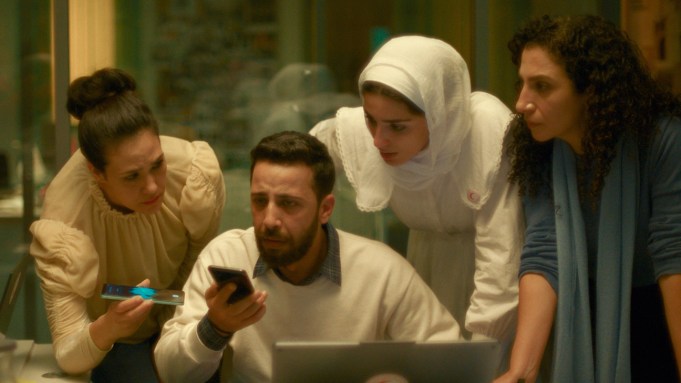
Nesbat Serhan, Motaz Malhees, Saja Kilani, and Clara Khoury in The Voice of Hind Rajab. Photo: Mime Films & Tanit Films.
The Voice of Hind Rajab: Be forewarned: This docudrama by Tunisian director Kaouther Ben Hania is an extremely tough watch. It revisits a horrific event that occurred in Gaza City in January 2024, when workers at the Red Crescent (similar to the Red Cross) in Ramallah took a call from inside a car that had been shot up by the Israel Defense Forces. The initial call was from a girl who perished while on the phone; then the emergency workers found themselves communicating with the vehicle’s lone survivor, a six-year-old girl named Hind Rajab. The Red Crescent dispatchers are all actors recreating the situation, but the voice of Hind Rajab comes from the real recordings, which are shown as audio waveforms. The dispatchers and their superiors frantically work to untangle the bureaucratic red tape required to send an ambulance safely into the war zone to rescue the girl, and the tension is unbearable. At the time, the incident made international headlines; if you’re not familiar with the story, it’s best to remain unaware while watching the film. The deft handheld camerawork lends a searing immediacy to this real-time drama, and the lead actors—Motaz Malhees, Saja Kilani, Amer Hlehel, and Clara Khoury—are extraordinary in their re-enactments of this emotionally devastating day. The Voice of Hind Rajab recently made the shortlist in the Oscars’ International Feature category.

The Gallaudet activists in 1988. Photo: Apple TV.
Deaf President Now!: This documentary by Davis Guggenheim (An Inconvenient Truth) and Nyle DiMarco (known as the pioneering deaf winner on both “America’s Next Top Model” and “Dancing with the Stars”) recounts a campus protest that wasn’t on my radar. It took place at Gallaudet University, the nation’s only liberal arts university for the deaf and hard-of-hearing. Founded in 1864, the school had always been led by a hearing president. In 1988, yet another hearing president was chosen by the board over two qualified deaf candidates, and the student body collectively signed, “Enough is enough.” The film focuses on four student activists with differing personalities: the voluble Jerry; cerebral Greg; former cheerleader Bridgetta, who notes the sexism in her community; and the relatively timid Tim, who’s chosen as their leader because he seems more conciliatory. Over the course of one week, the protests grow increasingly stronger, becoming national news and earning coverage on ABC’s “Nightline” news show. The movie’s chief villain is board chairperson Jane Bassett Spilman, who haughtily believes deaf people are incapable of functioning in the hearing world, much less running a university. Guggenheim and DiMarco gather ample footage from that turbulent week, and they cannily apply audio techniques that give the hearing audience a vivid sense of what it’s like to be deaf. I’m disappointed this highly engaging film didn’t make the shortlist in the Oscars’ documentary feature category. (Streaming on Apple TV.)
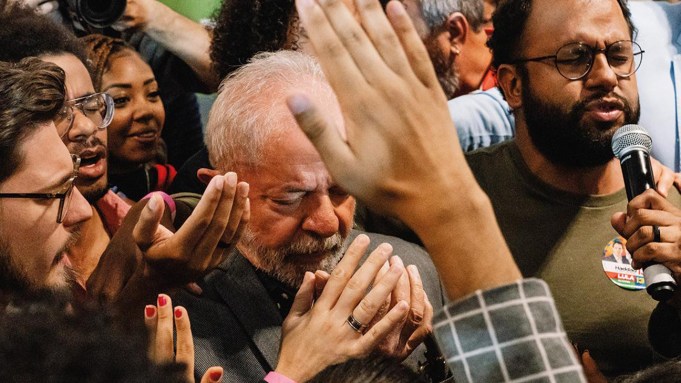
Apocalypse in the Tropics. Photo: New York Film Festival.
Apocalypse in the Tropics: Petra Costa’s documentary reveals how much of the current tumult in that nation is directly linked to the influence of Christian evangelicals, both Brazilian and American. The roots of this go back decades to preachers like Billy Graham, who were aligned with conservative American politicians in their opposition to the Catholic Church’s liberation-theology wing. Today, the leading champion of the evangelical movement in Brazil is popular TV preacher Silas Malafaia, a mentor to the country’s dictatorial former president, Jair Bolsonaro. Costa obtained remarkable access to both Malafaia and Bolsonaro, despite her own opposition stance, as well as Bolsonaro’s socialist opponent Luiz Ignacio Lula de Silva, who returned to power in an extremely close election that led to riots eerily echoing America’s January 6 insurrection. That’s not the only echo of what’s happening in America, where the bedrock separation of church and state is being challenged in many quarters. Costa, by the way, is not only a shrewd historian but a true filmmaker—the look of the movie, with its many aerial drone shots, is exceptionally handsome. (Streaming on Netflix.)
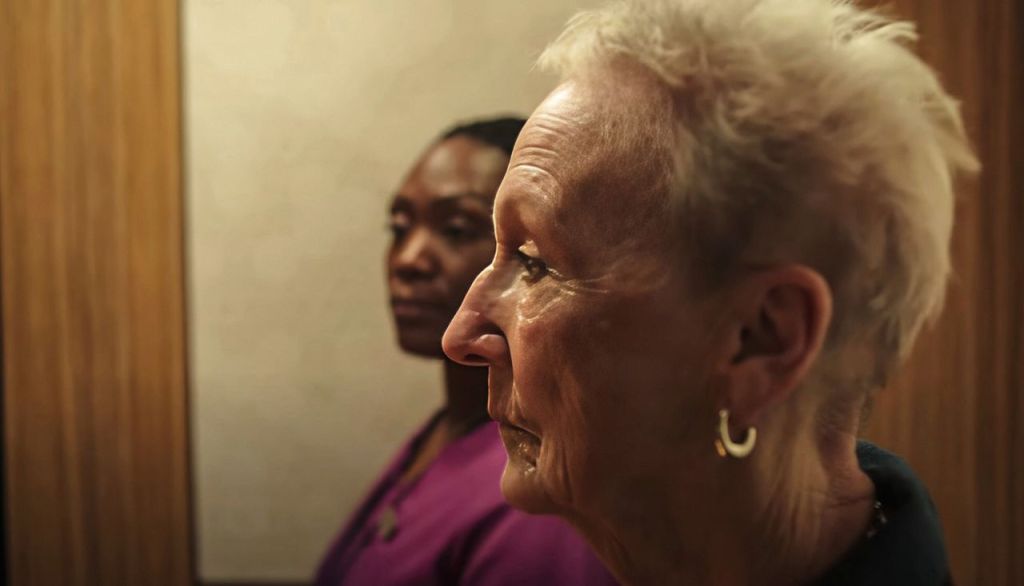
Kathleen Chalfant in Familiar Touch. Photo: Armchair Poetics.
Familiar Touch: There have been many fine films in recent years about the awful curse of dementia—Away from Her, Still Alice, The Father—but Familiar Touch is something special. Broadway veteran Kathleen Chalfant, in her first leading film role, plays Ruth Goldman, who we first see in her kitchen preparing lunch for two. A visitor arrives—her son, Steve (H. Jon Benjamin, the voice of Bob in “Bob’s Burgers”). But Ruth doesn’t recognize Steve as her son; she thinks she’s going out on a date. The “date” is a drive to her new home, an assisted-living facility.
What makes writer-director Sarah Friedland’s film exceptional is that so much of it is told from Ruth’s point of view: the alienating experience of unfamiliar new living quarters, the sudden anger and then the impulse to connect with strangers, the sense memories that evoke a long-ago feeling. In a wonderful scene, Ruth, a retired cook, enters the facility’s kitchen and spontaneously helps the staff prepare breakfast, actually making herself useful. Friedland’s delicate approach opens our minds to the idea that dementia isn’t unrelenting horror—there are moments of grace and discovery even within that terrible affliction. It’s all anchored by Chalfant’s subtle, beautifully modulated performance, abetted by supporting actors Benjamin, Carolyn Michelle, and Andy McQueen, and the real-life background players at the Villa Gardens retirement community in Pasadena, Calif. Ms. Chalfant hasn’t been part of this year’s awards conversation, but she should be. (Streaming on MUBI; available to rent on Prime Video).
Here are 25 more highlights of the movie year 2025, in alphabetical order: Black Bag, Caught Stealing, Final Destination: Bloodlines, The Friend, Griffin in Summer, The History of Sound, If I Had Legs I’d Kick You, La Grazia, Materialists, Misericordia, No Other Choice, Nouvelle Vague, One Battle After Another, The Phoenician Scheme, Pillion, Resurrection, Roofman, Sentimental Value, Sisu 2: Road to Revenge, Sovereign, Thunderbolts*, Train Dreams, Twinless, Wake Up Dead Man: A Knives Out Mystery, Weapons.
Pictured at top: Louis Garrel in An Officer and a Spy. Photo courtesy of Film Forum.
 Kevin Lally on Film
Leave a comment