By my count, the 2025 edition of the New York Film Festival offers no less than 15 features about artists or performers, including documentaries about Martin Scorsese and the comedy team of Jerry Stiller and Anne Meara. That emphasis on the arts will no doubt have strong appeal for the Lincoln Center demographic.
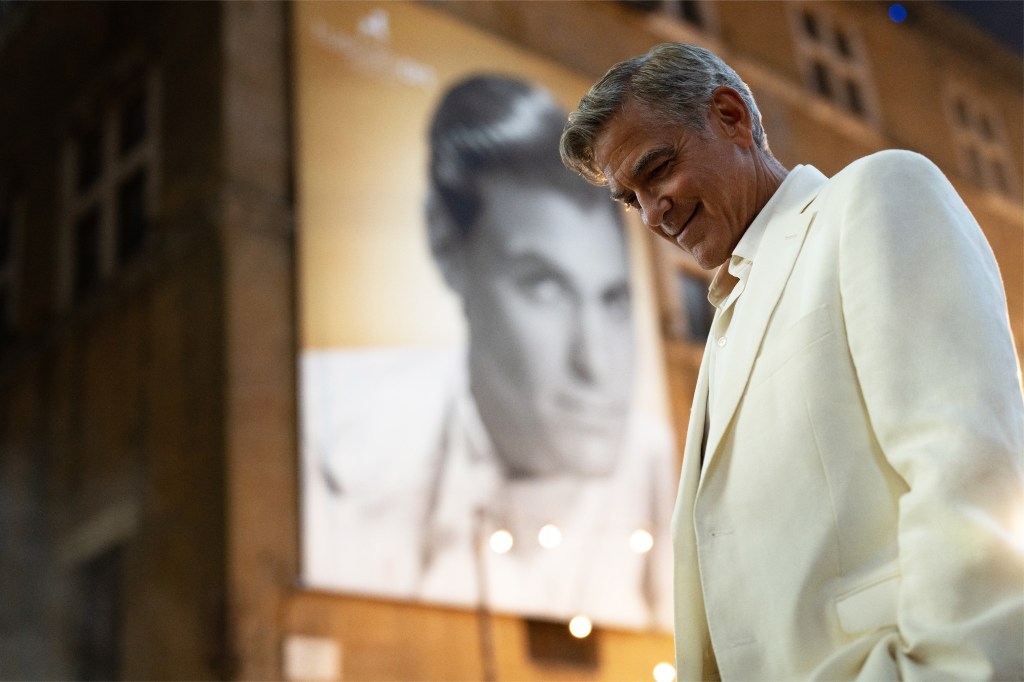
The most meta of the bunch is Jay Kelly, in which mega movie star George Clooney plays a mega movie star named…Jay Kelly. Noah Baumbach’s film for Netflix is his most ambitious to date, immersing us in the perspective of a world-famous celebrity who’s experiencing a midlife crisis. That crisis is set in motion when Jay encounters an old friend he hasn’t seen in years, Timothy (Billy Crudup), a onetime aspiring actor, now a child psychologist. Jay tagged along on Timothy’s audition for a big movie role and wound up getting cast in the film that made his career. During their at-first cordial lunch, Timothy reveals that he’s always despised Jay for “stealing” his chance at stardom, and their reunion ends in fisticuffs. Jay also has a fraught relationship with his older daughter Jessica (Riley Keough), a schoolteacher who resents her father’s many absences and calls him “an empty vessel.” Jay is closer to his younger daughter Daisy (Grace Edwards), who’s about to go off to college to study engineering. Jay longs to spend some quality time with her, but she already has plans to go to Europe with friends. Impulsively, Jay decides to quit his upcoming movie and follow Daisy to France and Italy, much to the distress of his harried manager, Ron Sukenick (Adam Sandler, in a surprisingly soulful performance).
The script by Baumbach and actress Emily Mortimer (who has a small role as Jay’s hair and makeup artist) alternates between the present day and key moments from Jay’s life (that fabled audition; his failure to come to the aid of Peter Schneider [Jim Broadbent], the now-struggling director who first cast him and has just died; a disastrous therapy session with Jessica). Tracking his daughter Daisy’s movements, Jay winds up on a crowded train, mixing with the hoi polloi for once and thrilling his fellow passengers. The adventure does him some good, breaking him out of his privileged bubble, even if it’s a huge headache for Ron and for Jay’s acerbic publicist, Liz (Laura Dern). Ultimately, the one-way relationship between Jay and Ron (“my friend who takes fifteen percent”—ouch!) is the heart of the movie, a comment on the collateral damage of the star machine. It’s a stretch for the likeable Clooney to play such a dark variation on himself—the film-festival tribute reel at the end of the film consists of clips from Clooney’s career—but he does make you wonder what’s behind that constant smile.

The festival focuses on some legendary, real-life filmmakers in Richard Linklater’s Nouvelle Vague, a tribute to the pioneering French New Wave and particularly one of its spikiest practitioners, Jean-Luc Godard. Set in 1959, the film finds Godard chomping at the bit to make a feature like his fellow Cahiers du Cinema critics François Truffaut and Claude Chabrol, who found notoriety with their films The 400 Blows and Le Beau Serge, respectively. He convinces producer George de Beauregard (Bruno Dreyfürst) to back a low-budget movie about a gangster and his girlfriend. Nouvelle Vague, written by Holly Gent, Vince Palmo, Michèle Halberstadt and Laetitia Masson, chronicles the 20-day shoot, day by day. Godard (Guillaume Marbeck) casts amateur boxer Jean-Paul Belmondo (Aubry Dullin) and rising American starlet Jean Seberg (Zoey Deutch) in the leads; Seberg is especially baffled by Godard’s methods, relying on improvisation and calling it a day when inspiration has waned. Though the shoot appears to be a fiasco, Godard’s bravado never wavers; newcomer Marbeck creates a droll portrait of this cocky contrarian, a font of defiant aphorisms. Deutch, speaking decidedly American-accented French, is also terrific and a ringer for the iconic Seberg. Movie buffs will be delighted by the flurry of brief cameos depicting celebrated cinema figures; Roberto Rossellini and Jean-Pierre Melville get more extended screen time. David Chambille’s black-and-white cinematography transports you to 1959 Paris, with the aid of many visual-effects shots. As the end titles note, the resulting film, Breathless, is one of the most influential movies ever made, with its jump-cuts and freewheeling aesthetic. Godard himself may very well have despised a film this straightforward and entertaining, but Linklater, with two marvelous movies at the festival (the other being Blue Moon), is having a moment.
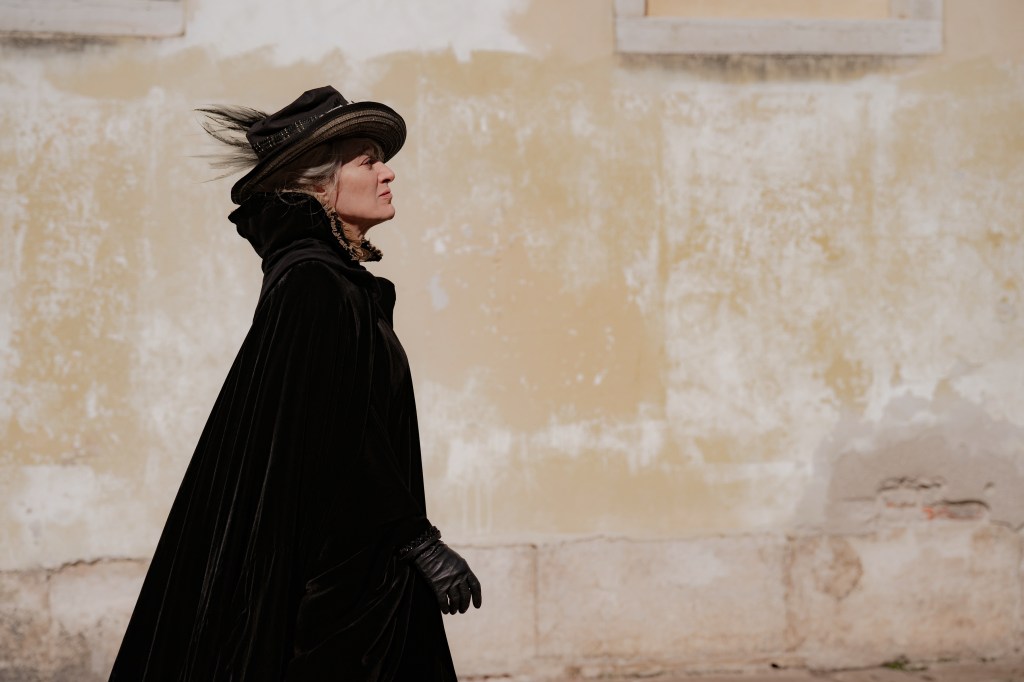
Valeria Bruni-Tedeschi in Duse
Duse has the more difficult task of imagining the life of a legend of live theater, Eleanora Duse. An influence on acting gurus Konstantin Stanislavski and Lee Strasberg, adored by the likes of Chekhov, Chaplin, and Shaw, Duse is virtually unknown today—she only appeared in one forgotten film and an Edison sound recording of her is lost. Pietro Marcello’s film chronicles her final years post-World War I, struggling financially and in poor health but determined to return to the stage after a ten-year absence. She triumphs in a new production, but her confidence is shattered when her rival Sarah Bernhardt (Noémie Lvovsky) taunts her as stuck in the past. That swipe leads her to mount an avant-garde production by a young playwright that is met by vicious catcalls.
Veteran French-Italian actress Valeria Bruni-Tedeschi has risen to the challenge of embodying one of the greatest stage stars of all time. Two sequences in particular stand out: a rehearsal in which she ferociously berates her young co-star into giving an authentic performance, and a delightful scene in which she reads Pinocchio to her grandchildren and scares the dickens out of them. Letizia Russo and Guido Silei’s script also delves into her relationships with famed poet Gabriele D’Annunzio (Fausto Russo Alesi) and rising fascist Benito Mussolini (Vincenzo Pirrotta), and her tense dealings with her neglected daughter Enrichetta (Noémie Merlant). The high-voltage theatricality of the performances here (compounded by all that Italian emotion) sometimes verges on risible, but hey, theater people aim to be larger than life. In any event, Duse helps revive an icon who’s been eclipsed by time.

Greta Lee and Willem Dafoe in Late Fame
Continuing on the theme of forgotten artists, Late Fame is the fictional story of a gifted poet whose notoriety has come and gone. Ed Saxberger (Willem Dafoe) has been working for 37 years at a post office in Lower Manhattan when he’s surprised by a young man named Meyers (Edmund Donovan) who reveres his obscure book of poems, “Way Past Go.” Meyers persuades Ed to join his equally worshipful group of friends dubbed “the Enthusiasm Society,” who meet regularly at a local tavern’s upstairs room. Ed is flattered but rather nonplussed by their doting attention, and it soon begins to get under his skin. Meyers asks Ed to write a new poem for a public event he’s planning, but the ex-poet is unable to find inspiration; he does perform a reading from “Way Past Go” that’s mightily impressive.
Gradually, it’s revealed that Meyers and his coterie are a bunch of rich kids with naïve pretentions. They’re all a bit ridiculous, but director Kent Jones and writer Samy Burch (May December) still respect their generosity and good intentions. Also part of their circle is an older member, Gloria (Greta Lee of Past Lives), an actress and singer who’s struggling like Ed and demonstrates true talent. (Lee’s rendition of Brecht and Weill’s “Surabaya Johnny” is a showstopper.) Will this late taste of local fame be a turning point for Ed? Or will he return to the world of his working-class buddies? The dependable Dafoe keeps Ed’s odyssey (derived from a novella by Arthur Schnitzler) compelling and relatable.
Pictured at top: George Clooney in Jay Kelly. Photo courtesy of Film at Lincoln Center.
 Kevin Lally on Film
Leave a comment