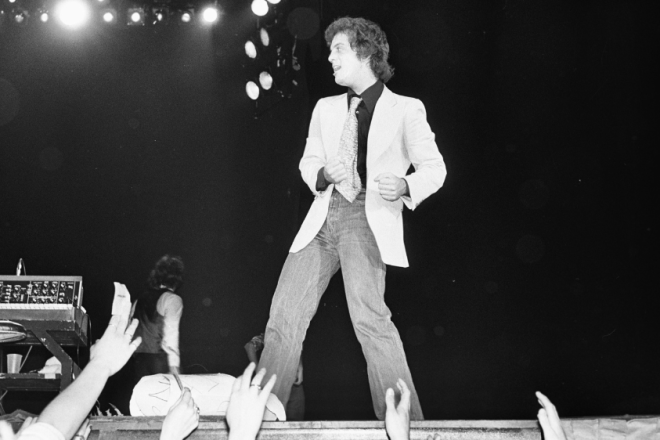
The 24th annual Tribeca Festival kicked off on June 4, 2025, with a sadly newsworthy opening-night attraction: part one of Billy Joel: And So It Goes, a two-part HBO documentary detailing the career of one of pop music’s most successful singer-songwriters. It’s newsworthy because Joel recently announced he’s suffering from Normal Pressure Hydrocephalus, a rare brain disorder. The singer was absent from the Tribeca premiere, but he sent this wry message: “Getting old sucks, but it’s preferable to getting cremated.”
The film itself is filled with revelations: how Joel, early in his career, fell in love with his best friend and bandmate’s wife, Elizabeth; how her departure from this fraught triangle led to two suicide attempts by Joel; how his institutionalization persuaded him to get on with his life and music. Billy eventually married Elizabeth and chose her to be his manager, and her skill in that position, often butting heads with male record executives, became key to Joel’s subsequent success.
Running two-and-a-half hours and ending with Joel’s 1982 motorcycle accident and the dissolution of his first marriage, part one is as comprehensive as any fan could want. I long ago decided I never needed to hear “Piano Man” again, but the section on that radio classic’s genesis brings it to fresh life. Joel had signed a terrible contract with a record producer named Artie Ripp that restricted his freedom. Out of desperation, Joel took a gig at a Los Angeles piano bar named The Executive Room, performing under the name “Bill Martin.” That experience resulted in “Piano Man” and its colorful menagerie of characters, including Elizabeth as “the waitress practicing politics.”
The pivotal moment in Joel’s career was the album The Stranger. The Beatles’ legendary producer George Martin had seen Joel perform and was slated to produce the record, on one condition: that the singer replace his band with musicians of Martin’s choosing. Joel refused. At the Columbia Records’ listening session for the completed album, company executives said they couldn’t detect a hit single (ironic, since the album is almost all hit singles). Elizabeth demanded the right to choose the second single: “Just the Way You Are,” a song Joel didn’t want to include on the album because he thought it was too “mushy.” The song became a monster hit, winning Grammys for Record and Song of the Year, and taking Joel to a new level of stardom. The Stranger, meanwhile, became Columbia’s biggest-selling album up to that time.
Directed by Susan Lacy and Jessica Levin, the film is refreshingly frank about Joel’s life: the damage done by an abusive father and a bipolar mother; his laughable stab at a heavy-metal career with the duo Attila; the inevitable temptations that come with massive success. And coursing through the doc is that wide-ranging songbook of pop classics. Here’s wishing Billy Joel a triumphant recovery.
The Tribeca Festival has always been big on music. I still fondly remember the post-film concert at Radio City Music Hall celebrating the premiere of a Clive Davis documentary, featuring performances by Aretha Franklin, Dionne Warwick, Barry Manilow, and Carly Simon. Fondly, except for the moment I shouted, “Shut the fuck up!” to some obnoxious loud talkers sitting in front of me during, of all songs, “That’s What Friends Are For.” Of the 118 features at this year’s Tribeca Fest, no fewer than 18 are music-oriented. Artists represented include Sun Ra, Billy Idol, Metallica, Miley Cyrus, and Eddie Vedder. But Counting Crows? I think I’ll skip that one.
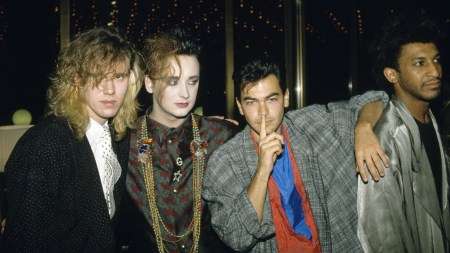
I did catch Boy George & Culture Club, a lightly entertaining but rather shallow doc about the pioneering gender bender whose pop group became a worldwide phenomenon in 1982. David Bowie and other artists were already challenging gender norms by the time Culture Club appeared, but there was something about George O’Dowd that pushed people’s buttons harder. Was it the makeup, the wide-brimmed hats, the dreadlocks, the colorful schmattas? Yes, all that and a certain feminine affect that freaked out portions of Middle America once the hit “Do You Really Want to Hurt Me?” crossed over. Four decades later, it’s hard to believe people actually wondered whether George was a man or a woman, or that his cheeky statement at the Grammys, “Thank you, America—you’ve got taste, style, and you know a good drag queen when you see one” would cause such a stir.
All four members of the group are interviewed separately by director Alison Ellwood. The most intriguing dynamic by far is between George and handsome drummer Jon Moss, who had never had a same-sex affair but fell hard for his lead singer. Moss is refreshingly open about their relationship, but Ellwood should have inquired about why he felt the need to keep things on the downlow as the band exploded. The director also avoids confronting George about the drug problems that sabotaged his success. For their part, bassist Mikey Craig and guitarist Roy Hay don’t hide their resentment that George dominated the front cover of their first album while the rest of the quartet was relegated to the back cover. But, hey, George was their gifted lead singer, and quite the attention-grabber. In his interviews, George—still looking chic at 63—comes off as endearingly bratty. Somehow, the band—now minus Moss—has continued to perform into this decade.
 Kevin Lally on Film
Leave a comment