
For the 24th year, Film at Lincoln Center and the legendary Italian studio Cinecittà are presenting “Open Roads: New Italian Cinema,” a chance for New Yorkers to catch up with the latest offerings from one of the world’s greatest cinema nations.
Running May 29 to June 5, the 2025 series opens with a film that will be of particular interest to Italian film buffs. The Time It Takes is Francesca Comencini’s highly personal account of her relationship with her famous father, Luigi Comencini, director of such films as the 1953 Gina Lollobrigida classic Bread, Love and Dreams and the 1970s arthouse hits Till Marriage Do Us Part and The Sunday Woman. The first half of the film focuses on the very young Francesca’s experiences watching her father create his version of the children’s classic Pinocchio, including an elaborate recreation of that ambitious production. An amusing scene shows the child’s frantic attempts to scurry out of camera range as her dad tries to capture a landscape shot before the sun goes down. The film then jumps ahead in time to find Francesca as a teenager (played by Romana Maggiora Vergano), still living with her father but resentful of his interference in her life. But Luigi, vividly portrayed by Fabrizio Gifuni, has good reason to interfere, since his daughter has become addicted to drugs. The writer-director doesn’t hold back about this period in her life; indeed, she comes off here as ungrateful and unsympathetic. This chapter culminates in a searing sequence in which Francesca reveals her complete lack of self-esteem; her father comforts her by admitting his own artistic insecurities.
Happily, Francesca went on to her own successful directing career, winning a prize at the Venice Film Festival at the age of 23 for her debut feature, Pianoforte. Oddly, The Time It Takes focuses exclusively on father and daughter; there’s no mention of Francesca’s three older sisters (one of whom is also a director) or her mother, who outlived her husband by ten years. But a delightful addition are the clips from the silent movies Luigi helped rescue from extinction as a young man, which are now housed at the Milan Cineteca.

Francesco Di Leva, Francesco De Lucia, Barbara Ronchi, and Stefano Valentini in Familia
A much more fraught family is the focus of the ironically titled Familia, based on a true story. Writer-director Francesco Costabile depicts the turbulent life of the Celeste clan: Franco (Francesco Di Leva) is a brute whose constant abuse of his wife, Licia (Barbara Ronchi), prompts a call to the authorities. But much to Licia’s distress, her two sons are removed from the household and placed in state institutions. Without parental figures to guide him, younger son Gigi (Francesco Gheghi) falls under the spell of a fascist skinhead cult; older son Alessandro (Marco Cicalese) remains clear-eyed throughout the story. The boys are in their twenties when Franco is released from prison, eager to reconnect with his family. Licia tries to keep her whereabouts secret, but Franco ingratiates himself with Gigi, insisting he’s changed. Eventually, Franco wears down his wife’s resistance and she takes him back. But the second-honeymoon period is all too brief, as Franco reverts to his jealous and violent ways, leading to an explosive confrontation between father and son.
Familia is well-acted, especially by Ronchi, and it maintains an unnerving tension, but overall it’s a downbeat, unpleasant experience. And its skinhead subplot, topical though it may be, feels like an afterthought. At least the end titles let us know the family is in a better place today.
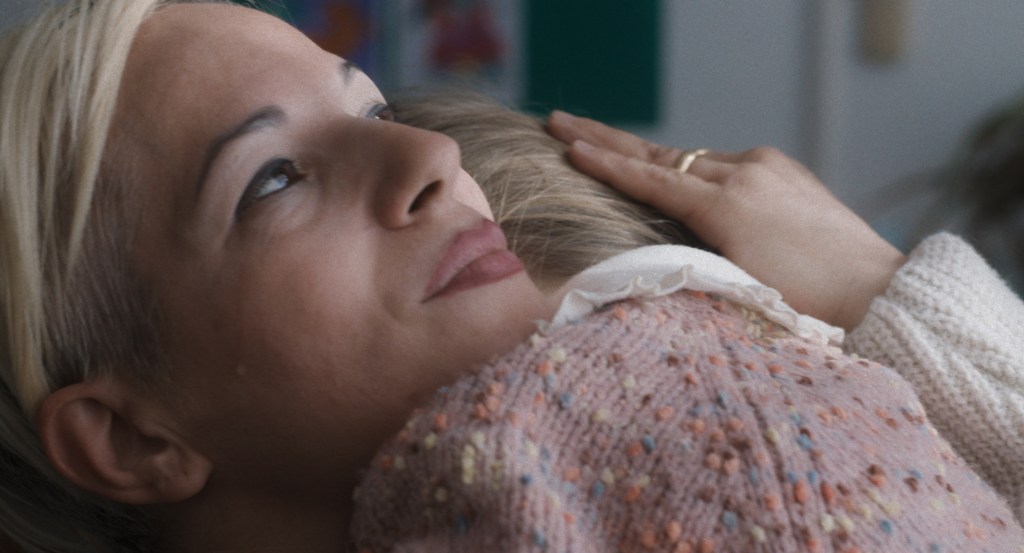
Marilena Amato in Vittoria
A more loving family is depicted in Vittoria, a drama set in a village south of Naples. Jasmine is a feisty hairdresser with a hard-working carpenter husband and three sons, the oldest of whom becomes an apprentice at her hairdressing salon. But something is missing from Jasmine’s life—namely, a daughter. Jasmine has a recurring dream of a little girl holding hands with her late father, and it won’t leave her alone. Jasmine doesn’t want to become pregnant again—her previous births have been difficult, and there’s no guarantee a fourth child would be female. So, despite her husband’s strong reservations, she begins the adoption process. Her odyssey leads her to Belarus, where she and her husband must decide whether to welcome a child with mental challenges. The narrative is simple and straightforward; what makes this film by documentarians Alessandro Cassigoli and Casey Kauffman special is that lead actors Marilena Amato and Gennaro Scarica are essentially playing themselves and re-enacting their own adoption journey.

The cast of Diamonds
Family comes in all shapes and sizes, including the families that are formed on a movie set. Diamonds, the 15th feature from director Ferzan Özpetek (Facing Windows, Saturn in Opposition), is his tribute to the women who design and fabricate the spectacular costumes that are such an essential part of movie glamour. Many of Özpetek’s films have centered on gay men, but this time his primary focus is a huge ensemble of women. The movie begins with the director himself gathering his actresses for a sumptuous meal and reading of the script (something Özpetek does in real life). It then segues to the fictional story set in a Rome fashion house in the 1970s, led by the imperious and demanding Alberta Canova (Luisa Ranieri) and her far gentler sister Gabriella (Jasmine Trinca). They’ve been tasked with making the costumes for an 18th-century epic under the supervision of Oscar-winning designer Bianca Vega (Vanessa Scalera).
Subplots abound: One of the seamstresses is married to a wife-beater (a rough storyline resolved with a touch of mischief); another has a teenage son who is clinically depressed; a milliner is forced to hide her young son at work because she can’t afford child care. There’s also another stowaway at the shop who emerges as a design prodigy. There are men in the film to complicate these women’s lives, most prominently the film director played by Özpetek veteran Stefano Accorsi, but the spotlight rightly remains on the female ensemble. Özpetek has always been a stylish director, but his camerawork (by Gian Filippo Corticelli) has never been more sweeping and virtuosic, abetted by the lush production and costume design of Deniz Kobanbay and Stefano Ciammitti. The film is slated to be released in the U.S. this fall by Outsider Pictures.
Pictured at top: Fabrizio Gifuni and Romana Maggiora Vergano in The Time It Takes.
 Kevin Lally on Film
Leave a comment