David Lynch has died at the age of 78. I had the pleasure of meeting the visionary director way back in 1984 to discuss his third feature, the much-maligned adaptation of Frank Herbert’s epic sci-fi novel Dune, which today has its staunch defenders. (I was frankly bored by Denis Villeneuve’s Oscar-nominated 2021 version and find Lynch’s gonzo take on the material a lot more entertaining.) Lynch redeemed himself two years later with his mesmerizing classic Blue Velvet, to be followed by such singular works as Wild at Heart, Lost Highway, Mulholland Drive, and the groundbreaking TV series Twin Peaks and its feature prequel and 2017 Showtime revival. And let’s not forget Lynch’s priceless appearance as John Ford at the end of Steven Spielberg’s The Fabelmans. Here’s my encounter with this one-of-a-kind filmmaker.
“Life is very strange,” says director David Lynch of the seismic jump from the struggle to finance and complete his first feature, the mini-budgeted, near-indescribable midnight cult classic Eraserhead, to his being entrusted with the $42 million screen translation of Frank Herbert’s beloved 1965 science-fiction saga Dune. But that contrast is no stranger than the films themselves, which confirm Lynch’s status as one of the most original, imaginative, and audacious talents in American cinema today.
A former art student, Lynch began his filmmaking career with two abstract shorts, The Alphabet and The Grandmother. The latter won prizes at the San Francisco and Atlanta film festivals and led to Lynch’s acceptance at the AFI’s Centre for Advanced Film Studies in L.A. and the initial funding for Eraserhead. A definitive example of a labor of love, Eraserhead grew out of Lynch’s memories of his life as an impoverished student in an isolated section of Philadelphia. With the uncanny feeling of a nightmare, it combines comic and horrific elements in its portrait of a Brillo-haired loner dealing with, among other curiosities, his lizard-like mutant baby and a tiny, tumor-laden lady in his radiator. Since the AFI never agreed to a feature-length film, Lynch struggled over the course of four years to finish his movie, at one stage interrupting his evening shoots to deliver The Wall Street Journal. Ben Barenholtz’s Libra films picked up the finished work for distribution, and Eraserhead gradually attracted a passionate following.
Among Lynch’s fans was Mel Brooks, who decided the director was the right man to helm his production of The Elephant Man, the true story of the severely deformed Englishman John Merrick. Lynch’s sensitive, poetic handling of the subject earned him 1980 Oscar nominations for both his direction and screenplay collaboration.
Only his second commercial project, Dune represents a mammoth undertaking for Lynch, encompassing 18 months of paring Herbert’s book down to filmable size and 18 more of preparation and production at Mexico City’s Churubusco Studios. There, the economic benefits were offset by the thin, polluted air, the lack of sufficient electricity and phone lines, and various illnesses that beset most of the cast and crew. A mythic tale of heroism which takes place on four different planets, Dune features such fanciful creatures as mile-long sandworms and drug-addicted humans who mutate into 15-foot, insect-like monsters.
Wearing his stock outfit of khaki pants and white shirt buttoned to the top, with a full head of reddish-brown hair and light blue eyes, the 38-year-old director met with me recently in New York. Punctuating his comments with adjectives like “neat,” “nifty” and “supercool,” he proved exceptionally friendly and enthusiastic, an odd contrast to the often stark and unnerving quality of his films.
What about Frank Herbert’s book appealed to you?
I don’t like a one-thing film, and Dune is a story that takes place on four different planets. I love the idea of going into different worlds. In Eraserhead, it was a different world made of recognizable things. The Elephant Man was also like going into a different world, back in time; to make it feel like there and then was so nifty to me. In Dune, I liked the idea of making these four different places as real as possible, having an atmosphere come out of them. I also like the dreams and visions in the book. It has an adventure story on the surface, which is a structure that other things, other ideas, swim in and amongst. The dreams are a texture, the space travel is a texture, these different worlds are a texture—all things that I thought would be great for a film.
On Dune, did you feel you lost the kind of personal control you had on Eraserhead?
No one ever had or will have the kind of control I had on Eraserhead—in one way. I had four years, and I didn’t have to get anyone’s permission to do anything, but I had no money, which brings a whole other set of problems. I never would want to go through that experience again, it was way too painful. On something like Dune you have money and the people to get what you want, but you have time restrictions and the pressure is so much more.
The ideal would be money and time. I came into film through painting. When I’m painting or drawing, to me it’s a process of action and reaction. I’d like to do the same thing in film—if I see something in the dailies that gives me an idea I never could have gotten until I saw the way the film treats that scene, I like to be able to incorporate that back into the film somehow. Whereas if you have a regimented schedule, it’s very difficult to reshoot something or change something around.
Do you feel the rigors of making Eraserhead over that long period were, on a smaller scale, training for the rigors of making this film?
Absolutely. To hang onto an idea and be enthusiastic about it for three and a half or five years is almost impossible, but you have to do it. You can’t let go. Sometimes it’s so horrifying.
Especially when you’re in a country where half your cast is sick and you have no phone lines..
That’s right.
Did it ever start to overwhelm you at certain points?
While I was in Mexico I was working so hard every day that most of the problems other people were having I wasn’t really worrying about, because you’re just concentrating on getting ideas for the film and that’s all you can think about. I never got sick, I just got a couple of colds and my eyes got infected. But there’s an awful lot of stuff floating in the air in Mexico. There were many different types of sicknesses, and some people got conjunctivitis, which is really murder.
Were there are benefits to you being there other than the obvious economic ones?
Absolutely. The only place in the world to make this picture was Mexico. While I was in Mexico City, I felt I was in another world. I’d never been in a city quite like that—I really liked its architecture and mood. It was like a way station, a halfway point between somewhere and Arrakis [the desert planet where much of Dune’s action takes place].
Venice was also an influence. When you read the book, there are so many references to a medieval feeling. Dune is a combo of the old and the new, it’s not a high-tech picture. People are expecting Star Wars and they’re not going to get Star Wars. It’s got a different feeling, it’s almost a different genre. Dune has sort of a renaissance richness, with more details and textures.
What was your biggest technical challenge?
The whole film was a technical challenge, because there were special effects throughout. The hardest thing for me was this business of action and reaction, which was impossible in a picture like Dune, because you didn’t know what you had until it was too late to change it. There were a lot of sequences that couldn’t be finished until the eleventh hour, since it took so long to combine elements. It was hard to even put sounds to some things—you had to imagine the feeling, and hope that it would be that, because there was nothing there for you to react to.
You’ve always had an interest in upgrading the quality and imagination of movie soundtracks. Are there other elements that you think could also use a lot of improvement and exploration?
One day a director will sit down at a console—maybe it would be after scenes had been shot—and manipulate images and sounds and timings and feelings. I think that technology is going to help someday make these things controllable. Now it seems like we’re in the dark ages; everything takes so long to do, it’s so crude and cumbersome. One day it will all come into one room. People get afraid of losing their jobs with computers coming in and it’s a difficult change, but somehow, I’m sure, a balance will be found. Actors will still be acting and there will be so much creativity going on, but people will have more control over it. The whole point is to get an idea that’s in your head on the screen.
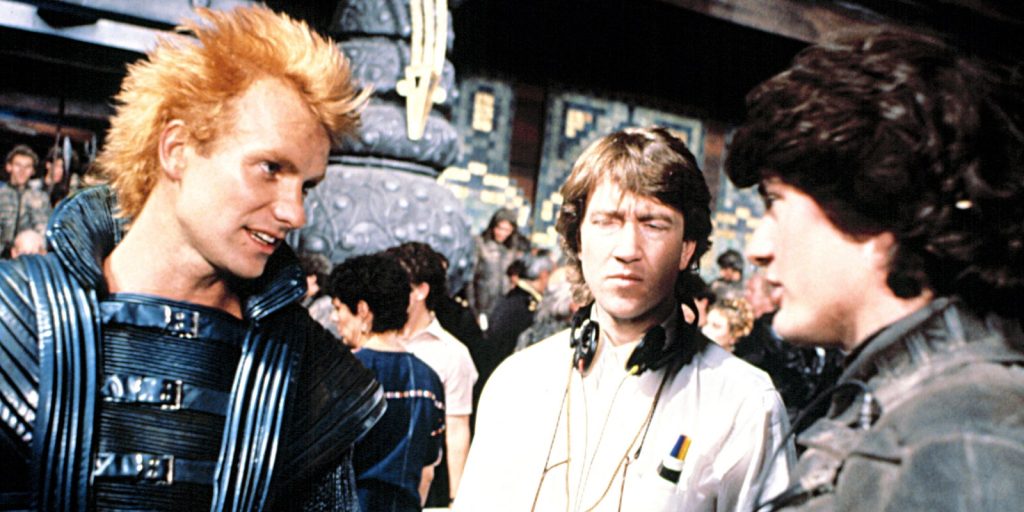
Pictured at top: David Lynch (center) directing Sting and Kyle MacLachlan in Dune. Photo courtesy of Universal Pictures.
 Kevin Lally on Film
Leave a comment