
The annual New York Film Festival has no shortage of exotic, esoteric, and demanding films. But some of the biggest highlights of this year’s event are comedies. Yes, comedies. Raucous comedies. Quirky comedies. Comedy-thrillers. Comedies that double as poignant character studies. But comedies nonetheless.
Among the most popular and crowd-pleasing entries at NYFF 62 is the winner of the Palme d’Or at Cannes, writer-director Sean Baker’s outrageous Anora. Baker has made a career of telling stories about people on the fringes of society: Chinese delivery men, transsexual sex workers, single mothers hooking up with johns to survive, porn stars past their prime. In Anora, the title character is a lap dancer at a Manhattan strip club who mesmerizes young Ivan Zakharov, the puppy-like son of a Russian oligarch. Like Richard Gere in Pretty Woman (minus the maturity and suave sophistication), he offers Ani, as she prefers to be called, a bundle of cash to stay with him for a week at his father’s huge Brighton Beach mansion. The couple have lots and lots of sex (Ani teaches the overeager Ivan how to slow down), hang out with Ivan’s friends at Coney Island, and take an impulsive trip to Las Vegas, where Ivan proposes, partly motivated by the lure of a green card that will keep him in the States. Hesitant at first, Ani takes the leap with her stoner Prince Charming.
Ivan’s parents soon learn of the quickie wedding and dispatch their Armenian fixer (abetted by two henchmen) to arrange an annulment. But Ani is not about to go quietly, not by a long shot. Baker stages a ferocious battle of wills between our heroine and these three strongmen, a gratifying masterpiece of physical comedy. Ivan, showing his true colors, has run off—Ani insists on finding and speaking to her new husband before any arrangement can be made.
Baker’s career has evolved beautifully from his $3,000 portrait of New York City and its underappreciated restaurant workers, Take Out; through the kinetic Tangerine (shot with iPhone cameras), and his evocative drama set on the poor side of Orlando, The Florida Project. Anora is his most commercial and engaging movie yet, an exhilarating, funny, ribald and poignant ride whose high energy never flags. Much of its success is owed to Baker’s lead actress Mikey Madison, who takes on a killer Brooklyn accent and is up for the many physical challenges of the role. It’s refreshing to watch a female character who is so brash and self-assured while also revealing layers of vulnerability. The supporting cast also fully delivers: Mark Eydelshteyn as the hedonistic Ivan, Baker regular Karren Karagulian as the fixer, and Vache Tovmasyan and Yura Borisov as his partners in intimidation. I can’t wait to see what Baker cooks up next.
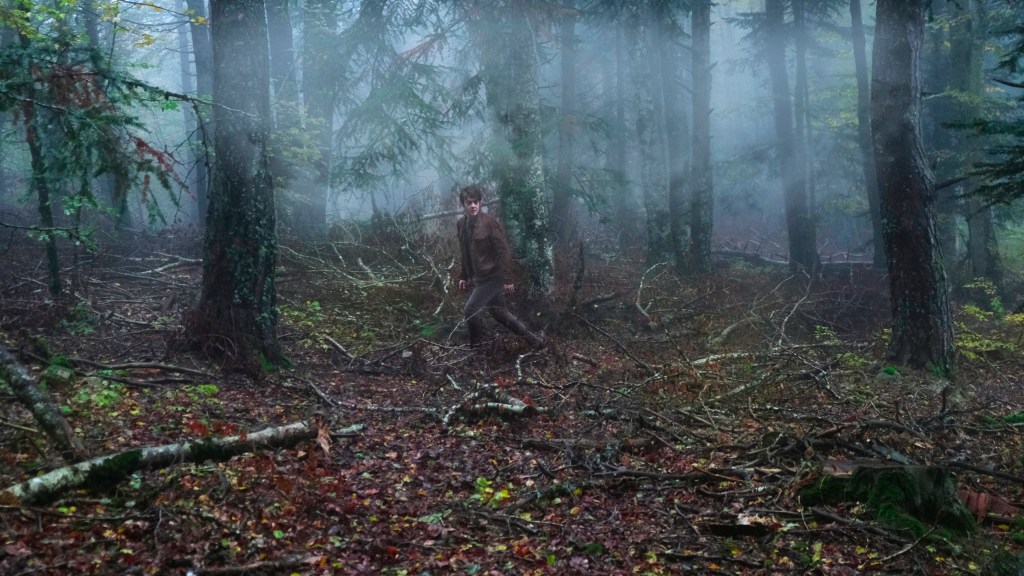
Félix Kysyl in Misericordia
Another filmmaker enjoying a career high is Alain Guiraudie. The French director raised eyebrows in 2013 with his sexually explicit tale of murder at a gay cruising spot, Stranger by the Lake. His new film, Misericordia, is equally provocative, and more subtle in the way it morphs from the prosaic to the shocking and perverse. The story centers on Jérémie (Félix Kysyl), a young man who returns to a small village for the funeral of Jean-Pierre, a baker who was once his boss. Jérémie is warmly welcomed by Jean-Pierre’s widow, Martine (Catherine Frot), even though she suspects that Jérémie and her late husband had more than a paternal relationship. Far from welcoming is Jean-Pierre’s son, Vincent (Jean-Baptiste Durand), Jérémie’s onetime playmate, who is miffed when Martine invites the young man to stay in his former bedroom. Curiously, Jérémie seems most interested in reuniting with Vincent’s friend Walter (David Ayala), an overweight farmer who likes to keep to himself. The longer Jérémie stays in town, the more tensions rise. I won’t reveal the details, but the second half of the film is all about the cover-up of a murder.
No surprise to Guiraudie fans, there are a lot of polyamorous vibrations circulating in this small village—even the local priest (Jacques Devaley) gets in on the action. And though the story becomes increasingly dark, it also incorporates some very mischievous and transgressive comedy. One critic described the movie as “Hitchcock Meets Pasolini,” and I can’t think of a better capsule description for this cheeky anti-morality tale.
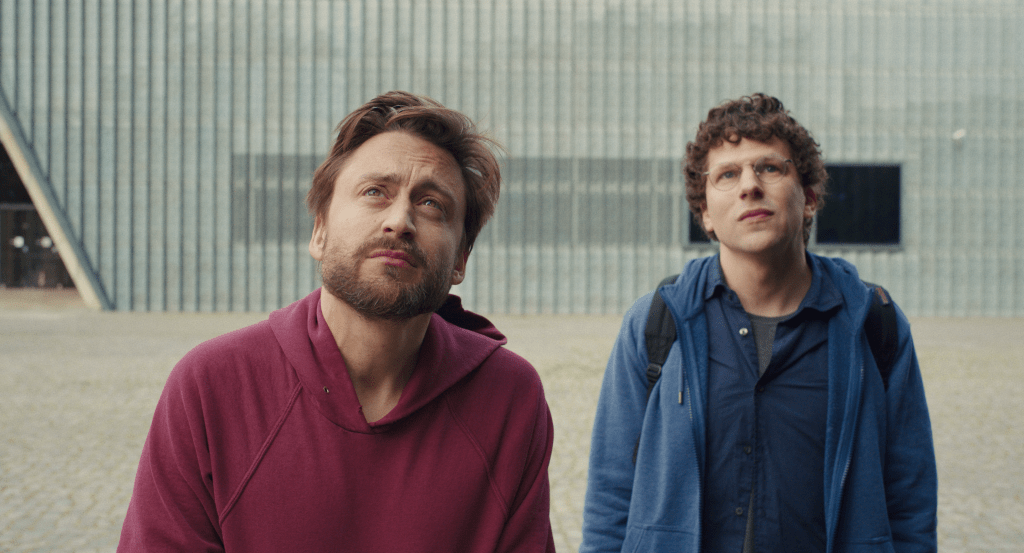
Kieran Culkin and Jesse Eisenberg in A Real Pain
Oscar-nominated actor Jesse Eisenberg proves himself an assured writer-director with A Real Pain, his comedy-drama about two cousins who take a Holocaust-themed tour of Poland, with the goal of also tracking down the home of their late grandmother. Eisenberg’s David, like many of the characters he’s played, is uptight, neurotic, a bit of a wet blanket. His cousin Benjy (“Succession” Emmy winner Kieran Culkin) is his polar opposite, but neurotic in his own way. Benjy is spontaneous, unfiltered, reckless, and irritating whenever he’s turned off his ability to charm. The trip is an attempt by these childhood pals to reconnect—especially by David, who’s trying to heal something in Benjy’s nature.
At various times, both cousins are “a real pain”—David with his fretting, Benjy with his outbursts and inappropriate behavior. But the title also refers to the real pain of their psyches and, of course, the generational pain that their somber Holocaust tour represents. Eisenberg’s script is nevertheless funny, but the laughs come out of recognizable character interactions—between the cousins, with their earnest Gentile tour guide (Will Sharpe), and the other members of the tour who include a Rwandan Jewish convert (Kurt Egyiawan) and a recent divorcée (Jennifer Grey). The wisecracking Benji isn’t dissimilar to Culkin’s “Succession” character, but it’s a meaty, mercurial role he pulls off with panache and poignancy. The film, by the way, was co-financed by Poland, and Eisenberg’s travelogue certainly makes me want to add that country to my European checklist.
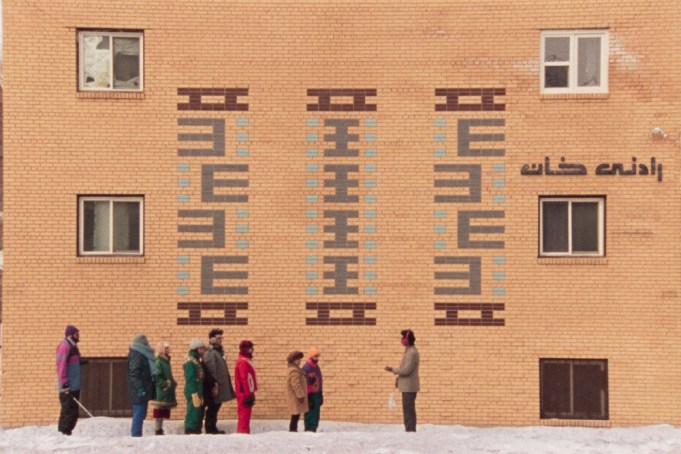
Universal Language
A knowledge of Iranian cinema would help with the appreciation of Universal Language, director Matthew Rankin’s absurdist comedy set in Winnipeg, since it’s strewn with references to Iranian classics. But you can still enjoy this eccentric tale in which the Manitoba city has seemingly been taken over by its Iranian population. (Even the Tim Horton’s signage is in Farsi.) The plot, such as it is, follows two children who’ve discovered a 500 Riel bill frozen under ice (a reference to the classic The White Balloon); a man (played by the director) who returns to his mother’s home in Winnipeg, only to discover he’s been replaced by another man (a nod to Abbas Kiarostami’s Close-Up); a tour guide who leads his clients to such dismal sights as a shrine next to a bustling highway, a fountain in an abandoned mall, and a long-forgotten briefcase; and many more ridiculous tangents. There’s the store that only stocks Kleenex, the turkey riding a bus, the man inexplicably crying in an office cubicle, the child wearing a Groucho mask. For the most part, the tangents intersect, all in a droll visual style of largely stationary shots reminiscent of another culture’s genius, Jacques Tati.
Pictured above: Mikey Madison in Anora. Photo courtesy of Neon. Other photos courtesy of Film at Lincoln Center.

 Kevin Lally on Film
Leave a comment