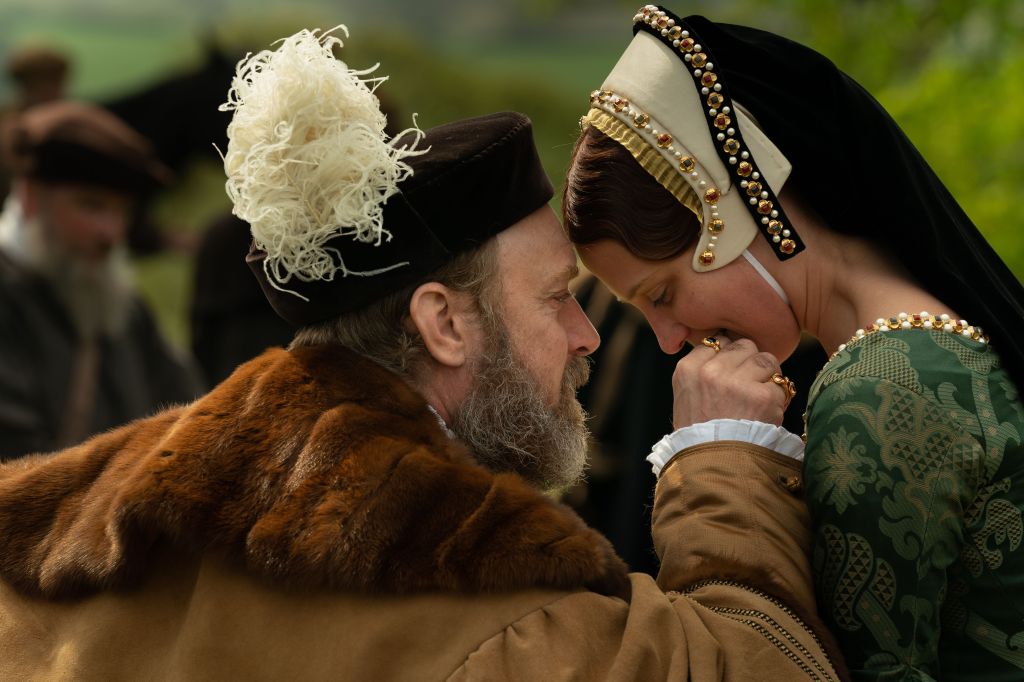
Debuting at the 2023 Cannes Film Festival, Firebrand has made the Tribeca Festival its final stop before opening in theaters on June 14. A distinct departure for Brazilian director Karim Aïnouz, this is the latest in a long line of cinema portrayals of the notorious King Henry VIII of England. Onetime matinee idol Jude Law is surprisingly ferocious and intimidating as the volatile monarch, but the central focus of the film, based on the novel The Queen’s Gambit by Elizabeth Freemantle, is Henry’s sixth and final wife, Catherine Parr. It’s also a more feminist spin on the historical legend than we’re used to seeing (not counting the Broadway girl-power revue Six, which I haven’t seen).
Oscar winner Alicia Vikander is Catherine, in a subtle performance that conveys both the Queen’s audacity and her watchful survival skills. We first meet her in a forest rendezvous with her old friend Anne Askew (Erin Doherty), an activist who dares to preach allegiance to God over any king. That bit of indiscretion arouses some court rumors, along with Catherine’s close relationship with Thomas Seymour (Sam Riley), the brother of Henry’s third wife Jane, who died shortly after giving birth. Vikander’s high-wire portrayal paints Catherine as an intelligent and forthright woman who nonetheless knows when to defer to the whims of her frighteningly mercurial husband. The hell of her life is summed up in a quick cut from Henry howling from the pain of his diseased leg to his grunting atop his wife in bed. Although history tells us that Catherine was one of the lucky wives who survived, the film still generates suspense as her enemies plot against her. Firebrand also indulges in the wild speculation that Henry may not have died of natural causes—Catherine’s ultimate protest.

The Tribeca Festival doesn’t hesitate to program light comedies that would never find a berth at the lofty New York Film Festival. Among those generating the most interest this edition is Sacramento, due to its notable cast. The film pairs two former teen stars, Michael Angarano (Sky High, “Will & Grace”), who also directed and co-wrote the screenplay with Chris Smith, and Michael Cera (Juno, Superbad, “Arrested Development”). Cera is Glenn, a suburban husband and soon-to-be-dad who suffers from anxiety attacks, not least over his fear that he’s about to be laid off from his job. He gets an unexpected visit from his childhood frenemy Rickey (Angarano), who persuades him to take an impromptu road trip from Los Angeles to Sacramento to spread the ashes of Rickey’s late father. But Rickey has a secret reason for his excursion north.
Old showbiz pros now in their mid-30s, Angarano and Cera have a prickly rapport onscreen, and it’s to Angarano’s credit that his script is so honest about how immature and unstable these two man-children can be. (It’s the movie’s women—Kristen Stewart as Glenn’s wife and Angarano’s real-life spouse Maya Erskine as Rickey’s recent fling—who are the level-headed ones here.) The story spirals into a true crisis in the final act as Glenn is triggered into a manic episode, but both men emerge as better, more responsible people. Sacramento is slight, but there’s something gratifyingly deep beneath its surface as it asks the question: What’s the matter with men today?

Another Tribeca comedy worth checking out is Griffin in Summer, mainly for the wonderful performance of its young star, Everett Blunck, in the title role. Griffin is a very precocious 14-year-old with dreams of becoming a major playwright. In the hilarious opening scene, he performs both lead roles in an excerpt from his new play, Regrets of Autumn, at his high-school talent show: a New York stockbroker and his bitter, alcoholic wife. “They weren’t miscarriages, they were abortions!” the wife screams; Griffin describes his age-inappropriate drama as “Who’s Afraid of Virginia Woolf? meets American Beauty.”
When Griffin’s mom (Melanie Lynskey) hires a neighbor’s 25-year-old son Brad (Owen Teague) as a handyman, at first his presence is a major annoyance as the boy tries to summon his muse. But when the shirtless intruder helps Griffin move a couch, the boy is suddenly smitten—even more so when Brad reveals his recent stint as a (failed) performance artist in glamorous New York City. Griffin starts incorporating Brad’s details (including his old apartment in Bushwick) into his play, and even recruits him to replace one of his regular troupe of teen players. Complicating matters is Brad’s dizzy girlfriend (a fun Kathryn Newton), who becomes the victim of Griffin’s rising jealousy.
Teague, currently onscreen in Kingdom of the Planet of the Apes, is perhaps too much of a dumb brick as Brad, but that is probably a deliberate choice on the part of writer-director Nicholas Colia. But Blunck is utterly perfect, nailing Griffin’s combination of “sophistication” and naivete, and keeping the boy sympathetic even when he’s being obnoxious and mean. And refreshingly, the gay angle is handled matter-of-factly: There’s no wringing of hands over Griffin’s budding sexuality. Here’s hoping young Mr. Blunck finds equally good showcases for his comic talent.
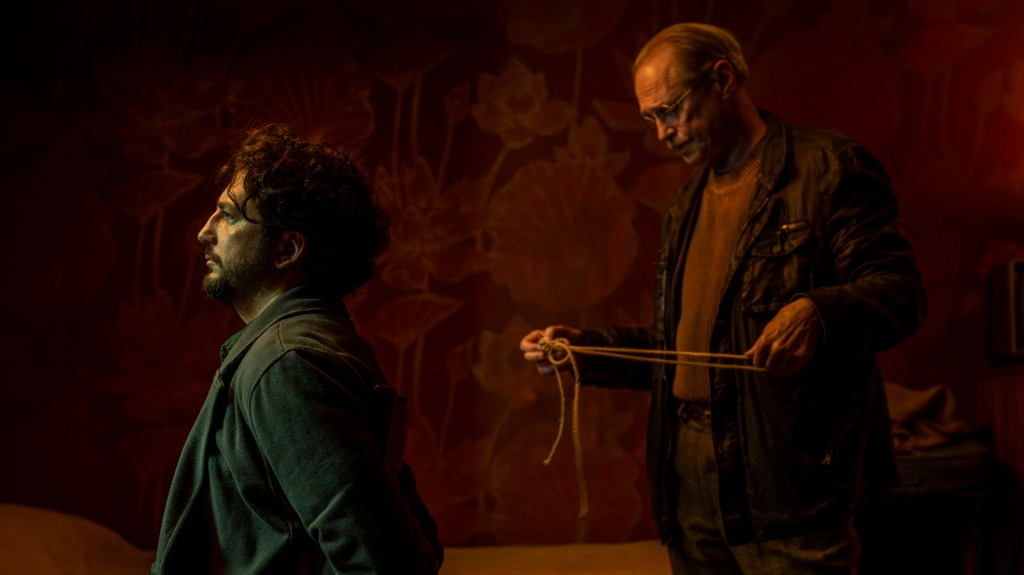
And now for something completely different. The unfortunate title The Shallow Tale of a Writer Who Decided to Write About a Serial Killer portends a case of quirkiness overload. The opening scene, set in the year 40,000 B.C. in Slovenia, certainly confirms that suspicion. It’s the vision of a writer working on his second novel, about the romance between a Neanderthal and a Homo Sapiens. That writer, Keane (John Magaro), had a minor success with his first book, but he’s struggling and doesn’t realize that his marriage to Suzie (Britt Lower of TV’s “Severance”) is in big trouble; she sees him as a milquetoast and a bore. But Keane has a fan: Kollmick (Steve Buscemi), a chatty fellow he meets in a bar, who eventually confides that he’s a “retired serial killer” and would be the perfect subject for Keane’s next book.
When the drunken Keane brings Kollmick home and wakes up Suzie, he refers to the stranger as his counselor—uh, his marriage counselor. Startled by his initiative, Suzie agrees to participate in sessions with this eccentric advisor—the comically absurd high point of Turkish writer-director Tolga Karacelik’s English-language debut. The narrative becomes increasingly absurd as Kollmick plots a kidnapping as research, a plan that goes completely awry. Suzie persuades a cab driver to follow the nighttime misadventures of her husband and his new pal, in an increasingly fraught series of episodes reminiscent of Martin Scorsese’s After Hours.
The zany narrative is anchored by three solid performances. Magaro has a puppy-dog appeal even when his character is being annoyingly pedantic; Lower ably orchestrates Suzie’s transition from fed-up spouse to gobsmacked witness, and Buscemi is dependably droll in a part that feels like it was written for him. Get past the title and you may have a good time.
At top: Jude Law and Alicia Vikander in Firebrand. Photo by Larry Horricks.
 Kevin Lally on Film
Leave a comment