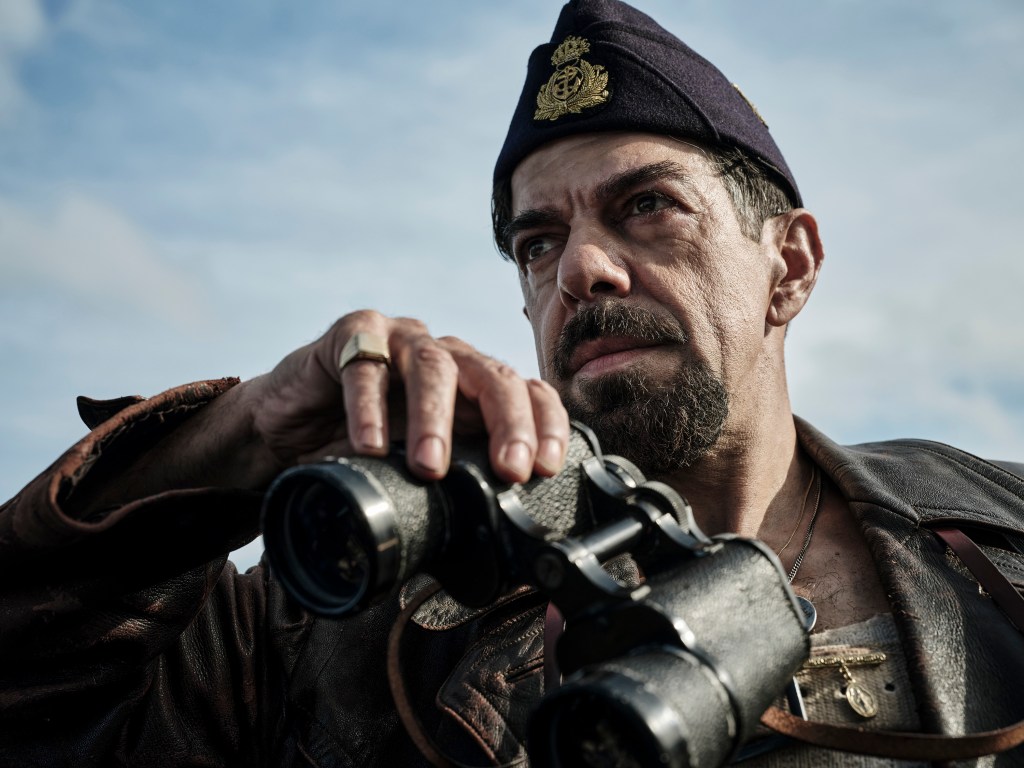
Film at Lincoln Center’s 24th annual “Open Roads” series of new Italian films launched in spectacular fashion with Comandante/The War Machine, the incredible true story of an Italian submarine crew during the early years of World War II. What makes the epic stand out is its humanism: After the Cappellini sinks the ostensibly neutral Belgian freighter Kabalo, Italian captain Salvatore Todaro (Pierfrancesco Favino) takes mercy on the 26 survivors and brings them aboard his sub. But Todaro faces a huge dilemma: Because of the tight quarters, some of the Belgians must stay in the conning tower. Unless it submerges and drowns those men, the sub will be a sitting duck for enemy aircraft. Remarkably, Todaro is able to negotiate safe passage for his crew and their “guests.”
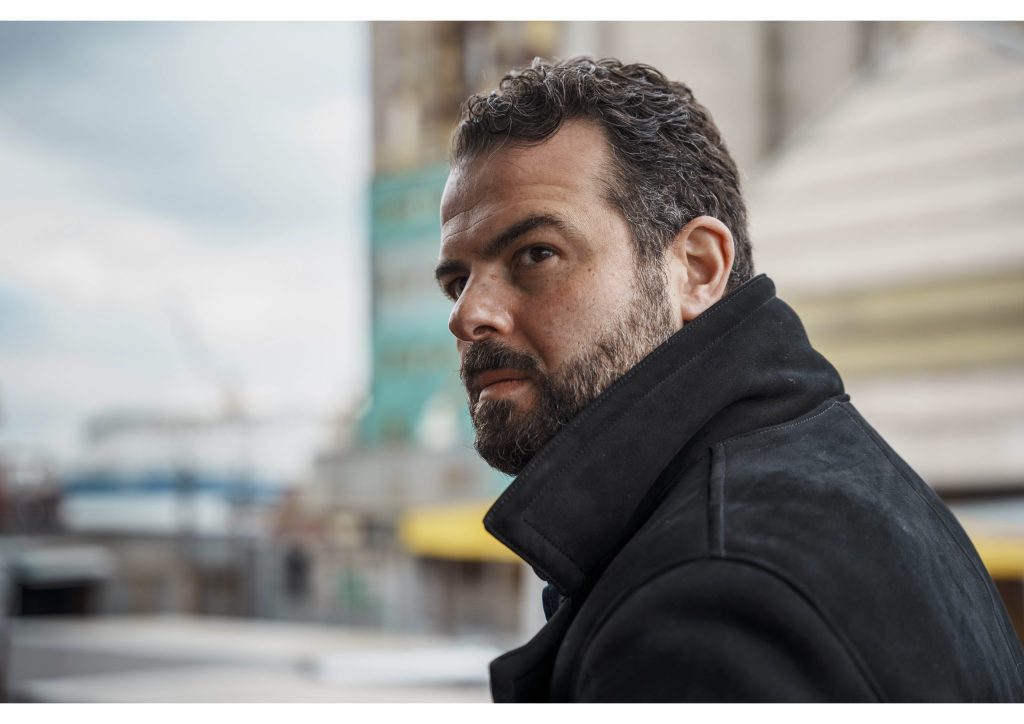
Comandante is the sixth theatrical feature directed by Naples native Edoardo de Angelis. His 2016 film Indivisible won six David de Donatello awards (the Italian Oscar), and his credits include the Netflix series The Lying Life of Adults, based on the novel by Elena Ferrante. We recently met with de Angelis the morning after Comandante’s New York premiere.
This is an amazing story and I’m so glad it’s out there for people to learn about. When did you first hear about it?
It was 2018. My government closed the docks and the chief of the Coast Guard needed to say a word to his men about the situation. We need to remember that our Coast Guard has permission to make the seas safe and save people. But he could not explain himself clearly [due to] his conflict with the government, because he was part of the institution. So he decided to tell a parable, to use this story like a parable. It’s a true story, to say to his men: Don’t stop saving people in the middle of the sea, because this is an eternal law and there is no government that can change it. When I discovered this story, I thought it was so emblematic of all the things that I care about.
I grew up in the south of Italy, immersed in an idea of strength, of violence, of humiliation of the enemy. I always refused this idea. I always thought that the real strong man is the man capable of helping. And for the same reason I grew up in this idea of Italian people, good people that need to protect their borders. But I refused this idea. If there is any meaning to being Italian, we’re a melting pot, our broth is so mixed. The only possible meaning is to let the door open for other people to come in, because if we close the door, Italy ends. To be Italian doesn’t mean anything.
We’re facing that same dilemma here in the United States.
That’s so universal. People move and people fight. Salvatore Todano is a soldier and he fights, but I like to remember that this happened, that a man decided even during wartime to say, okay, there is a limit. You can fight each other. You have a weapon, I have a weapon. I kill you, or you kill me. I sink you, or you sink me. But after this moment, when you are without any weapons in the middle of the sea and you are dying, I must help you. Because if I don’t do that, all the sea’s divinity will damn me forever.
So you just discovered this story about six years ago. Is that true of most Italians? Is this an unknown story?
It’s quite an unknown story. It’s very well known in the professional community of military people. But in the civilian world, no, no, no.
Has the film had an impact in Italy?
Yeah. There was a short circuit about this man who fought under the dictators but still remembered laws that the new fascists broke systematically every day. So it generated a short circuit in the conscience in the politicians in my country. It was very interesting, because I believe in the political importance of movies, not in a way which increases the polarization of the conversation, but in a way in which we can show a vision of the world which is much more complex than the left or right positions.
I’m always curious when a filmmaker embarks on a project of this scale—was it intimidating knowing you had to oversee this big, big story?
Something happens in my mind when I start a movie. I don’t care about anything else outside of the movie. Even the movies before this, I work in the same way because I go deep into the subject. I just look for what I need to make the movie—it doesn’t really matter if it’s one million or ten, it doesn’t make a difference for me inside. It’s sort of a naive approach, I know that. But I love that naive process. I think it’s a value for a filmmaker, to protect him because this naive side of life can keep that flame of inspiration that you follow without thinking of the problems. There are problems always with a little budget, with a medium budget, with a big budget—there are the same problems.
Were you a fan of the genre of the submarine film?
No. I really don’t care. I just care about feelings, emotions. So if I feel emotion for a war movie, then I love a war movie. But I don’t necessarily love war movies.
You were working in a very confined submarine set. Is that a plus for you in terms of the intimacy of dealing with your actors?
To be honest, yes. It was a plus for me. It was a very nice challenge, and it helps me to drive my meanings. I always try to create an environment which tells the story by itself. Then I put people inside and they live with that.
Was Pierfrancesco Favino your first choice for Salvatore?
No, not immediately. Because he’s a very big star for us, and I never worked with a star. But to be honest, I found him the best choice for that character. Because he’s a man who’s totally under control of what he does. And I asked to him to lose that control during this adventure with me, during this journey.
How much of what we’re watching is visual effects and how much is the reality of being out at sea?
Everything in the foreground is practical. But in the background, we built with CG. I wanted to keep it very dark, because I wanted to create this feeling of truth more than reality—the truth of a battle in the middle of the ocean in the middle of the night, in which you see that something exists at the moment in which you see the explosions. Before that, you just have the moon and nothing else.
How would you define Salvatore?
He’s just a normal man. He just did something human, which should be natural for every human being. He didn’t do anything exceptional.
Watching the film, I kept thinking of Das Boot, which is one of the great submarine films. It’s a film about a Nazi submarine crew and you’re rooting for them. Was it tricky for you doing this film knowing that the submarine crew was on the wrong side of history?
It was a question for me all the time. But I solved it by wondering about every single man living that story. They just grew up at that age under that army without specific political ideas. It was important to me to show how even these people living on the wrong side of history, when they were called to behave like human beings, they did it. So the question for me was, if even then, in the midst of war, they did the right thing like normal human beings, why do we forget this now, in a time of peace? What happened?
How was the reception in Italy for the film, and what are your hopes for the film going beyond Italy?
We had very different reactions in Italy, in England, in America. It’s very interesting to see how, for example, in England, they totally refused this movie. But, month after month after month, the direction changed and now they will release it in theaters, even in England. Because this movie isn’t polarizing, it tries to ask questions.
Ultimately, it’s a very humanistic film.
Yes, if you see it. But it’s normal for people to ask, why do you choose to tell a story about this man that was under the Fascists. Why? Because I wanted to put at the center the thoughts of a human being trying to move on, trying to [move past] the polarization of the conflict… It’s time to found a new, progressive thought free from the ghosts of the past. That’s what I hope.
Your film was a last-minute substitute for opening night at the Venice Film Festival. What was your reaction when you heard that news?
Opening the festival was an honor, but it’s very surrounded by glam and gossip. I really don’t care about this. I just was grateful to have my movie in competition in Venice—that’s the most important thing for me. And after they decided to offer us the opening night, I accepted, but it was not so relevant for me.
That’s a very grounded attitude.
I like movies, I like making movies. So when I have the opportunity to show in a big competition like Venice, I’m very proud and happy. The other things I am much less interested in.
This interview has been edited for clarity. Pictured at top: Pierfrancesco Favino as Salvatore Todaro. Photos courtesy of Film at Lincoln Center.
 Kevin Lally on Film
Leave a comment