The new thriller Silent Night marks action master John Woo’s first American film in 20 years. Seems like a good occasion to look back on my summer 2002 interview with the Hong Kong legend; the subject was, like Martin Scorsese’s Killers of the Flower Moon, a rare, big-scale story about Native Americans.
Gentle, modest and courtly, John Woo seems like the unlikeliest person to lay claim to the title of king of action movies. But, with calm determination, the 56-year-old director has not only created a legendary legacy of kinetic Hong Kong gangster films, but broken barriers as the most successful Asian filmmaker in Hollywood history. After thrilling audiences with box-office hits like Broken Arrow, Face/Off and Mission: Impossible 2, Woo brings us his biggest action canvas to date with MGM’s Windtalkers, a fact-based World War II drama starring Nicolas Cage.
Woo’s films often deal with morally conflicted heroes and anti-heroes, and the life-or-death dilemmas in Windtalkers perfectly suit the director’s sensibility. Cage plays Joe Enders, a U.S. Marine still haunted by a horrific ambush, who is assigned to guard Ben Yahzee (Adam Beach), a young Navajo trained to use his unwritten native language as a secret military code. Joe and Ben develop an unusually close bond, but always in the back of Joe’s mind is the knowledge that if Ben is ever in danger of being captured by the enemy, his first priority must be to “protect the code.”
“When the writers [John Rice and Joe Batteer] pitched the story to me, I cried,” Woo recalls. “I really loved the friendship in the movie. And I was stunned by the fact of the code talkers. I so much admired their bravery and patriotism, and their contribution to the country. And I was stunned by the orders given to the Marines: to protect the code more than the code talkers.
“It’s like my usual characters—the man searching for his own redemption, and the struggle for honor and loyalty. It’s very much like my Hong Kong films. But most of all, it’s about friendship—two different kinds of people and how they work together.”
Like Ed Zwick’s Glory and its depiction of black soldiers in the Civil War, Windtalkers sheds light on a little-known chapter of American history—and the valuable role played by a persecuted minority. In 1942, 29 Navajo Marines completed boot camp and developed the code that was eventually used by some 400 Navajo code talkers in the Pacific front; the original 29 were awarded Congressional Gold Medals last summer.
“Before this movie, I had never met any Native Americans,” Woo says. “They are very, very interesting people. They are very optimistic, they have a good sense of humor—and they are so proud to be Americans.”
Woo admits that casting the key role of Ben Yahzee was not an easy task. “Before we started shooting, we talked with the Navajo people, and they suggested we use real Navajo actors. We interviewed about 400 Navajo young people, but we couldn’t find anyone. Then my casting manager, Mindy Marin, showed me a tape of Adam Beach in Smoke Signals. We wanted someone natural—I didn’t want to make a stereotype of an Indian character. And Adam was so charming and natural and pure—that’s what we needed for the character. So we went back to the Navajo leaders and explained that we couldn’t find a real actor among the Navajo and we were planning to use Adam, even though he comes from a different tribe. They were totally in agreement and they loved him.”
Windtalkers marks Woo’s second collaboration with Nicolas Cage (after his wild star turn in Face/Off), and the director is actively pursuing Cage for his next project, Men of Destiny. “We’d like to work together forever,” Woo enthuses. “He is such a creative actor, and I really enjoy his performances. We have a lot in common. We both like to try different things, we like to do something beyond the script. For Men of Destiny, I think he will give us another surprise.”
Woo has made a surprisingly smooth transition to big-budget Hollywood movies, unafraid to bring his trademark emotional intensity to genres often dominated by macho stoicism. “Essentially, I’m doing the same thing as in Hong Kong,” Woo insists. “I just like to explore myself, to show what I feel, to say what I want to say. I have no problem doing emotional sequences. I like emotion, I like to make a movie with a lot of emotion and a lot more of a human touch. And I find that actors really like that, they feel free working with me. I like them to explore themselves as much as they can. I never limit them. And the audience likes it, too. Face/Off is a good example. Some people in the studio were a little worried about the drama. They said it was a great story, but they didn’t know how the audience would feel about it, since the movie was so emotional. But it worked. At the test screening, the audience loved it. I never worry about having too much emotion in my films. I encourage my actors: If you want to cry, just cry. If you want to laugh, just laugh.
“When I came to America, they said the American hero must be very straight and never cry. And I said, ‘How boring! It’s not real.’ A hero is also a human being—a human being should have a human being’s true reactions.”
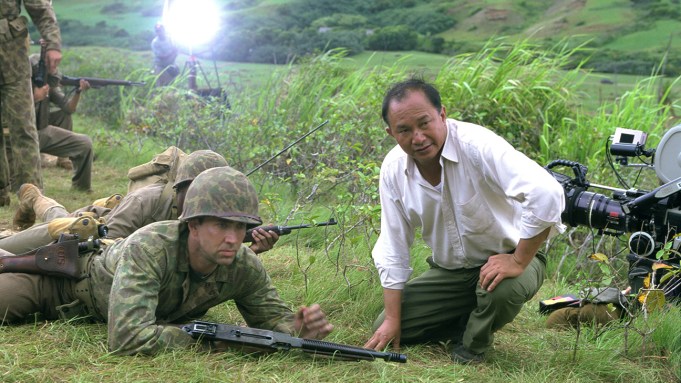
A master of the action set-piece, Woo recreated the battle of Saipan for Windtalkers on a private ranch on the island of Oahu, employing some 700 extras. The director admits the responsibility can be nerve-racking. “The thing I’m most nervous about is people getting hurt. There are so many explosions and so much gunfire. The stuntmen and also some of the camera crew are in a very dangerous zone, they’re very close to the explosions. The timing has to be just right. And, of course, I feel very protective of the actors.
“The movie was so expensive and our schedule was so tight that for every action shot, every setup, we only got one chance. We couldn’t afford to make any mistakes. Every setup was three to four minutes long. I shot a whole piece of story with multiple cameras, using moving cameras and handheld cameras.”
[Our discussion next turned to an unrealized project, Men of Destiny, a drama about the building of America’s railroads by Chinese and Irish immigrants in the 19th century.] “We’ve been scouting locations in Colorado, Utah, Sacramento,” Woo says. “We took an old train traveling alongside Durango, and I saw the snowy mountains and it was so beautiful! I was yelling, ‘Oh, I love America!’ It really opened my eyes, it’s really a beautiful country.”
As John Woo’s American career continues to expand in new directions, so does his influence: Directors like the Wachowskis, Ang Lee, and Robert Rodriguez all owe a tremendous debt to his stylistic innovations. “I feel pretty happy about it,” Woo says. “It makes me feel I have so many friends. The great thing is we share all these good things together. Actually, when I was young, I learned so much from the West. I learned so much from American movies and French films and Japanese films. And then I tried to combine that with my own vision and create my own style. And actually, we’re all learning from each other. And we’re all learning from the great old masters. It makes me feel we’re all in a big family.”
Pictured: Nicolas Cage and John Woo on the set of Windtalkers. Photo courtesy MGM. Windtalkers is available for streaming on Prime Video.
 Kevin Lally on Film
Leave a comment