The acclaimed British writer-director Terence Davies died today, October 7, at the age of 77, after a short illness. I met the soft-spoken but defiantly idiosyncratic artist in 1993, to discuss one of his most lauded films, The Long Day Closes. Davies went on to make seven more features: The Neon Bible, based on the novel by John Kennedy Toole; The House of Mirth, the Edith Wharton adaptation starring Gillian Anderson; Of Time and the City, a documentary about his native Liverpool; The Deep Blue Sea, the Terence Rattigan adaptation starring Rachel Weisz and Tom Hiddleston; Sunset Song, a lush drama set in Scotland in the early 1900s; A Quiet Passion, starring a remarkable Cynthia Nixon as Emily Dickinson; and Benediction, the story of poet Siegfried Sassoon. His final words in this interview are especially poignant today.
“I love the poetry of the ordinary—it reveals so much more about people.”
Writer-director Terence Davies’s films may be swept up in the mundane details of British working-class lives, but there’s nothing ordinary about them. The 47-year-old Liverpool native first gained festival-circuit attention with his trilogy of stark, autobiographical 16mm films: Children (1976), Madonna and Child (1980), and Death and Transfiguration (1983). Worldwide acclaim—including the 1988 Cannes Film Festival International Critics Prize —followed with his first color feature, Distant Voices, Still Lives, a boldly stylized, mysterious, and powerful memoir of his abusive father, valiant mother, and haunted elder siblings. Now, Davies returns to more directly autobiographical territory with The Long Day Closes, an evocative portrait of his own brief period of peace and discovery as an 11-year-old in 1950s Liverpool.
Davies’s films are daring in their rejection of conventional narrative structure, their impressionistic approach to time and space, and their purely cinematic union of imagery, music, camera movement, and cutting. They’re also extremely personal: Davies is unconcerned that the pattern of sunlight moving across a carpet might not touch the same chords in his audience as it does in him.
“I made them for myself, with the most modest of intentions and the most modest of budgets,” the genial filmmaker admits during a recent visit to New York. “I needed to make them, you see—I just did. It came as an enormous shock and surprise—a very nice surprise—that people began to like them and to say that they were art. When I showed the trilogy, which was my apprentice work and took ten years to make, three people and a dog turned up. There were tiny audiences. Those people who loved it really loved it, but what I found was that people really liked my work or they absolutely detested it.
“When I write, I see it visually. I know where the camera is, I know what the shot is, I know the look of the shot and what’s going on on the soundtrack—I see it complete. Some sequences come fully formed, others I have to work hard at. I can’t write anything unless I see all those elements, because it seems to me what cinema does that no other art form has ever achieved is to make something which is completely false seem utterly real… It also has this ability of letting an audience respond to it with their collective consciousness whilst always feeling that individually the truth is only being told to them. And that’s incredibly powerful.”
Davies defends his often elliptical style as a logical outgrowth of his interest in the workings of memory. “If you can tell a linear narrative—this happens, that happens, the end—that’s fine, there’s nothing wrong with that. But if you’re dealing with something like memory…memory isn’t chronological, it is cyclical. And it moves within its own parameters, because you’ve got all the background to any given memory. The difficulty is, when you translate that to film, you’ve got to give the audience enough of a background to feel as if they’re sharing the background and the memory at one and the same time.”
Dealing with his 11-year-old alter ego in The Long Day Closes required a somewhat different approach than the fragmented family portrait of Distant Voices, Still Lives, Davies says. “A child’s relationship to time is completely different to that of an adult—you move on an emotional plane, from one emotional state to another, and things which are in themselves completely unimportant take on enormous importance… People who don’t like my work say: ‘There’s no mention of the Hungarian uprising of 1956.” And I say: When I was 11, I didn’t even know where Hungary was. I knew there was this uprising, but that’s all. It was exactly like when the members of the Manchester United football team were killed in an air crash over Munich in the 1950s—we had to pray for them, but try as I might, I did not feel it had anything to do with me. I was sorry they were killed, but I hated football. I thought it was boring, and I still do. It was of much more interest to me if I was able to sit on the stairs and listen to my mother sing and watch her make rice pudding. That seemed to me of the most extraordinary importance, and I couldn’t tell you why—that was my subjective response to the world. And what I was trying to do in the film was recreate what it was like to be a child, of simply exploring the world, discovering the world every day and thinking: Isn’t it magic? It doesn’t matter about the story in a way, as long as you feel the magic of what it was like,”
Part of the magic of The Long Day Closes is supplied by production designer Christopher Hobbs (Caravaggio) and his uncanny reconstruction of Davies’s childhood street on a London soundstage. The film’s look is further enhanced by cinematographer Michael Coulter, who has continued Davies’s experiments with desaturated color, first used in Distant Voices, Still Lives.
“I wanted the look of The Long Day Closes to be slightly different,” Davies notes. “We used the same bleach-bypass process, but we also tried to recreate some photographs that were taken at the end of the ’50s in Manchester in northwest England, before the Clean Air Act, when people burned coal and there was a lot of soot in the air. A lot of [the photos] are backlit, so you get the sun filtered through this air which is full of particles, and it makes it look fabulous. So it was a combination of that, bleach-bypass, and trying to recreate parts of the old three-strip Technicolor and the look of Rembrandt.”
The Long Day Closes follows the Davies character (sensitively played by newcomer Leigh McCormack) as he deals with his first erotic yearnings, copes with the oppressive environment of his new school, and falls under the spell of the local cinema. As the boy gazes at the screen, we hear audio excerpts from film classics like Great Expectations and The Magnificent Ambersons that capture the director’s own fascination with the passage of time. Davies enthusiastically recites the Orson Welles narration from Ambersons: “‘In those days, they had time for everything—time for sleigh rides and balls and cotillions and open house on New Year’s.’ I weep every time I see that film and I hear that line. It’s so unutterably perfect. Because what it’s saying is: ‘…and we’ve lost it. It’s gone. And once we had it.’ It’s so beautiful. I know The Magnificent Ambersons is about moneyed people, but it’s the sort of thing people do remember—that they once went and had a wonderful time at a ball, or going down a little street in the ’50s in the middle of Liverpool and having a few drinks. That moves me more than I can say, because that’s what people truly enjoy. You don’t really remember the huge things, you remember tiny things. How many of us ever see a car chase or a gun battle?”
Davies grew up the youngest of ten children, three of whom died in infancy, in a Catholic household dominated by a brooding, brutal father. He vowed to become an actor after seeing The Robe in 1954. “Jay Robinson played Caligula, and I thought he was fabulous—he had all the best lines, and he was as camp as a row of tents. I remembered all his dialogue, and I thought that’s what I want to be—an actor.” Toiling by day as an accountant, Davies starred in local theatrical productions for some 12 years. “I look back on those years very fondly. I was a very good Vanya, a very good George in Who’s Afraid of Virginia Woolf?. I was a terrible Richard II, in a pair of tights with the crotch hanging between my knees. I learned a lot.’
In 1973, Davies entered Coventry Drama School and wrote the screenplay for his first short film, Children. “When I looked through a lens for the first time, I thought: This is it, this is what I was put on this earth to do, even if I do it badly. Once that happened, I just didn’t want to act anymore.”
Davies is appreciative of the funding sources in Britain that have allowed him to make his striking but unorthodox film portraits. “Without the British Film Institute and Channel Four, I would not have a career, and that’s the truth. I will be enormously grateful to those two institutions. They’re virtually the only sources of independent finance—the BBC is a bit more complicated. But you can’t go on making films with money from those institutions, because if you do, you’re taking it away from other young filmmakers who are coming up. It puts you in a peculiar position: Do you stay in England and make more films about England, or do you try to move to a broader canvas? I’ve given it a great deal of thought, and I want to move to a broader canvas, I don’t want to do any more autobiographical stuff. And it looks as though I may be able to. There may be two films shot in this country with English and French money, perhaps English and American money. That would be nice, because it would then prove whether I can make proper films, as opposed to these little essays in self-indulgence.”
Davies admits that, despite his growing stature as an international filmmaker, the little boy in The Long Day Closes is still very much alive inside him. “I think that’s in all of us, really. The past is so vivid. As soon as you smell something or remember something, it’s back in an instant… It’s not the past for me—the past is the present. What’s much more terrifying is the future. I’m terrified of change, and I will resist it with my entire being. But, of course, it’s a fight that you will always lose.”
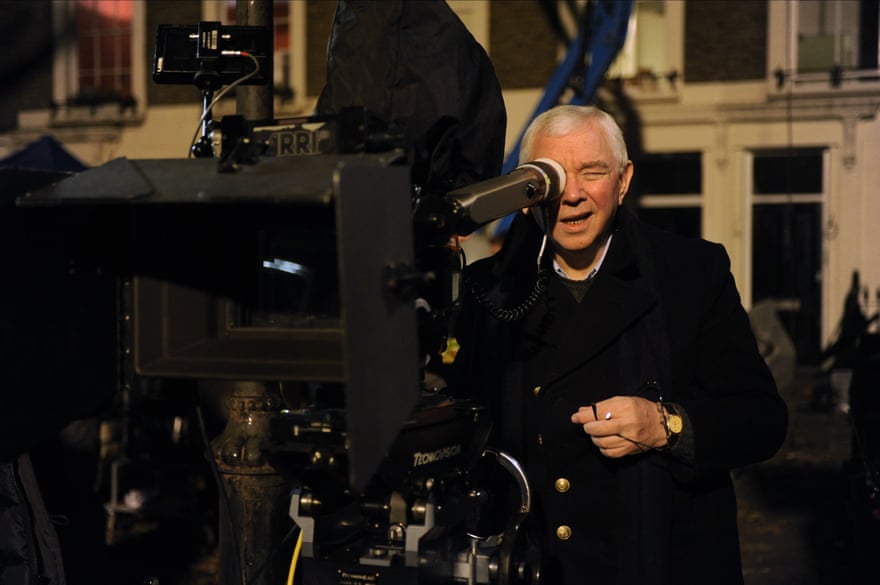
Photo copyright Film4/Allstar. The Long Day Closes is available to stream on The Criterion Channel.
 Kevin Lally on Film
Leave a comment