Every September I contract a severe case of Fear Of Missing Out, as word filters in from the Venice, Telluride and Toronto film festivals. Fortunately, my hometown New York Film Festival nabs many of the buzzy titles from those fests, so my FOMO is short-lived.
The 2023 NYFF would have been a starry one if not for the ongoing actors’ strike. Among those missing from the red carpets: Emma Stone, Natalie Portman, Julianne Moore, Juliette Binoche, Mark Ruffalo, Willem Dafoe, Andrew Scott, Saoirse Ronan, Paul Mescal, Carey Mulligan, Ethan Hawke, and Pedro Pascal. Even Bradley Cooper bypassed the press line, despite his role as co-writer and director (and star) of the Leonard Bernstein biopic Maestro.
Still, the press screenings have been very well attended, giving many New York critics their first chance to catch award contenders like Maestro, Poor Things, May December, Priscilla, Ferrari, All of Us Strangers, Cannes Palme d’Or winner Anatomy of a Fall, and Cannes Grand Prix winner The Zone of Interest.
As of today, October 3rd, I’ve seen 20 of the festival selections. Here are some personal highlights.
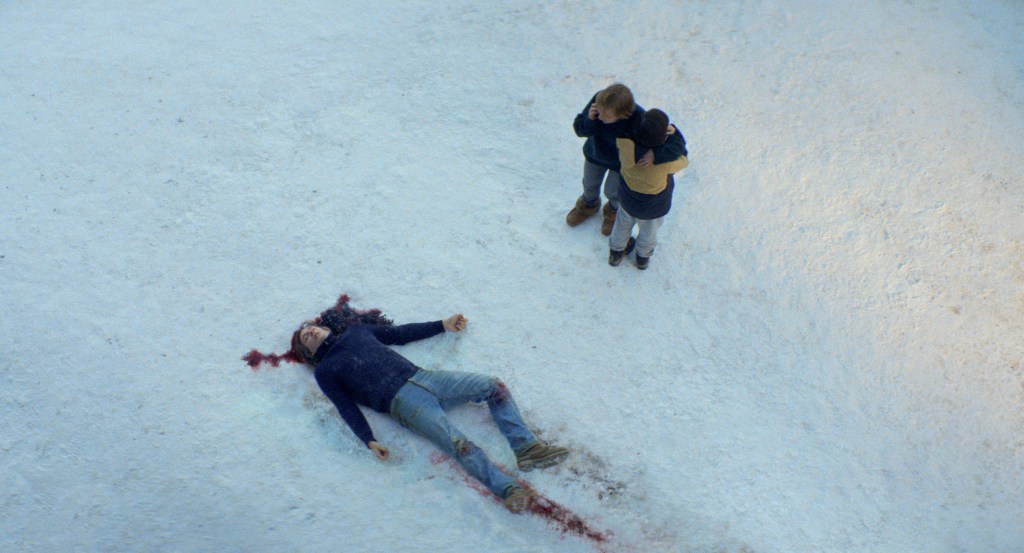
Justine Triet’s Anatomy of a Fall is just what its title says, but so much more. The literal fall referred to is a fatal one; the victim who plummets from an attic window in the French Alps is the husband of a famous novelist who sometimes writes about grisly themes. Was it an accident? Suicide? Or murder? The seemingly shellshocked wife is indicted and put on trial, which reveals layer upon complex layer about her troubled marriage. Germany’s Sandra Hüller (who performs primarily in French and English here) is sensational as the headstrong author fighting for her reputation and future. In interviews, Hüller says the director never told her whether her character was innocent or guilty. I have my own opinion, but this gripping drama remains boldly open-ended.

Hüller, who’s having quite the year, also stars in the Cannes runner-up, The Zone of Interest. Based on the novel by Martin Amis, director Jonathan Glazer’s film (unlike the book) specifically names the man at the center of the story: Rudolf Höss, the commandant of the Auschwitz concentration camp. What makes this a singular Holocaust film is that it’s told almost entirely from the point of view of Höss and his family’s pastoral domestic life in their house next door to the camp. The horrors of Höss’s handiwork are conveyed mainly by occasional screams, shouts and gunshots on the soundtrack, and a few shots of smokestacks; the audience is left to complete the picture in their mind. As Höss’s wife Hedwig—proud to be known as “the queen of Auschwitz”—Hüller is again exceptional; so is Christian Friedel as Höss. Both define the phrase “banality of evil” with their amoral placidity. Glazer’s clinical style throughout evokes Stanley Kubrick at his chilliest.
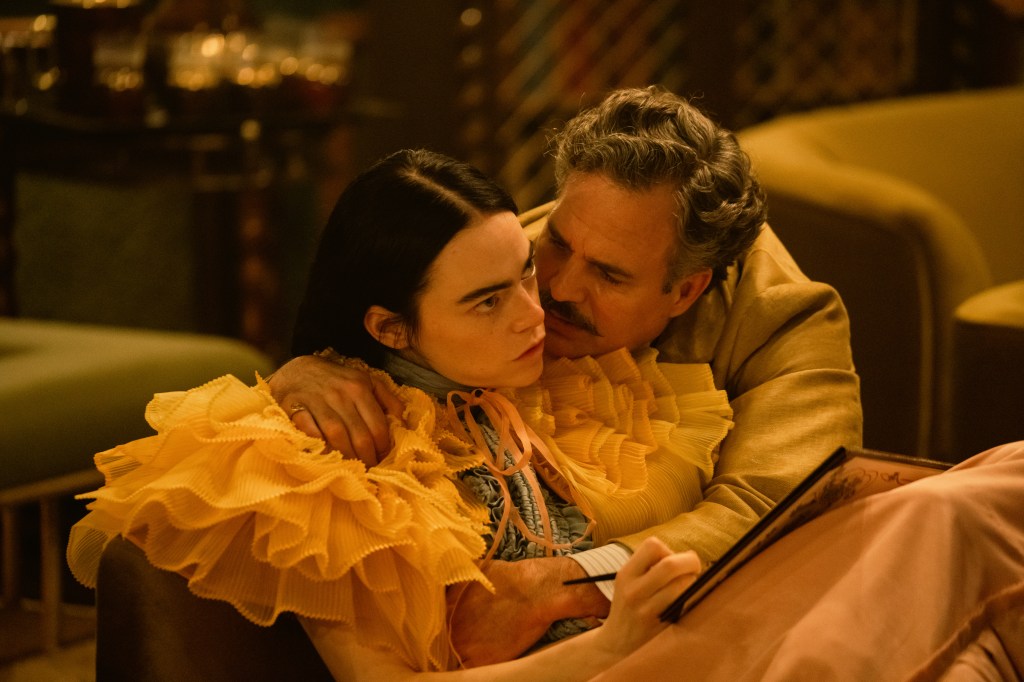
For something completely baroque—and bonkers—there’s Yorgos Lanthimos’s Poor Things, adapted from the 1992 novel by Alasdair Gray. A wild variation on the Frankenstein myth, it features Willem Dafoe as a deranged Victorian scientist who conducts a fiendish experiment, rejuvenating the body of a pregnant young woman who’s committed suicide by planting her live infant’s brain inside her skull. Emma Stone surpasses herself with a fully committed performance as this curious specimen who at first has all the unbridled impulses of a toddler but very gradually claims her own personhood. Early on she’s seduced by an egotistical cad played hilariously by Mark Ruffalo, and then moves on to a series of ribald, Candide-like adventures. The spectacular production design by Shona Heath and James Heath is truly out of this world, as Lanthimos proves himself one of modern cinema’s most outlandish and uninhibited visual stylists.
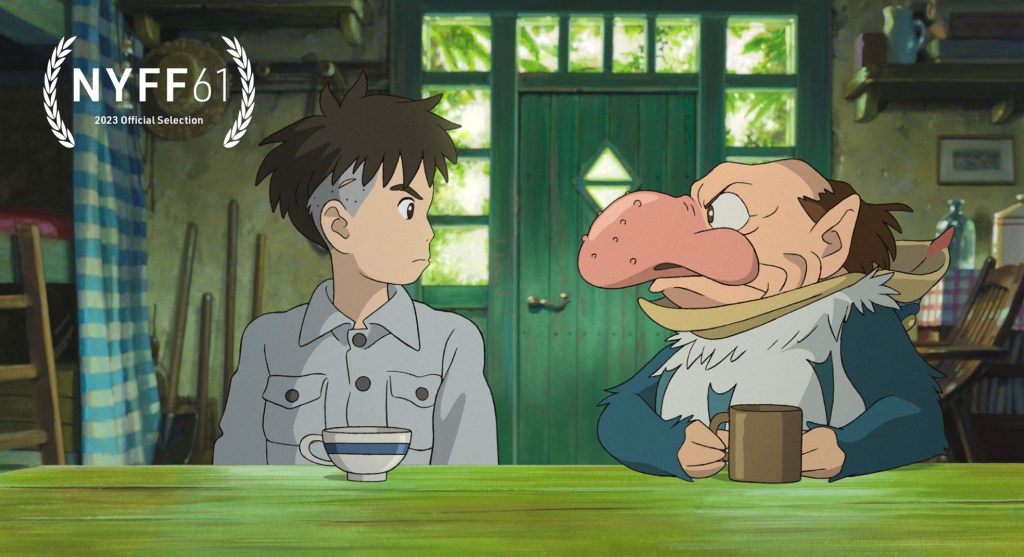
Speaking of visual stylists, it’s a pleasure to welcome a new animated feature from Japanese master Hayao Miyazaki, his first in ten years. The Boy and the Heron begins fairly straightforwardly, as young hero Mahito loses his mother to a hospital firebombing during World War II. The boy later moves from Tokyo to the country and learns that his father is going to marry his pregnant aunt. The first sign of the supernatural weirdness to come is the heron that pursues the boy; the bird is actually a demon with a human head grotesquely tucked inside its beak. The aunt disappears, and the boy enters a strange netherworld where giant parakeets hunt humans, and cute little blob creatures represent souls being born (that is, when they’re not eaten by pelicans). A second viewing is needed to decipher the symbolism in this tale of grief and rebirth, but the images sure are amazing.
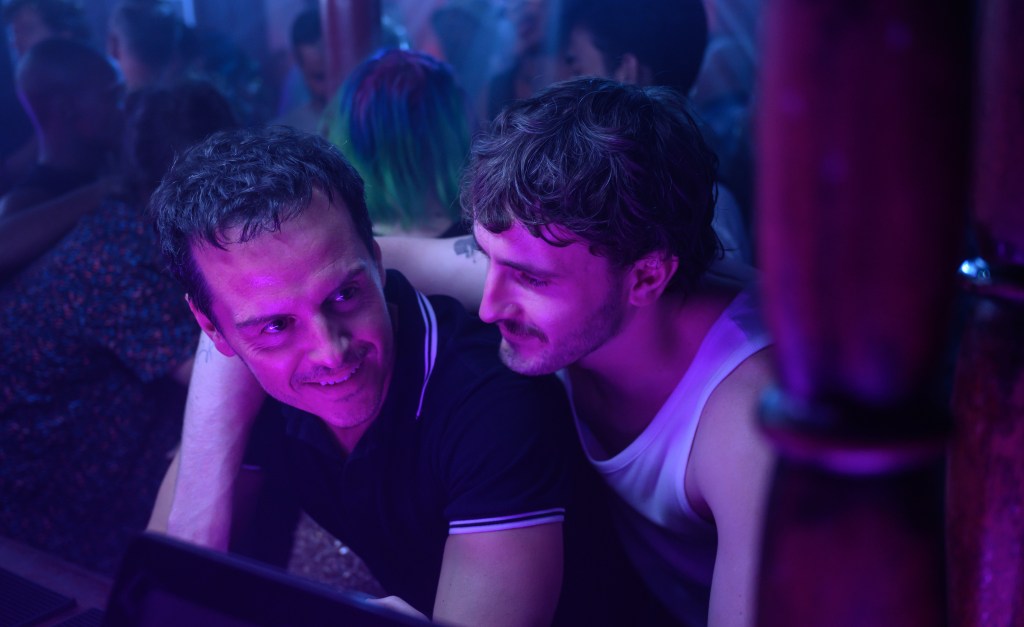
The supernatural is also a strong element in Andrew Haigh’s All of Us Strangers, a British drama actually adapted from a Japanese novel. It’s the eerie story of gay writer Adam (Andrew Scott), who lives in a newly opened London apartment complex where the only other resident seems to be another lonely gay man named Harry. Researching a script, Adam returns to his childhood home, where he mystically encounters his parents who died in a car accident when he was 12. The fact that they’ve remained the same and he’s now a middle-aged man doesn’t faze either parent; his mother is more unsettled by the news that her son is homosexual. Eventually, Adam hooks up with Harry, but his idyllic new romance and his reunion with his late mom and dad are both destined to be short-lived. Delicate and literally haunting, the film is beautifully acted by all four principals, Scott and Paul Mescal as the lovers, and Claire Foy and Jamie Bell as Andrew’s spectral parents.

Perhaps the most unconventional romance in the festival happens in Fallen Leaves, veteran Finnish director Aki Kaurismaki’s new film. Holappa is an alcoholic who loses his construction job due to his drinking and short temper; Ansa is a supermarket clerk who is let go for giving expired food to the needy. The two connect at a karaoke bar, but Holappa loses Ansa’s phone number—and doesn’t know her name. That’s just the first of the many obstacles to their budding relationship. Fallen Leaves boasts Kaurismaki’s trademark dry and droll humor, his casting of memorable faces, and his spare but handsome compositions. It’s a low-key but irresistible gem.
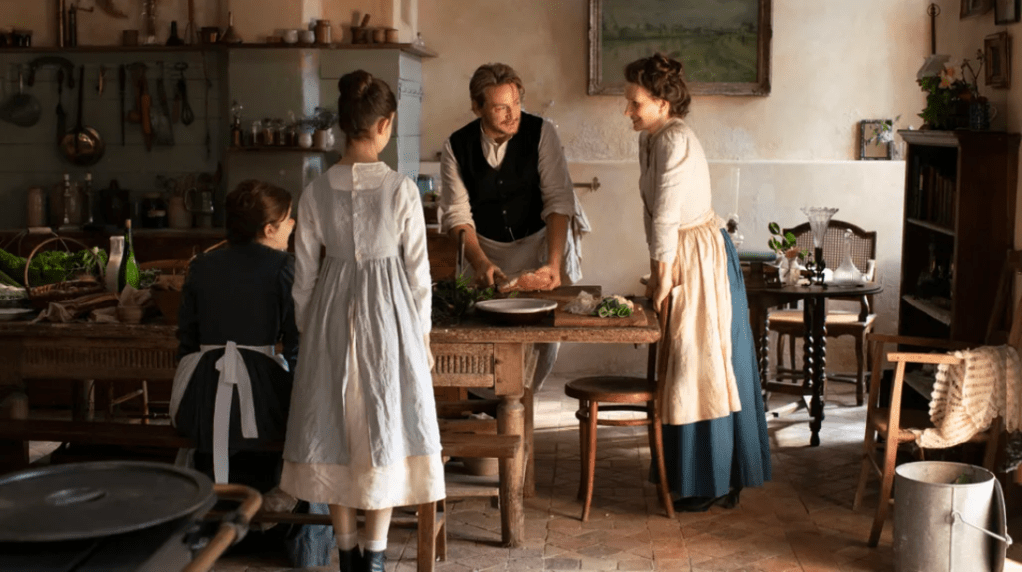
More romance can be found in The Taste of Things, which instantly takes its place among the great foodie movies. Set in the late 1800s in rural France, director Trân Anh Hùng’s film depicts the (fictional) life of celebrated chef Dodin Bouffant (Benoît Magimel) and his invaluable chief cook, Eugénie (Juliette Binoche). The first 15 minutes or so consists entirely of the meticulous preparation of a sumptuous meal for Dodin’s guests and benefactors. In fact, I’d estimate about 50 percent of the movie is devoted to documentary-like glimpses of the art of cooking. What plot there is concerns Dodin’s campaign to persuade Eugénie to marry him, the discovery of a brilliant young apprentice, and a mysterious illness that befalls Eugénie. The film moves at a deliberate pace, but former real-life couple Binoche and Magimel have wonderful chemistry, and you’ll salivate with envy over the incredible dishes prepared the old-school way onscreen.
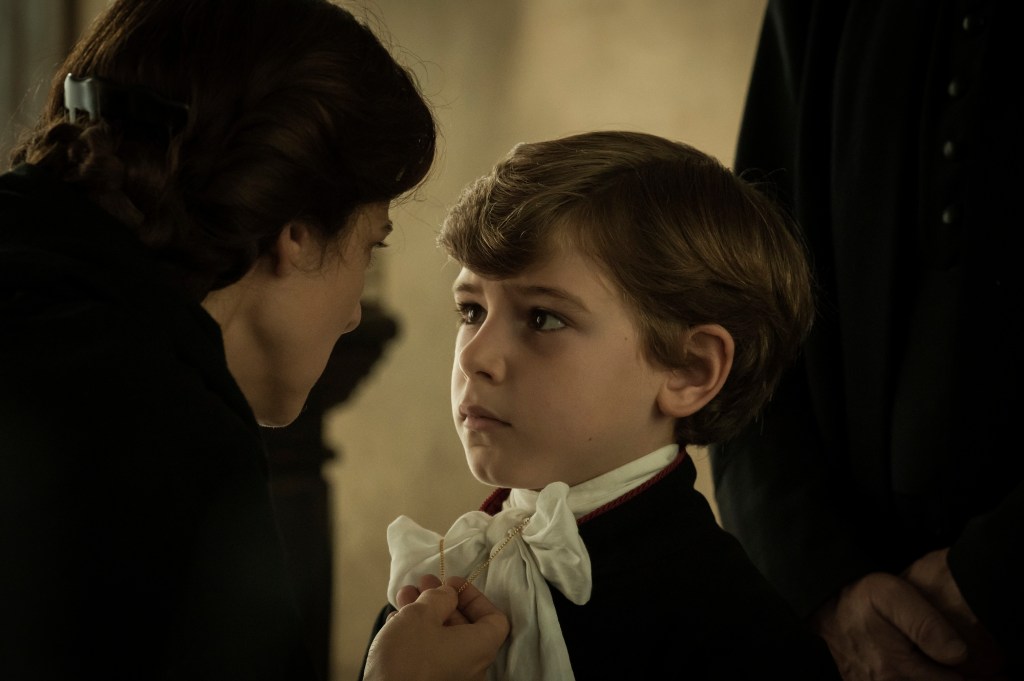
Remaining in the 19th century, you’ll be shocked by the true story that’s recounted in director Marco Bellocchio’s Kidnapped. In 1858 Bologna, a six-year-old boy is taken from his large Jewish family by Pope Pius IX when he learns that the child was baptized as an infant by the family’s devout Christian nurse. The powerful papacy simply won’t accept the notion that the boy can be raised as Jewish even after a makeshift baptism. Remarkably, the Mortara family’s fight to retrieve the son continues for decades of political turmoil in Italy, and the evolution of young Edgardo is unexpectedly disturbing. Bellocchio, now 83, made his first feature in 1965 and is still going strong with politically committed dramas.
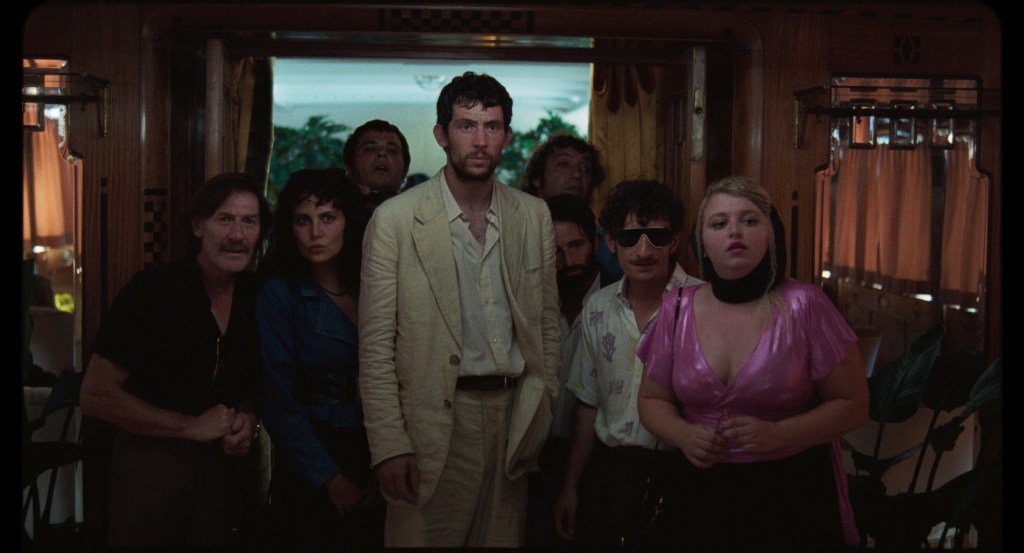
1980s Italy is the setting of La Chimera, the new film from director Alice Rohrwacher (Happy as Lazzaro). Josh O’Connor (Prince Charles on Netflix’s “The Crown”) gets to show off his Italian as Arthur, a Brit who returns to a rural Tuscan community where the locals take advantage of his rare talent—the ability to scope out ancient tombs holding rare Etruscan treasures. Arthur is haunted by the memory of his late lover Beniamina, and reunites with her sickly but still vibrant mother, Flora (a charming Isabella Rossellini). Arthur also strikes up a friendship with Flora’s scatterbrained housekeeper Italia (Carol Duarte), who accepts no pay in exchange for singing lessons, even though she’s tone-deaf. Ultimately, Arthur makes a major find that brings a dark, dark outcome. But until that turn of events, La Chimera seduces with its local color and motley collection of tomb raiders.

Rising star Glen Powell (Top Gun: Maverick) has made a very smart career move, creating a custom showcase for his comedic and leading-man talents. He’s the star and co-writer (with director Richard Linklater) of Hit Man, a comedy-thriller that’s one of the fest’s most purely entertaining films. Powell plays philosophy professor Gary Johnson (a real person, though the film takes wild liberties with his story), who moonlights as a tech guru for the New Orleans Police Department. When he’s called upon as a last-minute substitute in a sting operation, forced to pose as a hit man for hire, it turns out he’s very good at the ruse. The hit man gig becomes a creative outlet for Gary, whose alter ego Ron is as brash and confident as Gary is nerdy. All’s good until a sultry woman (Adria Arjona) looking to put a hit on her abusive husband enters his life. The plot thickens messily, and let’s just say the old Production Code would never approve of its resolution.
I was mixed on the festival’s opening-night film, director Todd Haynes’s May December. Samy Burch’s screenplay is inspired by the notorious case of Mary Kay Letourneau, who was convicted for her liaison with a 12-year-old boy. In Burch’s variation, that seventh-grader is now a 36-year-old husband and father of three children with the much older Gracie (Julianne Moore). Natalie Portman is Elizabeth, a TV star who’s set to play Gracie in a film and has come to Savannah, Georgia, to spend “research” time with the family. Burch’s screenplay reveals each main character’s complicated messiness—the story is certainly intriguing, but Burch and Haynes have trouble settling on tone. The film wavers between campy satire (especially of Elizabeth’s phony attempts at empathy when this juicy role is actually her top priority) and serious psychological study. Haynes also adapts a musical theme Michel Legrand wrote for the 1971 drama The Go-Between; those pounding notes lend the film an ominous grandiosity that’s out of proportion with the story.
More festival highlights to come…
Top photo: Anatomy of a Fall. Photos courtesy of Film at Lincoln Center.
 Kevin Lally on Film
Leave a comment