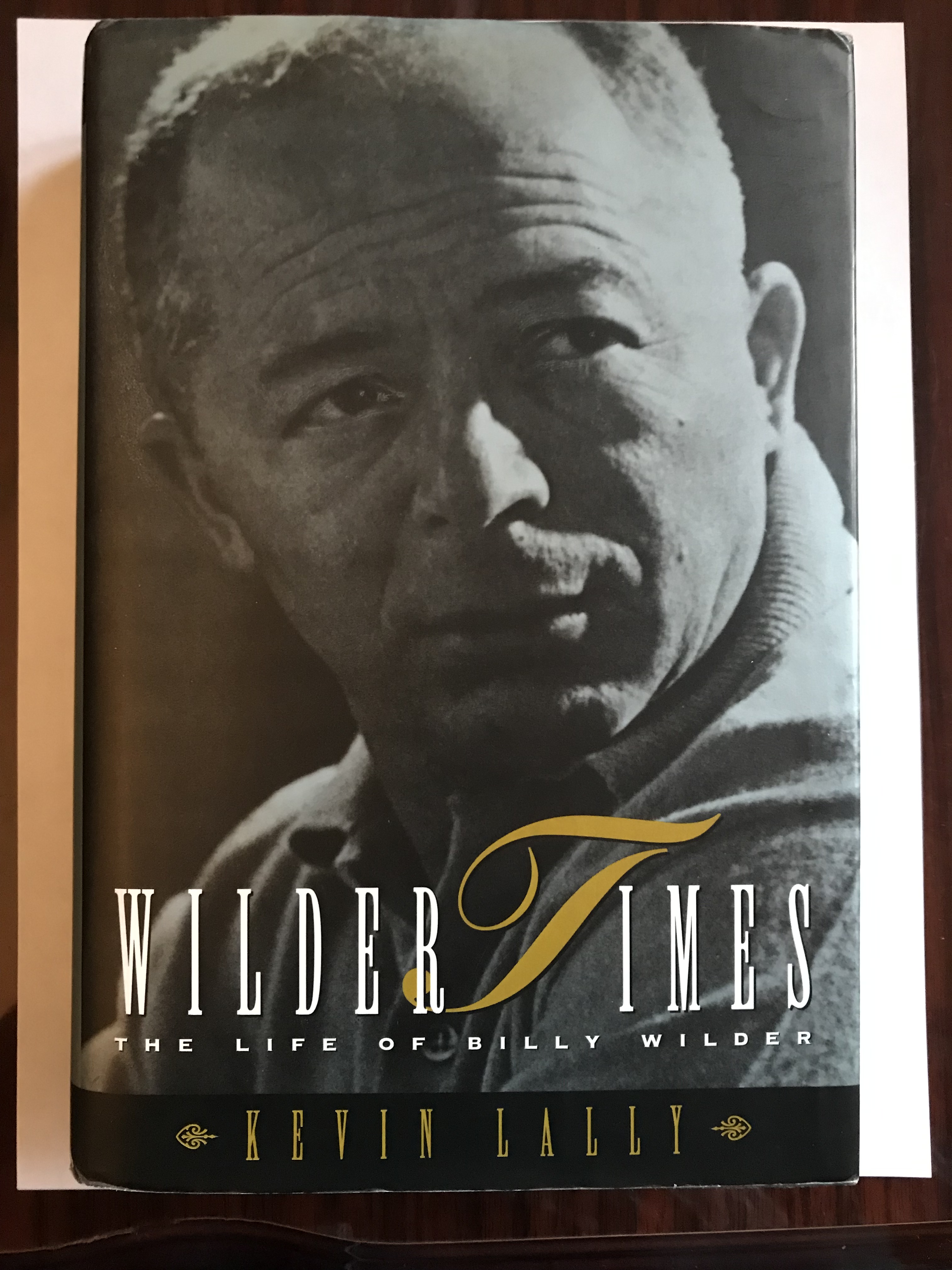

For my second interview session with Billy Wilder on March 4, 1994, at his office in Beverly Hills, the legendary writer-director allowed me 45 minutes—and served as my personal countdown clock. In our wide-ranging conversation, we talked about his relatives in Vienna, his early days in Hollywood, his reasons for becoming a director, his high regard for The Apartment and Ace in the Hole, and his regrets about his late masterwork, The Private Life of Sherlock Holmes.
I’m curious about that period when you first arrived in Hollywood and went to work for Columbia Pictures. How was your English at that point?
Very bad. Very poor. I was working with a translator, an American who also spoke German. It never got beyond a draft of a screenplay, with no final dialogue or anything like that. It did not work anyway—even if it were in perfect English, they did not like the product. They liked the original story [for a film called Pam-Pam], but they didn’t like what I did with it, and it’s forgotten, I hope never to be brought out again and made into a picture, because it would be very naive today.
What was the name of the translator you were working with?
It’s difficult for me to remember. He must be dead by now, because he was considerably older than I am, and I’m already 87. I forget the name. I had a friend who was a Viennese who helped me also with my English—his name was Reginald Le Borg, who died about three or four years ago. He was a director of smaller pictures.
There were a lot of great writers there at Columbia when you arrived. There was Dorothy Parker…
I was working at home, in my apartment. There were a lot more writers at Paramount, MGM, Warners. But Columbia had very few writers—they made fewer pictures. They made the obligatory one or two Capra pictures and some westerns, but it was not what Columbia is today. It was not a 50-pictures-a-year outfit. I remember that all very vaguely—all of that happened in 1934.
Did you get to know people like James Cain?
James Cain I met much later. He was not working there.
Hmmm. The Zolotow book says he was there.
The writers there were Robert Riskin, who worked with Capra. There was a guy called Jo Swerling. Robert Riskin, I’m sure was under contract. But many other big names were hired just for certain projects. While at Paramount, every writer had to deliver 11 pages on yellow paper every Thursday. Those were the days when you still had to work all week long, including Saturday—but at noon, you were through and you could get in your car and go and see a football game or something.
I’m also curious about that period when you were living with Peter Lorre at the Chateau Marmont.
That was a short period when we put our money together to rent a room and buy a can of Campbell’s soup or something. We were friends—later on a little bit less, when I found out he was a dope addict. But we never worked together.
How long were you roommates?
I would say a couple of months.
What was he like as a roommate?
Very nice. His name was Loewenstein. Hungarian descent. He was a very nice, funny guy. I liked him. He was an intelligent man.
Would you mind if I ask you a few questions about your very early years, your youth?
Sure. Just don’t waste time.
You’re so celebrated for your wit. Were either of your parents very witty?
No. My father was in the restaurant business—I think he started as a young waiter. He had nothing to do with literature, with music—he did not play an instrument, he did not read novels. He read newspapers, he was aware as to what was happening. The same thing with my mother. Her family was also restaurant people. There was an aunt who had a little library, who would talk to me about the German writers, who made me familiar with Zola, Dumas, made me read Thomas Mann. An uncle of mine who was an engineer in the army in the First World War, he also was interested in music—he was an opera lover. But that’s about all the connection my family had with the seven arts. That includes my brother.
Did any of them have a great sense of humor that you can recall?
I guess so. My uncle and my father, they said some funny things. I don’t know whether you can print them. I remember a few little sayings of his. I was about ten or twelve years old, and my father came out of the bathroom of our apartment in Vienna and he had forgotten to close his fly. I pointed it out to him, and he said, “According to regulations, when there is a corpse, the window must be open.” This is the kind of joke he would tell. But nobody, when I was young, ever dreamt that there was going to be somebody who would end up in the theatre or film, or become a novelist or actor—that was a different world. But I got out of that by the time I finished high school.
You did a lot of traveling around from place to place as a child.
Yeah, my father had railroad restaurants, coffee houses. That was his business. I grew up standing on chairs and playing billiards against the grownups and making a few kronen for myself.
Did you enjoy that itinerant way of life, or did you wish you could stay in one place for a while?
No, I was a good traveler, always something new, always some sucker who did not know how to play billiards, that I got to take for a few kronen. Or sometimes, I even stole some of the tips left over for the waiters.
Let me skip ahead to when you first started directing at Paramount. On the first film, The Major and the Minor, how close an eye did Paramount keep on you?
There was a producer, Mr. Arthur Hornblow, Jr., and he was the guy who gave me the chance. My collaborator [Charles] Brackett was pushing and pushing and pushing. I was a pest then, because I would go on the set and see how a director screwed up a scene, did not even know what the scene was about. I did not become a director because I loved being with actors and polishing scenes and giving them ideas—no, I would have been a very happy writer. But the directors—some of them were very good, but some others just missed the point. Somebody asked me once, “Is it important for a director to know how to write?” I said, “No, but it helps if he knows how to read.” So that was one of the reasons why…
I was the number‑two writer who became a director; the number-one writer, time-wise, was Preston Sturges—a very fine writer, naturally. He succeeded, and so they decided to give me a chance. But in those days, you know, we made 50 pictures. The pictures that I made in the beginning, they were never over a million dollars. The most expensive picture I made was something like two and a half million, for let us say a big picture like Sunset Blvd. Two and a half million was already enormous then, because, I have to remind you, the entire production including the release and the advertising of Gone with the Wind was five million dollars. Now they would spend five million dollars on advertising a big picture just in America.
What would you say was Mr. Brackett’s biggest contribution to your partnership?
He had class, he was Ivy League, he was a member of the Algonquin Round Table, he was the drama critic for The New Yorker. He spoke excellent English, he was a very classy guy—a couple of pegs above the ordinary Hollywood writer. And he was very patient with me and he also insisted on my English being less ridiculous than it was then. So I went to a good school—it lifted my street English a few pegs. What was good about our collaboration was: Two collaborators who think exactly alike is a waste of time. Dialogue or whatever comes from: “Not quite, but you are close to it. Let’s find something that we both like. This is a little bit too cheap, this is too easy. This character is not developed. I am a Roosevelt man and you are a Republican.” Unless there are sparks that fly, it is totally unnecessary to have a collaborator.
I watched Arise, My Love again recently, and the dialogue between Claudette Colbert and Ray Milland is so eloquent.
Really? I haven’t seen that film in 40 years. I’m glad to hear that. Midnight was a good picture. There were some good pictures, some pictures that I liked that didn’t make it at all, and some other pictures that became big hits. I made a couple of pictures that have fewer mistakes. I think, for instance, and I’m very proud of it—I talked to a Russian screenwriter, and he told me: “You know, at the Russian academy for screenwriting, we worked a whole semester on the screenplay of The Apartment.” You can’t say it’s a comedy, you can’t say it’s an observation of life—I think it is, as a matter of fact, but we didn’t write for laughs, we wrote for the sentiment. It just so happens that some sequences came out as comedy routines. Some Like It Hot, that was written for comic effect, but The Apartment, no, The Apartment was a stylized film, a kind of mirror of careers in New York.
They ran it in East Berlin while the Wall was up, when I was there doing One, Two, Three, and they were tremendously excited about it, especially when—some Russians were there too—I told them: “A situation like The Apartment could happen anyplace. It happened in Mr. David Lean’s picture Brief Encounter. It could happen in Brussels, in Buenos Aires, in Bucharest, it could happen anyplace—except it could never happen in Moscow.” Oh, I got big applause. Then I said: “Let me tell you why it could not happen. Because nobody’s got his own apartment. You would have to throw out six families.”
That’s a film where you really walked a tightrope between comedy and pathos.
But that’s the way life is, you know. Not everything is funny.
As you were filming it, were you confident that was going to work?
Yeah. I was very confident. I thought it was going to be a very, very good one. Other pictures that I shoot, I’m about one‑third through and I would say: “This is gonna lay an egg. It does not work, it does not play. I can’t do anything with it, I can’t lift it up…” But this was a picture I was very confident about, as I was about Some Like It Hot.
Going way back to The Lost Weekend, when you read the novel, what made you feel it was going to make a good picture?
To begin with, not only did I know it was going to make a good picture, I also knew that the guy who was going to play Don Birnam—Ray Milland, the drunk—was going to get the Academy Award. Because for the people who are watching pictures, if you are a cripple, if you stammer, if you are a hunchback, if you are an alcoholic, they think that this is acting. You cannot win an Academy Award when you play Cary Grant parts. Nothing is astonishing there, coming in and saying “Tennis, anyone?” But I knew that if I could go a little bit deeper, for the first time in pictures make an alcoholic who’s not a comedian, who doesn’t fall down and do stupid things. If I could dramatize it to the point where it’s a sickness, it’s like being an addict—like we say in the picture, “One drink is too many and a thousand are not enough.” I knew if I could draw the audience’s attention to the fact that this guy’s sick and he has to have it or he’s going to die in the gutter…
At the end of the picture, I didn’t have him cured or anything like that. He just says, “I’m trying not to drink.” And she says, “Yeah, you’re trying not to drink, like I’m trying not to love you.” And the last thing he does is throw his cigarette into a glass of scotch and soda—but it’s left questionable, will she succeed and get him off that stuff forever? One drink that he refuses is not going to make it. I talked to alcoholics, I went to AA, I talked to doctors, and it was pretty accurate—that was the first time you didn’t have the drunk [stumbling] upstairs at four in the morning, and the wife says, “My God, you have a brain operation today,” and he says, “I completely forgot,” and he puts on his hat and walks out of the apartment backwards. There’s nothing funny about a drunk.
Was that the first time you had to fight to make a picture you believed in?
No, but I had to talk to them like I’m talking to you, about why I wanted to do it. But they had confidence in me, as time went on. It was not easy to do Sunset Blvd. You see, heads of studios, if they hear something very original, they say: “I don’t know whether this is going to work—I’ve never seen a similar picture.” I say, “I don’t want to make a similar picture—I would like to make an original picture.” And they say, “Well, God be with you.” What they like is Godfather II and III, a sequel or a remake of something that was successful, it gives them confidence. But if somebody comes with something very original, it takes, as Mr. Spielberg says himself, it takes the clout of a Spielberg to let him do Schindler’s List. No one else would have been given the $30 million or whatever it was to make it. He can do anything. A good man he is, and a wonderful picture it is.
There’s an element in the book The Lost Weekend of sexual confusion on the character’s part that’s not in the film. Did you ever consider putting that into the script?
No, no. I had that male nurse, he was a little bit of it but tried to hide it. Charles Jackson, who wrote it, was a bisexual. But, look, I had enough problems already making an alcoholic a sympathetic character. If on top of that, he also was a homosexual, and nowadays he might also have AIDS. One problem’s enough. Now we’ve got everything, right?
Did A Foreign Affair ever open in Germany?
Yes, big success. Stalag 17 opened, but not right away. I quit Paramount [over that]. I said I’m getting out of my contract. I was making a picture in Paris, something for United Artists called Love in the Afternoon, and I got a letter from the head of distribution saying, “We’ve got good news. The Germans are crazy about Stalag 17. They would like to release it, but we have to make one little change: The spy that is hiding among them is not a German, make him a Pole.” And I just said: “Fuck you, gentlemen. Haven’t you got any shame? You ask me, who lost his family in Auschwitz, to do a mistake like this? Unless somebody apologizes, forget about my contract. Goodbye, Paramount.” Nobody apologized, and I left Paramount. But it was the way it was in the American picture.
Did the German audiences like A Foreign Affair?
They loved it. It was not so anti-German; it was anti‑Nazi. The character of Dietrich was much smarter than a Nazi‑convinced female… It was a very good picture, I thought.
You’ll forgive me for jumping around so much, but I know my time is limited. During One, Two, Three, you had to relocate from Berlin to Munich.
Yeah, because they cut us off. The Wall went up. We were half‑finished with the shooting, and then one day the East German army was there and they shooed us away. So [Alexandre] Trauner, my art director, built part of the Brandenburg Gate in Munich—that’s how we finished it.
What a brilliant man he was.
Yeah, he was a very, very good art director. I was lucky I got him when he was still working on eight cylinders. It was maybe the fastest-spoken comedy I’ve seen. But it needed that kind of locomotion.
James Cagney retired after that film.
Then he made one appearance in that picture, but he was seated—he could not walk anymore. What was it?
Ragtime.
Ragtime. Correct. You know everything.
Do you feel at all responsible for Cagney’s retirement?
No, no. People say that we did not like each other. I was crazy about him. He was just a very opinionated man, very right-wing, not very talkative. He painted—still lifes, like you think he would have painted, like a conservative would paint. But whether you liked each other has nothing to do with how good is the performance. I’d do any goddamn thing. If he kicked me in the ass, I just wanted his performance. The same thing with Marilyn [Monroe]. It was worth going through hell, it was worth making 80 or 90 takes of the same thing, because when you did it and it was right, it was the best it could have been.
Some people just have a quality…
Absolutely. That just kind of pops off the… Working with Gary Cooper, when you watched me shooting it, it didn’t look like anything, but when you saw it on the screen in the rushes, there was an added something going on. Like Garbo, some kind of a love affair between the performer and the celluloid.
You worked with so many great, great people.
Who are you writing that book for?
Henry Holt.
Holt. That’s a good publisher
They have a little class, I think.
You’ll send me a copy?
Oh, of course. And I want to stress that the book is really more of an appreciation…
More about picture-making than my private life, which is very dull. It gets duller and duller every day.
Oh no! I want to talk a little about the later films.
Please. You have another 16 minutes.
When did you first hear from United Artists that they were going to cut The Private Life of Sherlock Holmes?
I knew the next day. We discussed how we were going to cut it and look at it, but I had to go to Europe and start shooting—I forget what picture it was—and I could not control it anymore. I was very unhappy about it, because it got to be too long. I didn’t quite catch the atmosphere, I did not quite get Sherlock Holmes. Robert Stephens was a very good actor, and Dr. Watson [Colin Blakely]—they were very good. I just…it did not have enough character and enough mystique and enough audience involvement in one case. I made three or four cases, like episodes…with one tremendous love affair that kills his—it’s a tragedy, either she dies or she betrays him, making him a bachelor for life. But I never quite found it. It’s not one of my best remembrances. The sets were going up and I was still fighting with the script. It was an abortion.
Really?
To me. I wish I could do it again. I would take a different slant on it. But look, God in his infinite wisdom makes idiots and geniuses, he makes athletes and cripples. You can’t do it, picture after picture after picture. Show me a man who never had a failure, and I will show you a man who never had a big hit… The daring directors—I wouldn’t call myself daring—but I get bored being in the same rut. I made up my mind that, unlike Hitchcock, whom I admire, I couldn’t work like Hitchcock because he made the same kind of picture every time. I told myself, “Now, I’m going to make a picture that’s better than Hitchcock,” and I did Witness for the Prosecution. Or, “I can make a better picture than—I don’t know—Capra.” I hop around like a chessman, with different evaluations, different prospects. I’m always ready to make a very funny picture, on a good, robust basis—nothing stylized or conceited or “false class.” But I like to make different sorts of pictures. Spielberg does the same thing—either he does the dinosaurs or he does the Nazis. He will find out that that’s the only way. It’s very difficult to copy or to parody a picture of mine, because you never quite know what you’re going to see.
But your personality, your personal stamp is still on every picture, I think.
I hope so. If somebody is a perceptive onlooker, he knows that this is a little Wilderism. But I applaud Mr. Spielberg for having made Schindler’s List without any tricks—maybe that girl in the red, but it’s so subtle. If a picture is good, it’s good. And it’s convincing no matter how you feel—even if you were born ten years after the war was over, you are drawn into it and you see the tragedy, you see it coming. There are more handkerchiefs at the end of that picture, more people not looking at each other because there are tears in their eyes.
Getting back to Holmes, did the studio do the cutting? You had nothing to do with that?
The next time I saw it, it was cut already. They just cut like they cut for television. It lost everything. I just didn’t have the energy. I felt guilty that I didn’t do a good job. So maybe they had some right to operate on the thing, but they didn’t operate—they just killed it altogether. I think it was one of my better-shot pictures—it was elegant. But I’m trying to forget and you bring it back.
I’m sorry.
On this sunny day in March.
There was talk a few years ago…
About a re-release. But nobody knows where the original version is! If they find it, I’d gladly sit with them and say this is what we can do better. I pray that they find it, but I don’t have it… Ten minutes! Somebody’s coming at three, that’s why.
I love Fedora…
That was another catastrophe. I wanted to have one actress play both parts. And we got the Keller girl [Marthe Keller], who’s not a very good actress—she’s Swiss. We were about two days before shooting and we did a test—we put a mask on her to make her old and she started crying. It turned out that she had been in an automobile accident and all the nerves were exposed. She was screaming with pain, so we could not use it. So we needed two actresses. Then I hoped to get Marlene Dietrich and Faye Dunaway—they look a little bit alike. But that did not work. So now we took Hildegarde Knef.
I don’t know. It’s just terrible. I feel like if I saw that picture in a crowd, as a person, I would not put my arms around it. I would say, “Hey, how are you? We had a good time, didn’t we?” I’m very much more proud to have done a picture that did not work—that was Ace in the Hole, that was a very good picture, with a strong, well‑worked-out [story]. But people did not want to know, they don’t want to be told that if there’s an accident on the street and somebody’s dying, before people go call for a doctor, they look at that tragedy with that curious morbidity. That’s what I had there—the circus upstairs, the songs, people getting drunk and having fun… I would say it was not an easily digestible subject—people were not running to the hors d’oeuvres to eat them, because they felt a little bit guilty.
I remember one of my best gags was given to me as a present from my wife…when [Kirk] Douglas says to Jan Sterling, “Aren’t you going to church? Aren’t you going to pray?” and she says, “I don’t go to church. Kneeling bags my nylons.”
That’s the line everyone remembers from that film.
But then again, who knew how many lines they were going to remember from Some Like It Hot? And certainly from Sunset Blvd. If I hear just once more, “Nobody’s perfect” or “I am big—it’s the pictures that got small” or “We had faces then”… It’s like the night when—let me think, what was the line?—I met Goldwyn and I told him, “I’m going tonight to see Hamlet with Olivier.” And he says, “Hamlet! That’s so full of quotations!”
I’m going to go way back now. Of all the films you wrote in Germany, which is your favorite?
My favorite, I don’t know. Believe me, the level was low. I was not working for Murnau. Lubitsch had gone already to America. We tended to be popular. There was a little picture I did that they have at the Museum of Modern Art called Emil and the Detectives—that I would say was mine. But not my most successful—my most successful were some of the pictures with Lillian Harvey and Willi Forst and Willi Fritsch. But one should not look at my early, early ones—they were done to order, they brought the subject and said let’s do that.
You’ve been working on various scripts for the past ten, twelve years. If someone gave you the financing tomorrow, is there any one you’d want to do?
There are two or three. I’m going through that process right now. But I had an art exhibit of things that I did. I don’t whether you… Do I have a catalogue here?
I have one.
It was a tremendous success.
I wish they had held it over two more weeks. I would have seen it then.
People are not art lovers. They don’t go to museums very much, and they don’t buy anything. So I couldn’t ask the guy who’s got the gallery to keep it another two weeks. The stuff was just fun. I just wanted to have that experience. I found that making a picture about a profession of which I know nothing, by studying up, by getting the details correct, I learn something. Every picture’s a new adventure, which makes my profession so much more interesting than being a mail carrier. I’d like to be a mail carrier one week, then a barber the next week, then a guy who holds up a bank another week—if you know what I mean. But if I had the same profession, it’s very dull, especially if it’s a dull profession. Newspaperman is a little bit closer. Of course, when I was a newspaperman, very young, I did not do any political or church news—whatever came my way, and without any profound exploration I had a little taste of everything… Now where’s that guy? It’s three o’clock, and at a quarter past three I have to leave.
Mr. Lemmon told me something interesting. He said he’d like to see you do another melodrama like Ace in the Hole or Double Indemnity.
This, by the way, is one of my best-known pictures, Double Indemnity. They think that it’s the best and maybe the first film noir. I would like to do that, but it’s not easy, it has to have a human element in it. That was the big tragedy of Agatha Christie—she plotted like a god, but there were no human beings, they were cardboard. That’s why we changed a lot of that in the picture [Witness for the Prosecution]. And she wrote me a letter and sent me a photograph saying it’s the only good picture ever made of any of her material.
Well, you added all the material between [Charles] Laughton and [Elsa] Lanchester.
Sure. Laughton and the nurse. The heart condition. Going up and down the stairs.
[A knock at the door.]
Come in. So you will remember to call me?
Yes indeed.
Four more phone interviews followed. Pictured: Billy Wilder directs Jack Lemmon and Shirley Maclaine in The Apartment.
 Kevin Lally on Film
Leave a comment