Every spring, Film at Lincoln Center’s “Open Roads” series brings proof that Italian cinema is alive and well. The 22nd edition, running June 1-8, presents 11 new Italian features, plus a three-film salute to director Mario Martone. The opening-night selection is Francesca Archibugi’s The Hummingbird, adapted from the decades-spanning, Strega Prize-winning novel by Sandro Veronisi and boasting an ensemble cast including Laura Morante, Pierfrancesco Favino, Bérénice Bejo, and Nanni Moretti.
I had the good fortune to catch two of the “Open Roads” selections in preview screenings. Roberto Andò’s Strangeness features major Italian star Toni Servillo as Nobel Prize-winning playwright Luigi Pirandello. The conceit is that on a trip to his native Sicily in 1920, the great dramatist encounters two gravediggers who also happen to run an amateur theater troupe. When a fight breaks out at the premiere of their new play—spurred by a powerful town leader who’s insulted by his thinly disguised portrayal onstage—Pirandello is inspired to write his groundbreaking, fourth-wall-breaking play Six Characters in Search of an Author. Or so the filmmakers would have you believe.
Strangeness was nominated for 14 David di Donatello awards including best film, and won for its screenplay, production design, and costume design. A popular comedy duo in Italy, Salvatore Ficarra and Valentino Picone, play the gravedigger/actors, and I was frankly baffled by their comic patter in the film—a series of non-sequiturs that surely lost something in translation but has the 1920 audience in stitches. The high point of the film by far is its 20-minute recreation of the Rome premiere of Six Characters, an event that had half the audience cheering and the other half booing and calling Pirandello a fraud. At the least, the movie makes me want to bone up on my Pirandello.
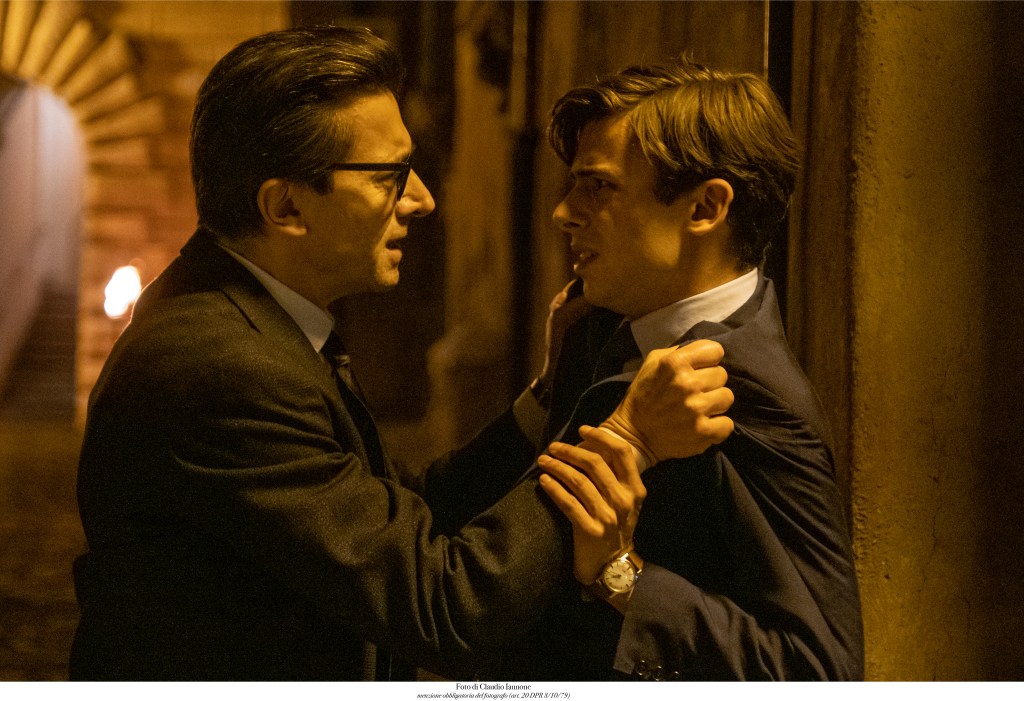
My other “Open Roads” screening was an eye-opener. Lord of the Ants, the 15th feature from director Gianni Amelio (Open Doors, Lamerica), tells the shocking true story of Aldo Braibanti (Luigi Lo Cascio), a poet, philosopher, theater instructor, and naturalist specializing in the study of ant colonies, who is arrested in 1965 for corrupting one of his male former students, with whom he shares an apartment in Rome. Young Ettore (not his real name), whose fictionalized religious family includes an older brother who clashed with Aldo as a student, is taken away and given electroshock therapy. Braibanti, meanwhile, is imprisoned and put on trial for the crime of plagio, or psychological brainwashing.
The Italian lawyers and judge can’t even utter the dreaded word “homosexuality.” Neither can L’Unita, the Communist daily newspaper that champions Braibanti’s cause solely because of his anti-Fascist activism but certainly not his sexuality. A major character here is dogged L’Unita reporter Ennio (Elio Germano), whose own sexuality is never stated.
The courtroom sequences, in which Braibanti at first refuses to participate in a sham trial, are compelling—most especially when Ettore, now a shell of the vibrant young man we met at the beginning of the film, testifies and proudly declares his allegiance to Aldo. Newcomer Leonardo Maltese is riveting in this long, single-take scene.
Braibanti, whose cause was taken up by the likes of Pier Paolo Pasolini, Umberto Eco, Elsa Morante, and Alberto Moravia, was released from prison after two years. The poignant closing scene of his one and only reunion with his former lover will move you to tears.
Lord of the Ants introduced me to an Italian intellectual and a disturbing episode in recent Italian history that were unknown to me. No doubt the “Open Roads” series will bring more discoveries from a still-vital national cinema.
Pictured: Luigi Lo Cascio and Leonardo Maltese in Lord of the Ants. Photo courtesy of Film at Lincoln Center.
 Kevin Lally on Film
Leave a comment