
I’m eternally grateful that early in my Film Journal career, thanks to the late, great publicist Renee Furst, I got to sit down with legends of the international film world like Alain Resnais and Andrzej Wajda. This fall 1984 interview with arguably Poland’s most acclaimed director is especially compelling to revisit, since Wajda had been forced to make features outside Poland after the release of his nervy, pro-Solidarity drama Man of Iron. Five years later, the power of the Solidarity movement would lead to Poland’s first free and democratic parliamentary elections since the end of World War II. Wajda earned an honorary Oscar in 2000 and would continue making films (including the Korczak project mentioned below) until his death in 2016.
In Hollywood circles, “taking risks” usually refers to some bold stylistic experiment or the tackling of subject matter—migrant workers, toxic waste dumps, nuclear holocaust and the like—that isn’t likely to be big at the box office. But in some parts of the world, filmmaking can be an authentic act of courage, and few have been more courageous than Andrzej Wajda, Poland’s leading film director for the past 30 years.
Always a provocative artist, Wajda startled viewers at the 1981 Cannes Film Festival (and subsequently won its Palme d’Or) with his amazingly timely drama about the still-burgeoning Solidarity movement, Man of Iron. The imposition of martial law came just a few months later, and since that time Wajda has not been permitted to make any films in his native country (although he has been active as a stage director). In May 1983, the government shut down Wajda’s Studio X (one of the ten state-sanctioned Polish film groups) and the following December demanded his resignation as president of the Polish filmmakers’ association in exchange for that organization’s continued existence.
Wajda followed Man of Iron with two projects made outside Poland: Danton, a 1982 French-Polish co-production about the French Revolution with a stirring lead performance by Gérard Depardieu, and A Love in Germany, a 1983 drama about Nazi Germany starring the gifted Hanna Schygulla.
Meeting with Film Journal in New York, the gracious, craggily handsome 58-year-old director spoke gingerly but honestly (with translation provided by Michael Kott) about his precarious status as an artist whose personal ties to his country remain strong. Some of his difficulty in Poland, he implies, stems from his own exacting standards. “It’s difficult to find a subject for a film that’s somehow ahead of the audience after all the things I’ve been able to do already,” he says. “The audience in Poland expects a movie from me to give some direction. At present, the situation is unclear—it’s difficult to explain in words, and more so in film.”
At the time of his New York visit, Wajda said his best prospect for a native production was “a film that would have some definite content without being directly political”—Korczak, the true story of a Polish physician, educator and activist who tried to save children of the Warsaw ghetto from extermination during World War II. “I hope to examine the choice which he must make—whether to save the bodies or the souls of the children,” he says. “It’s a very difficult subject.” After two years of waiting, Wajda finally got the green light for the project from authorities on his return to Poland.
Does Wajda see grounds on which he can agree with the Polish government? “I have no other choice,” he laughs ironically. “In Poland there is only a state cinematography, the state is the only producer.”
Within that structure, however, Wajda has continually stretched the limits of what can be portrayed in a Polish film. His first feature, 1954’s A Generation, was not only stylistically fresh (with elements of Italian neorealism and Wajda’s own baroque sensibility) but introduced a new kind of protagonist—a troubled World War II resistance fighter with echoes of the West’s alienated heroes of the ’50s. Roman Polanski, who began his film career as an actor in A Generation, has said, “For us, it was a film of tremendous importance. The whole Polish cinema began with it.”
Wajda’s next two features became international classics: 1957’s Kanal, the shattering story of a resistance group’s attempted escape from the Nazis through the sewers of Warsaw, and the surprisingly daring Ashes and Diamonds, in which the main protagonist is an anti-Communist with orders to kill a party secretary on the final day of World War II. The director continued to make an average of one film a year, but it wasn’t until 1977’s Man of Marble, the predecessor to Man of Iron, that he again made an international splash. Its portrait of the politically motivated rise and fall of a workers’ hero ultimately led to the dismissal of Poland’s vice minister of culture, but Wajda, a national celebrity and winner of three Moscow Film Festival awards, remained—for a time—invulnerable.
Working outside his country, Wajda has continued to court controversy. Danton, with its complex and highly personal view of the French revolutionary spirit, met some heated criticism in France and now A Love in Germany, produced for German television, has brought a similar tumult. The story of a married German woman’s reckless love affair with a Polish prisoner of war, the film deliberately avoids some of the more barbaric images one normally associates with films about the Nazi period.
“These have already been seen in other films,” Wajda argues. “There is another aspect that needs to be shown—the small provincial town, ordinary people, an ‘innocent’ atmosphere, an event that at first doesn’t seem particularly threatening that suddenly becomes something horrible, that forces these people to contradict and deny themselves. Through this the system becomes more visible—the fascism, the cruelty, the great spectacle.”
Wajda says he was surprised by the vitriolic response in Germany to his approach: “I thought this film was an entirely innocent love story. But the passion of the German reviewers who attacked it gave me reason to think there was something extremely irritating about it. Perhaps it’s showing the ordinary, everyday life of fascism, in which everyone is part of the machine, that arouses such resistance.”
Wajda’s portrait of the provincial Nazi reaches its satirical high point in a scene in which an S.S. lieutenant tries in vain to “Germanize” the condemned Pole, testing him for Aryan qualities that might save his neck and the community a great scandal. The director says this moment reflects the absurdity of Nazi ideology: “The totalitarian system is based on the necessity of an enemy. Without an enemy the society cannot be unified, and the unification of society is necessary for it to be aggressive toward the outside. It must have an attitude that it is surrounded by enemies.
“The closer the war was to the end,” he continues, “the more the German army needed soldiers and everything needed to be done to get them. But all Germany’s rules and racial laws constituted an immense obstacle to doing this. Their ideology in a sense killed itself, and the Germans perished along with it.”
Wajda says he was attracted to A Love in Germany for several reasons: “I liked the story, and I liked that the Pole was its hero—that gave me a kind of entrance point. And I liked the figure of the woman, especially knowing Hanna Schygulla was going to play the role—I wanted to get to know her very much. Also, I have worked with German actors before—I knew they’d be very professional and serious. But working outside one’s own country involves great risk; the audience is always a great mystery, especially one that speaks another language.
“When I work abroad, I need to rely more on certain things that I’ve already tried, that I know. Too many elements are unknown to me.” In the case of A Love in Germany, Wajda says, “What I know about Germany I know of its culture and not from personal experience. There’s a certain conception of Germans which I’ve taken from their art—the innocence and romanticism of their paintings, especially their landscapes.”
Is Wadja startled by the amount of international attention his films have received over three decades? “I’m perpetually surprised,” he answers. “I’m amazed that there are so many in the world who want to watch films which I always make with the Polish audience in mind.”
Does the director have any regrets about the acclaim Man of Iron received in the West and the subsequent negative effect on his career in Poland? “I’m proud of the film, that I was able to make a film openly in praise of Solidarity,” he responds. “All the consequences of this fact are irrelevant.”
As for the current climate in Poland, Wajda says, “I’m capable of expecting anything. But I’m aware that the key to the Polish situation is outside Poland—something would have to happen in the world for the Polish situation to change.” Still, Wajda sees signs of hope in current Polish cinema. Recent works coming out of the film schools reveal “a new generation of talent,” he says, and he’s very enthusiastic about a new feature about the martial-law period, Happy End, by Krzysztof Kieslowski. “It’s a penetrating, melancholic, important and courageous film. I don’t know myself how it’s possible this film came to be. Regardless of whether it’s ever shown publicly, the very fact that such a film was made attests that our cinematography is still alive.”
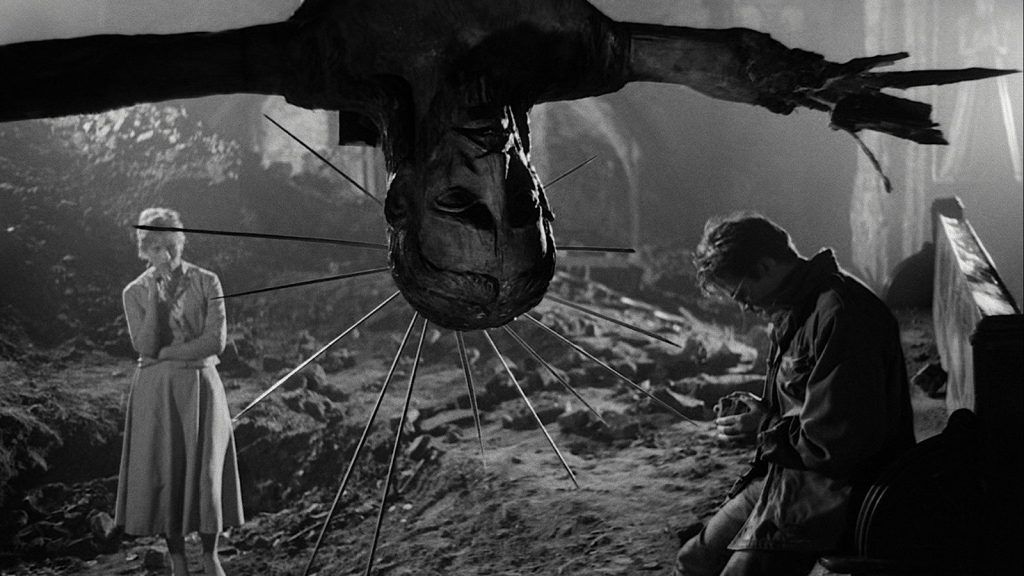
Pictured: The 1958 Wajda classic Ashes and Diamonds. Unfortunately, A Love in Germany is not available for streaming in the USA. But you can find A Generation, Kanal, Ashes and Diamonds, and Danton on The Criterion Channel.
 Kevin Lally on Film
Leave a comment