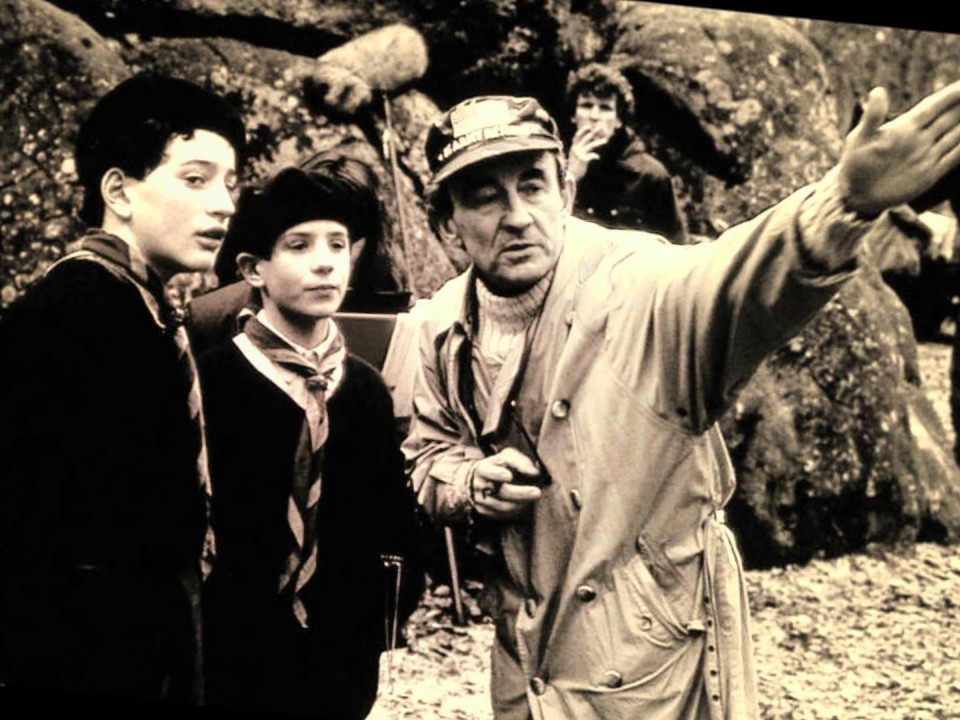
One of my very favorite interviews was with the great French director Louis Malle. In December 1987, he welcomed me into his lovely apartment on Manhattan’s Central Park South and was the essence of charm. We talked about Au Revoir, Les Enfants, his most personal film and his triumphant return to France after a successful decade in the States. In retrospect, this interview is especially poignant: He talks about his shock over the early death in 1984 of his compatriot François Truffaut, and his realization of how precious time was to him as an artist. Sadly, Malle himself died from lymphoma in 1995 at the age of 63.
“It’s like the return of the prodigal son”, says director Louis Malle of the smashing reception in his native France to Au Revoir, Les Enfants (Goodbye, Children), his first French-language film following a ten-year stint in the United States. This autobiographical drama, set in a Catholic boarding school in France during World War II, is not only a box-office hit, but has garnered the Golden Lion at the Venice Film Festival and France’s official designation for this year’s Oscar race. For Malle, these rewards are particularly sweet, since he considers Au Revoir, Les Enfants “my most ambitious and personal…effort as a director and writer.”
Au Revoir, Les Enfants, which the trimly handsome, urbane Frenchman describes as “a chronicle that becomes a tragedy,” deals subtly and hauntingly with the terror of the German Occupation. Malle’s screenplay was inspired by his memories of a fellow student, a brilliant Jewish boy whom the headmaster of his school tried to shelter, along with other endangered youngsters, from the Gestapo.
Talking to Malle, it’s clear this episode in his life still moves him deeply. Why, then, did he wait so long—through 25 features and documentaries—to grapple with it on film?
“Maybe I needed to make those 25 films,” he replies. “This was so important to me, and I had to feel confident of my handling of my craft. Often when novelists or filmmakers tackle their first novel or movie, it comes naturally to deal with something that is very important or traumatic in their childhood or adolescence. That’s one way to do it—like Truffaut making The 400 Blows as his first film. I never felt that way—anything as personal as that would have been very difficult for me. Then time went by and when I started thinking about it I felt it was good in a way not to hurry, because I was not sure there was a movie to start with. It was a very strong, very anguishing moment of my childhood that I remembered vividly, but at the same time I was not sure it would work as a complete feature. Frankly, I was not confident that it might work until I wrote the first draft of the screenplay.
“About two years ago, I realized it was time—I didn’t want to wait too long. I was very shocked by Truffaut’s death—I had not seen him that much in recent years because I was living here. Suddenly I realized this was my contemporary—it seemed like he was going to keep making films for years. And I started thinking, my God, this is so important to me that I better get going before something happens to me. It came with a lot of anguish—I was very scared. It would have been horrible if the film had been just so-so or had not worked completely.”
To achieve his goal, Malle says he made a conscious effort to distance himself from this highly personal story. “It could easily have become too sentimental, too heavy—I was always holding back as much as I could. I’ve always worked that way…well, maybe not at the very beginning. Showing off with the camera is not something I find interesting; It can be very detrimental. I never think of the camera as a character as some directors do. But in this case I was really going even further, to the point of making a direct connection between the characters on the screen and the spectator in the theater. Only at the end do I say: This happened to me, this is my story. I never considered using flashbacks or anything that would have made the structure too obvious, or it would have become artificial. It starts as a chronicle, and you can see the danger and the tension accumulating little by little until you get to the denouement. It was really important that every spectator live this experience, this story of a child discovering evil and injustice and discrimination.
“Sven Nykvist [the great Swedish cinematographer with whom Malle worked on the films Black Moon and Pretty Baby] years ago told me something beautiful. His lighting was getting simpler and simpler—beautiful but very simple, no tricks—and he told me, ‘It took me 20 years to reach this sort of simplicity.’ I really admire that, and I know it’s true, because the same thing happened to me in a way. Little by little you get rid of what’s not essential.”
When reminded that two other recent films, John Boorman’s Hope and Glory and Steven Spielberg’s Empire of the Sun, also deal with World War II as seen by children, Malle responds, “I don’t think it’s a trend. I can’t talk for Spielberg because it’s not his autobiography, but it happens to a lot of directors that at some point you want to say something about your childhood or adolescence. It goes back to Elia Kazan doing America, America when he was 50, or Bergman doing Fanny and Alexander, which is sort of a fantasy about his childhood, when he was well past his 50s. I think Boorman and I are about the same age, and suddenly we felt the same urge. But his film is completely the opposite of mine. That’s what I love about Hope and Glory: It’s a way of saying that for kids war is like a wonderful holiday. The basic difference between Hope and Glory and Au Revoir, Les Enfants is that one is taking place in a country at war, but we were occupied. That’s a huge difference, because of course we had the presence of the occupants, and the Jews being arrested and deported. What we had in France for several years was a sort of complex civil war; my film Lacombe, Lucien evokes another aspect of that. The British in World War II were in for terrible times, but they were together, they were fighting the enemy, and there was something about it that was exhilarating. I remember nothing like that in France, it was quite different, and that shows in the mood of the two films.”
All of the children in Au Revoir, Les Enfants, including leads Gaspard Manesse (who plays Malle’s alter ego, Julien) and Raphaël Fejtö, are nonprofessionals. “I don’t believe in child actors,” the 55-year-old director asserts. “There are exceptions—I don’t want to be unfair. But most of them…they’re not children anymore, they lose their spontaneity after a couple of films or TV shows. At the same time they don’t really become actors, because it’s too early to work on their technique or their knowledge of the character in a serious way. I don’t think I’ve ever used child actors. These we found in Paris: We saw hundreds of kids that age, from that sort of bourgeois milieu, from all the lycées in Paris. The ones we chose were very smart, very sensitive. They’d never worked in front of a camera before.
“Directing children is very special—it’s more an attitude or spirit than any technical tricks. You have to be very attentive, and you have to establish a very warm and precise working relationship. You cannot patronize them, especially when they’re very smart like these were… And if something doesn’t work, you have to be honest enough to think that maybe it’s not them, it’s you—there’s something wrong in the script or in what the cameraman has asked them to do. You cannot ask them to do anything that is not absolutely right and natural. You really have to work with your crew so that you go to the essential and you don’t do anything gimmicky. That’s why I like working with children—it forces you to be completely honest with your material.
“It was interesting in Au Revoir, Les Enfants to ask children of today—they were very modern, they all had Walkmans—to become these…for them it was like prehistory, these kids with their short pants and haircuts. But once we passed the difference in costume and look, I realized—I was always hoping this—that those kids would fit the characters very easily, just sharing the same emotions. It was wonderful to see that children are children and the differences are superficial. Forty years away, I don’t think children have changed in their heart and mind.”
Malle’s own childhood was spent in privileged surroundings, as a member of one of France’s wealthiest families, his mother the heir to the Beghin sugar fortune. After studying at the Institut des Hautes Etudes Cinématographiques, Malle spent a rugged filmmaking apprenticeship with Jacques Cousteau and was co-director of Cousteau’s Oscar-winning 1956 documentary The Silent World. Malle’s subsequent films won consistent acclaim and frequently courted controversy: The Lovers (1958), with Jeanne Moreau, was banned in several U.S. cities and prompted obscenity litigation; The Fire Within (1963) dealt uncompromisingly with an alienated young man’s suicide; Murmur of the Heart (1970) brought paradoxical charm to the subject of incest; and Lacombe, Lucien (1974) boldly examined the roots of French collaboration with the Nazis.
The director journeyed to the United States in 1977 to make Pretty Baby, starring Brooke Shields as a 12-year-old prostitute in turn-of-the-century New Orleans, and his next English-language film, Atlantic City (1980), an engaging comic portrait of con men and dreamers in the New Jersey resort, earned him an Oscar nomination as best director. Malle’s other recent films include My Dinner with Andre (1981), which proved that a conversation between two men could be arresting cinema, and Alamo Bay (1984), a hard-edged drama of conflict between Vietnamese and American fishermen in South Texas.
“I found it very easy to work in America,” Malle says. “I’ve worked with New York crews, Los Angeles crews, and it’s always been a wonderful experience, not really different. I like to work with small crews—I’m very uncomfortable when there are 120 people on the set. I know some movies need a lot of people, but basically on the kind of movies I like to make, it has to be a small unit with people working very closely together. It has to have a certain atmosphere…this is pretentious, but almost a little religious, that people are doing something important together, a certain quality of silence and concentration. I hate sets where everybody’s shouting and screaming. So it comes from the director in a way. I’ve managed to achieve that in different countries.”
Now that Au Revoir, Les Enfants is a big hit in his native country, Malle observes, “they take for granted that I’m ready to go back and work in France for the rest of my life, but I don’t know what I’m doing next. I’ve no projects, because it’s very hard for me to follow up with something immediately after this. This is such an achievement for me that I have to sort of regroup. For the time being, I’m still based in New York with my wife [Candice Bergen] and daughter. In a way, it would make sense for me to continue working in France, but I’m still really interested in working in this country. But it’s a little more difficult if you want to make very personal films. Something that I’ve realized in the last three or four years in this country is that working with Hollywood you can easily waste a lot of time, which is bad for me because I’m not getting younger. Movies are so expensive and each one is a corporate decision when you’re dealing with a studio. They don’t want to say yes and they don’t want to say no, and months go by and then you lose the momentum. Once I’ve decided that I really need and want to do something, I don’t like people saying, ‘Yes, but if you wait four months, you can get this actor.’ But I’m not sure I want to wait four months. I see around me friends, American directors, and it all seems to be very slow. That’s my main concern, because my time is the most precious thing I have. I don’t have that much time left.”
Au Revior, Les Enfants is available to stream on HBO Max, The Criterion Channel, and Kanopy.
 Kevin Lally on Film
Leave a comment