The Coen Brothers lied to me. Promoting their 1996 dark comedy Fargo, the filmmaking siblings told the press their crime tale was based on a real incident. The movie itself begins with the statement, “This is a true story. The events depicted in this film took place in Minnesota in 1987. At the request of the survivors, the names have been changed. Out of respect for the dead, the rest has been told exactly as it occurred.” (The “true story” claim also opens the fictional “Fargo” TV series, on which the Coens are executive producers.) Nearly 20 years later, Joel Coen finally fessed up to The New York Times: “It’s completely made up. Or, as we like to say, the only thing true about it is that it’s a story.”
Despite, or perhaps aided by, their fabrications, Fargo earned seven Academy Award nominations including best picture and best director, and won two, for lead actress Frances McDormand and the Coens’ screenplay. In 2008, the Coens’ No Country for Old Men would win best picture, direction and screenplay. In 2021, Joel Coen directed his first project apart from his brother, The Tragedy of Macbeth; Ethan is currently in production on his own untitled feature.
Out of respect for the naïve (me), the credulous opening of my 1996 interview with the Coens has been slightly altered.
Welcome to the world of Marge and Norm Gunderson, Jerry and Jean Lundegaard, and Gaear Grimsrud. Welcome to Fargo, Joel and Ethan Coen’s funny, nasty but affectionate tribute to the terrain of their youth—the upper reaches of the American Midwest, peopled by cheerful homebodies with amusing Scandinavian names, and pregnant cops who dig for nightcrawlers before reporting back from a crime scene. The Coens’ latest recalls their acclaimed 1985 debut feature, Blood Simple, with its wry perspective on murder, betrayal, greed and other smalltown vices, but the filmmaking brothers see a significant difference. “Everything that we’ve done in the past has been sort of self-consciously artificial,” says writer-director Joel Coen. “There’s an attempt here to do something that’s a little bit more observational in style, a little bit more reality-based.”
In Fargo, a Minneapolis car salesman sets in motion a half-baked scheme to kidnap his own wife and collect a ransom from her wealthy father. The Brainerd police chief investigating the deadly result is very pregnant. The narrative is shot through with the Coens’ trademark black humor and subtle irony, a vision realized by a superb cast including Frances McDormand (Joel’s wife) as unflappable sleuth Marge Gunderson; William H. Macy as frantic car dealer Jerry Lundegaard; and Steve Buscemi and Peter Stormare as sloppy kidnappers Carl and Gaear.
Film Journal met the Coens in a coffee shop in the Murray Hill section of Manhattan. Joel wears his long hair gathered in a ponytail; Ethan, three years his junior, has shorter, curly hair. Each possesses the kind of droll, sometimes cocky, sometimes self-deprecating wit you’d expect from the writers of such blazingly original and entertaining movies as Raising Arizona, Miller’s Crossing, and Barton Fink.
The Coens grew up in the suburbs of Minneapolis and came east after high school—Joel to study at New York University’s film school, Ethan to earn a philosophy degree at Princeton. “Going back to Minneapolis to shoot was almost like going to a foreign city,” Joel declares, “because the city has changed so much. The color we remember from the area, a lot of it’s still there, but a lot of it’s gone—it’s been homogenized into this Middle American beige monochrome kind of thing.”
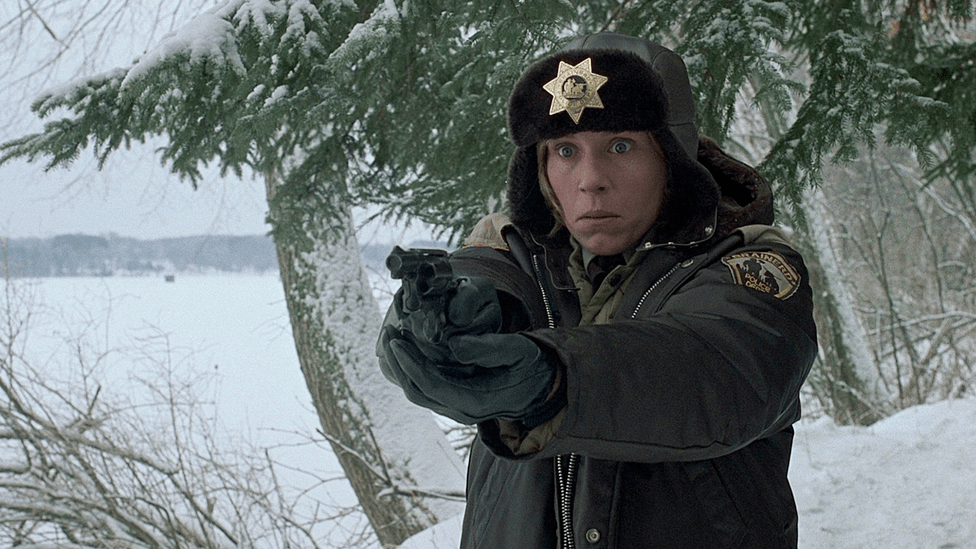
Still, Fargo captures a very specific regional flavor, particularly through its evocative photography of overcast winter skies and snow-blurred highways, and through the casting of local actors as genial, contented Minnesotans. McDormand’s Marge makes an especially atypical movie heroine. “We wanted a movie about a character who’s confronted by this almost surreal gruesomeness but deals with it very stoically,” explains Joel. “That’s kind of a Midwestern thing.”
“Right,” agrees Ethan. “There isn’t a lot of emotional display in Minnesota.”
“These are characters that we’re familiar with,” Joel notes, “and therefore we have a certain amount of affection for them. Even Jerry, the guy who’s the instigator of all the horrible things that happen in the movie, it’s hard not to like him a little bit. As we said to Bill Macy, he just keeps trying—Jerry never gives up.”
The Coen Brothers’ movies deliver a rare combination of memorably offbeat characters, idiosyncratic dialogue, and inventive visuals. In the latter department, they’ve enjoyed fruitful collaborations with two gifted cinematographers: Barry Sonnenfeld, who photographed Blood Simple, Raising Arizona and Miller’s Crossing before moving on to a successful directing career, and Roger Deakins, who has shot Barton Fink, The Hudsucker Proxy and now Fargo. Achieving the chilly mise-en-scène of Fargo proved an unexpected challenge since, as Joel explains, “it was a very warm winter. There was no snow in Minneapolis—a lot of the snow was made. We ended up going up to North Dakota at the end of the show for two weeks to do the big exteriors, because it was the only place that had snow. We were lucky—it started to warm up when we got up there, and you got this weird phenomenon of the fog moving in over the snow, so you literally could not see a horizon line, which was exactly what we were looking for.”
Joel and Ethan’s close collaboration as writer-director and writer-producer, respectively, may seem unusual to outsiders, but to them it’s a natural outgrowth of their screenplay work. ‘People collaborating on writing screenplays is a fairly common partnership,” Joel observes. “It’s less common when you see people extend that kind of collaboration into production, and that’s why people are curious about it. But it really isn’t that different from the way people work when they’re writing together.”
Adds Ethan, “It isn’t even like there’s a hard and fast line of demarcation between working on the script and talking about what you’re going to do, and then actually getting into pre-production and then actually doing it. It’s all a process of making more and more specific what you want to get across.”
“We really do co-direct the movie,” Joel notes. “We just continue the conversation of how to make the movie. We’re both always on the set, we both talk to the actors, we both talk to Roger—it’s almost like who’s closer to whoever needs to be talked to or whoever has a question.
“I’m the director of record, but that’s really almost because of the habit that we’re in—it started with the first movie. Directing a movie is really just answering questions, and the simplest way to explain it is that we both answer questions. The designer is just as likely to go up to Ethan and ask, ‘Should this shirt be red or black?’ Or an actor would be just as likely to ask Ethan a question about what he just did.”
Over the years, the Coens have given early exposure to a number of actors who’ve gone on to impressive careers, people like Holly Hunter, John Goodman, Steve Buscemi, and John Turturro. “That’s just a logical consequence of our always making movies on low budgets,” Joel says. “We don’t generally work with movie stars—we cast parts by auditioning lots of actors. There are a lot of good actors who are just waiting for a break, to do something in a movie. We tend to hire younger, more inexperienced actors, people with less exposure, out of necessity. Then they go off and do their thing, and they get better known because they’re good.”
Ethan graciously insists, “All the people you mentioned, doubtless they were going to go off and do their thing regardless of whether we got them early on.”
“You have to see them early on, while they’re still cheap,” Joel laughs.
A key link in the Coen Brothers’ company of players is Joel’s talented wife, Frances McDormand. “That’s how we met John Turturro,” Joel recalls, “because they went to school together. Fran and Holly were roommates when we first met Fran on Blood Simple. Years ago, she knew a lot more actors than we did, because she had gone to drama school and had a whole circle of friends who were actors. Now all of us kind of know the same people. A lot of them come from the theater world in New York. There are so many good actors with theatrical training in New York, and with that kind of background they don’t need us to coach them. They all have a lot of skills. You give them a part and they go with it.”
Brought in for $6.5 million, Fargo marks the Coens’ return to modestly budgeted filmmaking following the $25 million spectacle of their 1994 big-business comedy-fantasy, The Hudsucker Proxy. What did they learn from that experience? “Not to do it again!” Ethan exclaims. “Exactly!” Joel agrees.
“Because it was such a big production,” Joel explains, “it was ungainly and harder to control. You have a second unit, a blue-screen unit—it’s much harder to keep track of everything and to control the details. But it was fun to build those sets, and to work with Jennifer [Jason Leigh] and Tim [Robbins] and Paul [Newman]. And it was great to learn about the special effects. And I have to say [producer] Joel Silver turned out to be just a great collaborator. Despite all his press and people’s expectations, he was terrific to work with. All of that was fun. It’s just the movie laid a giant egg. That part of it wasn’t fun.”
“You always hope for commercial success,” Ethan frankly admits, “just because that makes more ambitious movies possible, different kinds of movies that need more money. That either happens and they become possible, or it doesn’t. On some scale we know what we’re doing and we can continue making movies. But we would have more options if we had a big commercial success. In that sense, Hudsucker was a disappointment.”
“We’d certainly like to do something that was a big commercial success,” adds Joel. “Also, we’re not making the movie for ourselves. We want people to see it, and the more people that see it, the better we feel about putting it out there.
“On the other hand, we have a lot of stories that we’re just as interested in doing as anything else, that are very small in scale, like Fargo. We don’t consider it a comedown or a second-best thing to do those kinds of movies. But it would be nice to feel you could do whatever you want.
“I think probably Hudsucker is the only movie we’ve made that actually lost money in the long run. Raising Arizona was very successful for its cost, it made Fox a substantial amount of money. Blood Simple made money, and Barton Fink was very successful overseas although it didn’t do particularly well here. Because we’ve kept the price of the movies fairly low, we’ve actually performed okay. Hudsucker was the exception—it had a much bigger budget and a smaller gross of anything we’ve done.”
Though they’re among the most adventurous filmmakers of their generation, surprisingly the Coen Brothers claim they don’t get much feedback from their fans. “If we have them, they’re pretty well-behaved,” Ethan insists. “They keep to themselves, they’re shut-ins.”
“But,” Joel hastens to add, “Fran gets a lot of mail from convicts.”
Photo ©MGM Home Entertainment. Fargo is available to stream on Starz and Prime Video.
 Kevin Lally on Film
Leave a comment