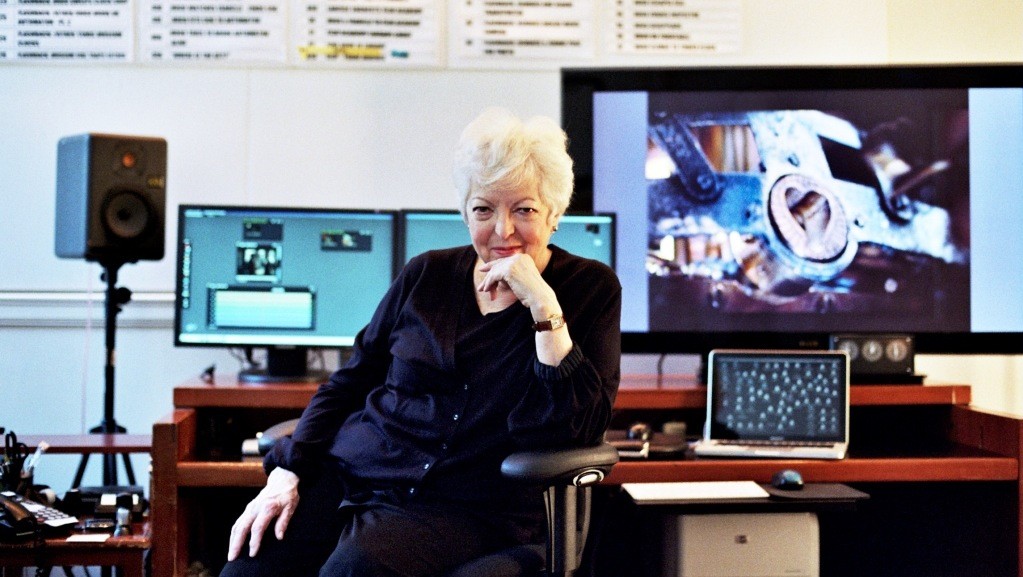
I find it hard to believe that it’s been nearly 28 years since I met Thelma Schoonmaker, Martin Scorsese’s longtime editor. The occasion was a retrospective of films by her late husband, the great Michael Powell, and the restoration of one of his masterpieces, A Matter of Life and Death. Since our 1995 interview, Schoonmaker has been nominated for five additional Oscars and won two, for Scorsese’s The Aviator and The Departed. She is currently in post-production on the director’s latest, Killers of the Flower Moon. Here is her account of one of cinema’s great off-screen love stories.
“The minute I saw him, I just instantly fell in love with him. He was such an amazing person, he was really like a slap in the face.”
The courtship and marriage of Michael Powell and Thelma Schoonmaker is a love story between two extraordinarily gifted people who, not incidentally, also shared a profound passion for movies. Powell, who died in 1990 at the age of 84, was one of British cinema’s greatest filmmakers, a bold stylist and fiercely independent iconoclast. He and his Hungarian-born writing-directing-producing partner Emeric Pressburger, collectively known as The Archers, created such classics as The Red Shoes, Black Narcissus, A Matter of Life and Death (released here as Stairway to Heaven), The Tales of Hoffmann, The Life and Death of Colonel Blimp, One of Our Aircraft Is Missing, I Know Where I’m Going!, and A Canterbury Tale. Apart from Pressburger, Powell also co-directed the spectacular fantasy The Thief of Baghdad and generated a wave of outrage with his 1960 psychological chiller Peeping Tom. Schoonmaker won an Oscar in 1980 for editing Martin Scorsese’s Raging Bull, and has worked with the director continuously ever since, on celebrated projects like The King of Comedy, The Color of Money, The Last Temptation of Christ, Goodfellas, Cape Fear, The Age of Innocence, and Casino. Scorsese, a longtime champion of Powell’s work, introduced his editor to his idol, and the couple began dating soon after the 1981 Oscar ceremony. In May 1984, they were married in the small English village of Avening.
A complete retrospective of the films of Powell and Pressburger, with sumptuous new 35mm prints, is currently underway at New York’s Film Forum and will tour the nation through next year. And Columbia Pictures is releasing a beautifully restored Technicolor print of Powell’s personal favorite of his films, A Matter of Life and Death, in major markets around the country. “We are so thrilled to get it back into distribution,” says Schoonmaker. “There are a lot of terrible 16mm prints around that are badly cut and are missing some of the best scenes.”
Interviewed at Scorsese’s production office in the MCA building in New York, the warm and vivacious Schoonmaker is eager to share her memories of the artist she loved. “Michael had a real appetite for life,” she recalls. “He kept on writing scripts, believing in filmmaking, loving younger filmmakers whenever he met them, never gave up. He was dreaming of making films till the day he died. Every day for him was a new adventure—it sounds corny, but it really, really was. He would wake up and I would look at him, and his mind would be going already.”
Powell and Schoonmaker met just as the director’s body of work was undergoing a major rediscovery by a new generation of film buffs, with Scorsese at the forefront. Powell had fallen on the difficult times after the virulently negative reaction to Peeping Tom; always something of an industry outsider, he was suddenly working in American television and making features in Australia. By the mid-’70s, things were at their lowest. Powell’s longtime love, the actress Pamela Brown, had just died, and he was living alone in a small cottage in Avening. “He had no money,” Schoonmaker says. “He only once told me this, because he would never dwell on it—he could only heat his little cottage with the wood he could chop, because he couldn’t afford the fuel oil. He couldn’t afford to buy a bottle of whiskey for a year. He sold all his first editions and his paintings. It was terrible. He would never describe it this way, but I know how bad it was. They almost took him to jail for nonpayment of his bills—they literally came and knocked on his door, and a friend loaned him some money.
“And then Marty out of nowhere finally tracked him down—he had been trying to find him for years, because he was intrigued by this Powell-Pressburger thing, he couldn’t understand how two people made a movie. He kept asking people in England whenever he went there, ‘Where is this person?” And they would all say, ‘Nobody knows where he is, what do you care?’ And Marty kept saying, ‘No, no, I must find him—he’s a big influence on me, I want to meet him.’ And finally, Michael Kaplan, an American who was over there and was representing Malcolm McDowell, met Michael because he wanted McDowell to be in his dream project of The Tempest. And Michael Kaplan said, ‘I know where he is—he’s coming to my house next Tuesday.’ And so he set up this meeting.
“Once Marty found him and told him how much he loved his films, he came back to the States and said, ‘I found him! I found him! Bring him to Telluride!’ And then [critic] David Thomson brought Michael to Dartmouth [as artist in residence], and Marty entered Peeping Tom in the New York Film Festival. The British Film Institute had been trying to restore his reputation, but it was Marty, with his ability to generate interest among young people, who really put it over. And then all these retrospectives started all over the world.”
Schoonmaker says she first encountered the films of Michael Powell while a young girl on the island of Aruba, where she remembers seeing The Red Shoes and The Life and Death of Colonel Blimp. “I knew that I had been deeply shaken by them, but that’s all I knew. And then Marty started educating me, and I began learning about them, and of course they just overwhelmed me. And fortunately there was a retrospective going on at the Museum of Modern Art, and I got to see a lot of prints and Michael and Emeric were there. Now, of course, they’re like my blood—I live and breathe them, and I get asked to go to a lot of places and show the films and talk, and it’s always such an incredible experience to share them with people and to see the films over and over, because I keep seeing more and more, particularly in A Matter of Life and Death, which has been asked for a lot recently. And young people are responding very strongly to it, which would make Michael so happy.”
A Matter of Life and Death (1946), the showpiece of the new retrospective, stars David Niven as a British fighter pilot in World War II who was shot down over the English Channel while returning from a bombing mission. Somehow he survives the crash, and he meets and falls in love with the American WAC radio operator (Kim Hunter) who talked him down. When a heavenly emissary arrives, claiming the pilot has cheated death and is overdue in the afterlife, the war hero demands to plead his case before a spiritual tribunal. From its hypnotic opening sequence to its imaginatively witty vision of the hereafter, A Matter of Life and Death is a complete original.
In fact, nearly every Powell-Pressburger film is like no other, from the phantasmagorical musical melodrama of The Red Shoes and The Tales of Hoffmann, to the hothouse eroticism of the Himalayan nunnery in Black Narcissus, to the satirical debunking of a pompous British war veteran in Colonel Blimp.
Schoonmaker continues to marvel over the stylistic wonders of her late husband’s films: “The camera movement and the dance-like movement of the actors, even when it isn’t a dance film. The brilliant use of color, and the editing! The daring, the guts, the boldness, always being a step ahead of your audience. Michael used to say to me, ‘Never, ever think that the audience isn’t with you—they’re probably ahead of you.’”
Powell began his movie career at the age of 20 as an apprentice with silent-film director Rex Ingram’s unit in Nice, France, acquiring a solid foundation in editing and lighting. “My husband was a very good editor,” says Schoonmaker, herself one of the top practitioners of the craft. ‘You can see in his films that he has very strong editing sense. He was also well grounded in lighting. He could tell what time of day it was without looking at a watch—he never had a watch. He would say to me, ‘Is it 25 after two?’ And I would say, ‘Yes, it is.’ He knew the light, all his life he had lived by the light, shooting by the light, and growing up on a farm where you get up early. That was part of his job when he worked for Rex Ingram, knowing when the shadows or sun were going to hit a certain street in Nice. He always knew. It was amazing.”
As Powell and Martin Scorsese cemented their friendship, the veteran director became something of an unofficial adviser to his younger colleague. It was Powell, for instance, who planted the notion that Raging Bull should be shot in black-and-white and steered Scorsese away from having the film’s aging Jake LaMotta recite Shakespeare in his nightclub act and toward the taxi speech from On the Waterfront.
“It always took a lot of courage for Marty to let Michael see a rough cut of one of his films,” Schoonmaker recalls. “But finally he would, and you would hear Michael laughing in the audience at things that Marty had done as a director that Michael would just spot. One of his finest moments was when he came to the Last Temptation screening, and he stood up afterwards and his face was just bathed in tears. It took Michael about five minutes to recover himself—he just wept with the emotion of that ending, the way Marty hoped that people would.”
Of course, the two directors weren’t always in sync. “Michael had an idea he wanted to do,” his wife remembers, “and Marty read it and didn’t think it was very good—in fact, he was quite upset about it. And Michael said, ‘Wonderful! That means it engenders passion. It’s great that Marty doesn’t like it!’ It was a wonderful thing to watch, how much they meant to each other, in this quiet, unspoken way.”
Regarding her own unique place in the lives of two influential filmmakers, Schoonmaker declares, “In my life, I’ve had all the strokes of luck I could ever have. It was just accidental—I answered an ad in The New York Times, which eventually got me to go to NYU the summer that Marty was there doing a little film and needed some help with his negative cutting. That’s how I met him—it’s just a miracle. And then he introduced me to Michael.”
Schoonmaker edited Scorsese’s first feature, Who’s That Knocking at My Door?, and they both worked on the monumental editing of 1970’s Woodstock. It was ten years before they teamed again, largely because Schoonmaker wasn’t part of the American Cinema Editors guild. Raging Bull was her first project as a union member.
The Oscar-winning editor says her services are often requested by other filmmakers, but there is never enough downtime between Scorsese projects. “I love working for Marty,” she beams. “Every film is a challenge, each one is different and I’m learning all the time from him and with him.”
For the past decade, much of Schoonmaker’s spare time has gone into the preparation of her late husband’s memoirs. Because Powell’s eyesight was failing, “he would dictate on tape and I would transcribe and read it back to him, or read back what he had already written. All this time he was doing the book with the structure in his head. It’s an enormous feat—I don’t know how he did it. To be able to hold it all in your head like that is amazing, the way he puts these very moving moments in at very key times.
“It was very painful having to finish the book without him. Things that he and I would have sat and reworked together on a lovely Sunday, I couldn’t do anymore, and I didn’t want to rewrite for him. I either had to exercise things or make a one-word bridge that would get two sentences together.”
Schoonmaker says the ongoing celebration of her husband’s work has been a great comfort in her time of loss. “It’s fantastic to know that I’m in the same room a lot with someone like Marty who cares as deeply about Michael as I do—it really helps. But Michael had friends like that around the world, and they all mobilized to help me, read the manuscript, helped me make a lot of difficult decisions. He was such a vivid person that people never forgot him once they met him, and the network still continues.”
Photo ©Marc Ohrem-LeClef
 Kevin Lally on Film
Leave a comment