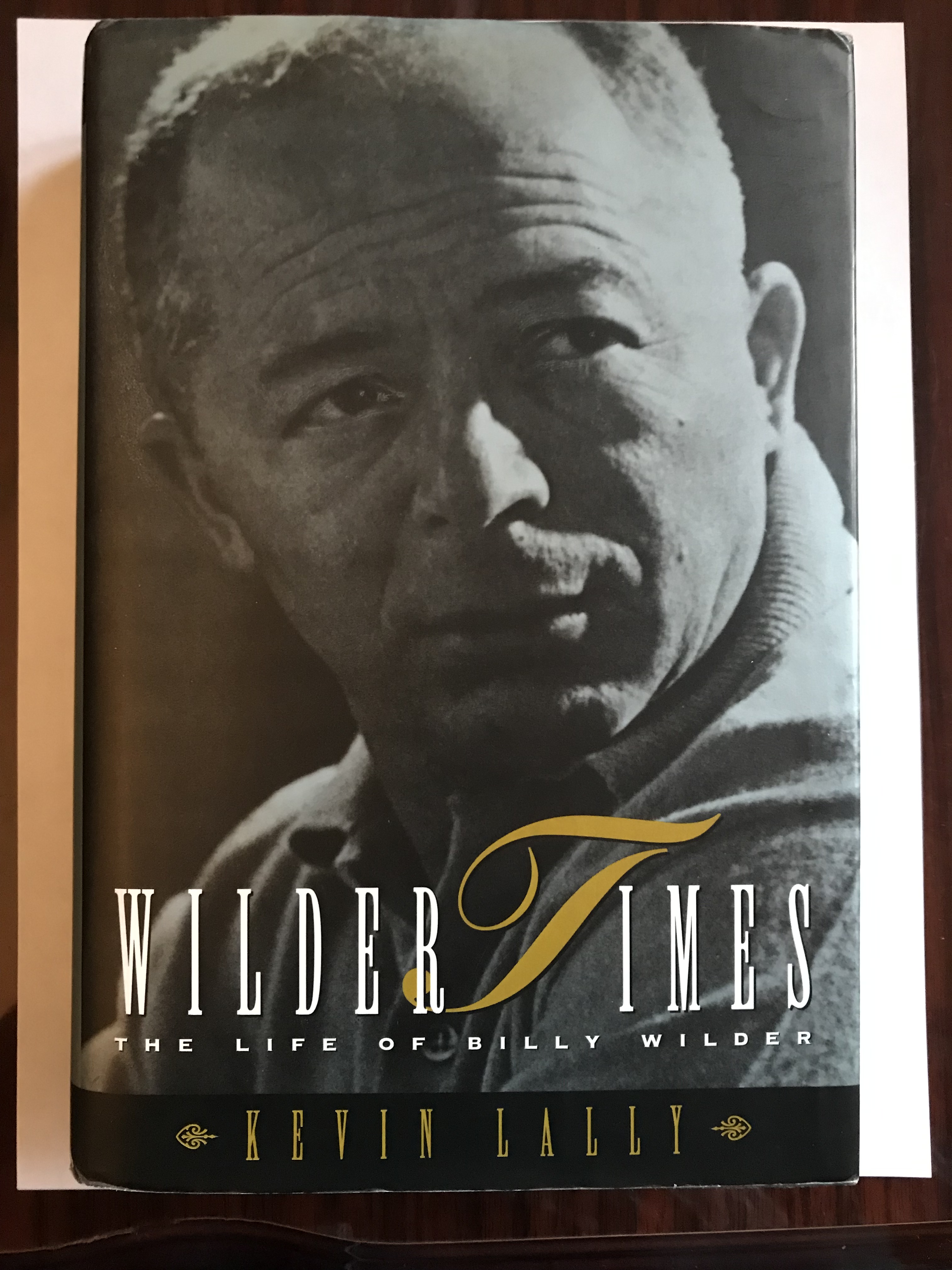
I was pleased to see Billy Wilder’s Oscar-winning The Apartment prominently featured in CNN’s 2022 special “Tis the Season: The Holidays on Screen.” A Christmas Story is great, but this is a film I’d happily watch in a Dec. 25th marathon. To celebrate the wonders of The Apartment, here is my chapter on that masterpiece from my 1996 book Wilder Times: The Life of Billy Wilder. And if you want more of my two cents, check out my 2007 appearance in the “Inside The Apartment” featurette in the Kino Lorber Blu-ray of The Apartment.
“We had the first screening of Some Like It Hot at Bill Paley’s house in Long Island,” Jack Lemmon recalls. “In the car on the way out, Billy started talking to me about The Apartment. So here I am, I’ve just finished one film that has not been seen, and Billy is already saying he wants me to play the lead in the next film. Sensational!”
The idea for The Apartment had been formulating in Billy Wilder’s mind ever since he had seen David Lean’s Brief Encounter in 1946. Based on a one-act play by Noël Coward, the British romantic classic concerned an affair between two married people. Wilder, always looking for that fresh perspective on the human condition, started wondering about one of the film’s minor characters.
Years ago, in an interview with French critic Michel Ciment, Wilder described the impulse that led him from Brief Encounter to The Apartment. “Surely, one can make superficial films on the theme of success, like 42nd Street, where the star breaks a leg and the understudy pulls off a triumph. But the understudy is in fact a tedious character. The interesting character, and one who is not treated, is the star who breaks her leg and sees the unknown take her place. That is, in a sense, the subject of All About Eve. To show the reverse of the coin, that is what counts. In Brief Encounter, for example, the subject treated is the liaison between a man and a married woman. The lovers meet in the apartment of a friend of the hero. Me, I think that the interesting character is the friend who returns to his home and finds the bed still warm, he who has no mistress.”
Wilder never developed this notion very far, realizing he’d be up against the censorship restrictions of the forties and fifties. Then, the memory of a 1951 Hollywood scandal helped crystallize the idea. Film producer Walter Wanger had shot agent Jennings Lang, who was sleeping with Wanger’s wife, actress Joan Bennett, and reports had filtered in that Lang’s love nest was the apartment of an unmarried subordinate at the agency. Wilder and co-writer I.A.L. Diamond brainstormed. What if the lending of the apartment wasn’t an act of friendship, but a career move? Now the concept had a little edge—something to do with what it takes to get ahead in corporate America. (In his autobiography, Tony Curtis claims The Apartment was inspired by his use of his friend Nicky Blair’s pad to conduct his extramarital flings; columnist Sidney Skolsky heard about the arrangement, wrote it up as a movie treatment and sold it to Wilder, Curtis says.)
A visual inspiration was director King Vidor’s 1928 silent classic The Crowd, which Wilder had named as his fifth favorite film of all time in an early-fifties poll. Centered on a young clerk who toils in a giant insurance-company office, the picture wowed twenties audiences with its opening scenes depicting an ordinary worker amid hordes of anonymous extras.
The beginning of The Apartment is Wilder’s modern-day homage to The Crowd. Lemmon narrates over aerial shots of New York City, followed by a pan up the fictional Consolidated Life building. We’re told that Consolidated is one of the top five companies in the country, with 31,259 employees in its home office—“more than the entire population of Natchez, Mississippi, or Gallup, New Mexico.” Our first glimpse of the nineteenth-floor office where Lemmon’s character, insurance accountant C. C. “Bud” Baxter, works is a stunner: a sea of identical desks and busy employees that seems to retreat back into infinity. Built on the same Goldwyn Studio soundstage that housed the catfish-row set in Porgy and Bess, the mammoth office set heightened its effect by using tiny desks at the back, manned by dwarves (according to Wilder) and “even tinier toy desks with cutout figures. After directing 350 extras rushing for the elevators, Wilder declared, in a nod to Ben-Hur, “This is my chariot race.”
In a piece he wrote for The New York Times, Diamond revealed that his partner originally conceived The Apartment as a play, then decided his vision of that huge office space could be realized only on the big screen. The film medium could also better emphasize the contrast between Baxter’s cavernous workplace and the drab bachelor apartment he comes home to at night—sometimes very late at night. “It’s not that I’m overly ambitious,” Baxter says about his long office hours. “It’s just a way of killing time, until it’s all right for me to go home. You see, I have this little problem with my apartment…”
It all began innocently enough when Baxter was going to night classes and lent his apartment key to a colleague from New Jersey who needed a place to change into a tuxedo before a hotel banquet. But then, “all sorts of guys were suddenly going to banquets.” Now, Baxter has four weekly regulars, all randy married men, all higher-ups promising to “put in a good word” for the accountant with the personnel boss, Sheldrake (Fred MacMurray). But when Sheldrake hears about the apartment, he wants it for himself. In exchange for the key, Baxter gets what he’s been hungering for: a promotion to second administrative assistant and a private office with a window.
Everything’s swell in Baxter’s world until the night of the office Christmas party. There, he discovers that Fran Kubelik (Shirley MacLaine), the pert elevator operator he has a crush on, is Sheldrake’s mystery mistress. It’s a bad night for Fran, too, as Sheldrake’s bitter secretary Miss Olsen (Edie Adams) informs her that she’s just the latest in a long line of office conquests—including Miss Olsen. Baxter goes off on a bender and picks up a daffy barfly; meanwhile, back at the apartment, Fran takes an overdose of sleeping pills after Sheldrake confirms what a louse he is by offering her a hundred-dollar bill as a Christmas present.
The following scene may be the riskiest of Wilder’s career, as Baxter brings home his addled date and discovers Fran lying unconscious in his bed. “There was a delicate balance there between drama and comedy,” Diamond noted, “and we were afraid that if we got a laugh in the wrong place, the whole picture would go out the window.” Diamond had reason to be concerned, since this tricky plot element came from him—years earlier, a woman had committed suicide in the apartment of an acquaintance of Diamond’s, as a gesture of revenge.
With Fran’s suspenseful recovery, The Apartment becomes that much richer. The elevator operator and the accountant develop an intimate bond over the course of two days, and Baxter is ready to take her off Sheldrake’s hands (as he rather indelicately puts it) until Sheldrake tells him his wife has kicked him out and he is planning to resume the affair (while still playing the field). The personnel boss then rewards Baxter for keeping Fran’s suicide attempt a secret by making Baxter his personal assistant. But when Sheldrake asks Baxter for the apartment key for a New Year’s Eve date with Fran, his new assistant gives him his key to the executive washroom and announces “I’m all washed up around here.” When Fran hears what Baxter’s done, she deserts Sheldrake and hurries to the apartment and the now unemployed accountant.
The casting of Jack Lemmon is crucial to the success of The Apartment. As scripted, C. C. Baxter has few redeeming qualities, and he seems to have no interior life apart from his desire to advance his standing at the company. As his opening narration reveals, he’s essentially a numbers cruncher, rattling off statistics about New York City and Consolidated Life as if figures are all that’s needed to describe his place in this world. Baxter never reflects on the larger scheme of things, which is why it’s so easy for him to lend his apartment key to his superiors for their extramarital dalliances. Even these assignations become part of Baxter’s systematized order, mere dates and times in his weekly calendar, divorced from their seedy, flesh-and-juice realities. This “time-share” arrangement has robbed Baxter of a private life: Even on those rare nights when he has the apartment to himself, he sits alone with a frozen dinner, searching in vain for something on his TV other than westerns and endless commercial interruptions.
Unlike Wilder’s earlier antiheroes, the roles created for Lemmon aren’t schemers, but pathetic victims of other people’s machinations. Like Jerry in Some Like It Hot, Baxter lacks the nerve to fight back once people see how easily he can be taken advantage of. And, like Jerry, Baxter sniffs out a potential reward for his timid acquiescence: For Jerry, it’s the “security” of settling down with a millionaire, even if he is a man; for Baxter, it’s the promise of a sudden ascent to a private windowed office on the twenty-seventh floor. Baxter is the perfect corporate soldier: cooperative, unreflective, and blindered not only by his empty worship of career advancement but by his glib acceptance of his bosses’ childish sexual games. “He’s actually innocent, he is a Forrest Gump,” says Wilder, always ready with a contemporary reference point.
Baxter is also a shlemiel and, by his complicity, a heel. Yet, in Lemmon’s artful hands, the character is instantly likable and empathetic. It’s a performance that would set the pattern for so many of Lemmon’s roles in the 1960s and ’70s: the well-meaning white-collar drone who falls prey to his own eagerness to master the corporate game. Aided by Wilder’s oppressive mise-en-scène, the deeply flawed Baxter becomes an urban Everyman, someone whose struggle a 1960s audience of Organization Men (and forgiving women) could connect with.
Lemmon’s performance is expertly modulated, his first chance to show the range that would enable him to alternate between comedy and drama so successfully later in his career. His comic moments in The Apartment are among his best: the lengthy scene at his desk as he rearranges his apartment bookings so he can get a night’s sleep, all while fighting a fresh cold; his drunken haze on Christmas Eve; the celebrated spaghetti-cooking scene in which he uses a tennis racket as a strainer. But Lemmon also delivers powerful emotions, whether frantically working to revive the unconscious Miss Kubelik, or gazing tenderly into the elevator girl’s eyes, or realizing there’s a limit to how far he’ll sink to get to the top.
Putting an adorably young Shirley MacLaine opposite Lemmon also helped make Baxter that much more sympathetic. “There are any number of actresses in Hollywood who can be sexy or funny or sad,” Diamond stated at the time, “but we knew of only one who could be all three simultaneously—Shirley MacLaine.” The vivacious actress-singer-dancer, then twenty-five, had recently earned her first Oscar nomination for her quirky role as a good-time girl in Some Came Running and was making news as the only female member of the Rat Pack, the exclusive clique of Vegas swingers headed up by her Running co-stars, Frank Sinatra and Dean Martin.
MacLaine—still a movie box-office name and concert draw [in 1996], and a best-selling author in her spare time—says she saw only twenty-nine screenplay pages when she started The Apartment, but “I admired the social statement Billy was making, and the extraordinary sophistication he brought to making that statement. And I liked the idea that Fran was caught in this maze, like everyone else in the film.”
Meeting Billy Wilder was a decisive moment in MacLaine’s life. The two films she made with him, MacLaine declares, “confirmed that I was a star and that I could act.” The actress says she learned a lot about timing from Wilder, and that “there are details of your performance that you’re never aware of… I had a habit of clicking my tongue when I did The Apartment—he must have cut out twenty-five of those. Billy never misses a thing—sometimes he’s diplomatic about it, sometimes not. Bob Fosse is the only other director I know who was as detail-oriented. Most others are involved with emotional generalities and esoterics. With Billy, the emotion the audience feels is orchestrated by specifics that you’re aware of.”
As Lemmon recalls it, MacLaine got a tough early lesson in Wilder’s methodology. “The first day of shooting on The Apartment, Billy got one thing very straight with Shirley, because Shirley was used to getting a little loose with the dialogue at times. Now there’s nothing unprofessional about that, because with other writers every actor does that, in film and very often in the theater. Actors used to do it in the theater, and that’s why they made the law that you can’t make a change without the approval of the author. They don’t have that in film, unless the individual writer has it in his contract. And all too often the writers don’t even come to the set. She liked the feeling of spontaneity, and not necessarily saying the lines word for word. The first scene that Shirley had was when she was in an elevator, early on in the film going up and down, doors are opening and closing, people are getting on and off, and it’s a pretty long, complicated scene for her—which she did beautifully. However, she was not saying the lines at first. And she didn’t know about Billy, this was her first time. And Billy kept saying, ‘Say the words!’ And she says, ‘You mean exactly…’ ‘Exactly!’ Sweat’s beginning to fly, because she’s got a million of them, two full pages of stuff. And finally, when she did get a good take, all the way through, Billy turned to Izzy and Izzy whispered something to Billy, and Billy said, ‘Let’s do it just once more—you forgot the word “and” on the second page.’ And he really made her do it again. And then he gave her a kiss. But, by God, she never came in and started to ad-lib or drop any words from that day on. She came to me afterward and I said, ‘Hot dog! You learned! It’s just with Billy, you don’t do it.’ And she said, ‘God, I wish somebody told me.’”
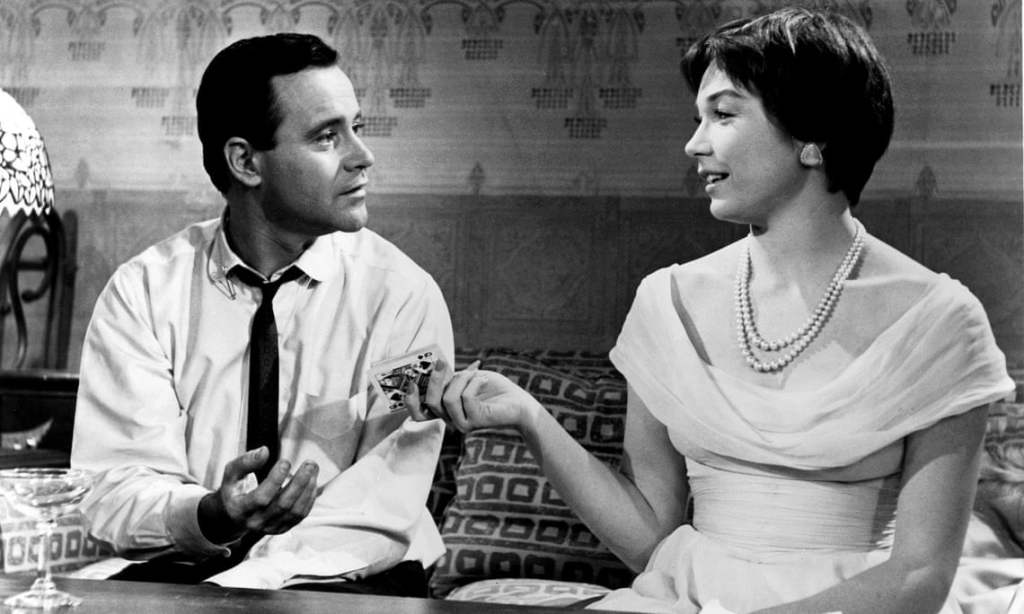
Though vehemently protective of his and Diamond’s words, Wilder remained open to creative suggestions, as both MacLaine and Lemmon affirm. “He’s the only director who, when he found something you said personally that made sense for the character, would go back and reshoot,” MacLaine notes. The actress says that when Wilder discovered she had learned gin rummy from her Rat Pack cronies, he incorporated her new talent into the character of Fran. The result is some touching card-playing moments between Lemmon and MacLaine, and the memorable anti-sentimental closing line, “Shut up and deal.”
Recalls Lemmon, “I’d pop into the office any time I got an idea, and Billy would always stop me and say, ‘Don’t tell me. I might misunderstand. Show me.’ And he was always wide open. Even though he was the writer and the director and there was no gray area of misinterpretation, he would always let any actor bring whatever they had to offer, and very often would accept it. I have seen him take suggestions for a scene from a prop man—that had nothing to do with the props—and say, ‘Hey, that’s a good idea,’ and use it. Which is really amazing. What it shows, interestingly enough, is a great security.”
Lemmon in fact contributed one of The Apartment’s best sight gags, when Baxter, struggling with a bad cold, is summoned to Sheldrake’s office for the first time. Lemmon took his prop nose spray and had it filled with milk—“because nose spray won’t show in black-and-white film. Sheldrake says, ‘So we’re going to make sure this never happens again. Am I right?’ And I say, ‘Oh yes, sir!’ And I squeeze my hands like that and—Pssheeww!—the stuff went across the screen right onto Fred’s nose. Fred did not bat an eyeball.”
Reflecting on his onscreen relationship with MacLaine in The Apartment, Lemmon says, “I always like to say that what Billy did so successfully was to grow a rose in a garbage pail, because he told a romance, he made you care about these two people, with their flaws—it’s interesting that both of them are flawed and he made you care about them. At the same time, he made a hell of a lot of personal comment about our business society and our mores and behavior, and made the best picture of the year.”
After Some Like It Hot, people may have been expecting another frenetic comedy from the pairing of Wilder and Lemmon. What they got instead was a daring hybrid of comedy, drama and social criticism. At the 1982 Film Society of Lincoln Center tribute to Wilder, Shirley MacLaine analyzed the elements that collide in a picture like The Apartment: “In a Wilder film, nobody is spared that Wilder X-ray cynical wit. As a matter of fact, there is no institution so sacrosanct that it can’t be punctured by Billy’s sense of humor. I’m rather glad he hasn’t put his talents to the life story of Mother Teresa yet… Billy Wilder’s films are so savagely funny that we’re usually too busy laughing to notice that he’s really telling an underlying truth about human beings. The Wilder touch goes beyond cynicism. I think what he’s been doing all these years is making movies about reality, undermined by the best punch lines in the business.”
Wilder himself insists, “I don’t regard The Apartment as a comedy. It’s a slice of life that seemed very naturalistic. We were never opening our mouths wide trying to be funny and doing Ritz Brothers routines. It could happen to anybody.”
Nowhere is The Apartment more serious than in its depiction of Fran Kubelik’s suicide attempt. Once before, in Sabrina, Wilder had employed suicide in a comedy, but there the attempt was more the result of an adolescent crush and more obviously halfhearted. Here, Wilder means it, and the process by which Baxter and his good-hearted next-door neighbor, Dr. Dreyfuss, save the girl is deliberately painful to watch. Talking to critic Michel Ciment, Wilder bridled at criticism of the brutality of the scene. “I had three doctors on the stage to whom I asked what one does with a patient who has taken twenty-five sleeping pills. They told me that to keep someone awake it is absolutely necessary that you slap them, feed them coffee and make them walk without stopping. They even told me: It is necessary to hit harder.”
Fran’s desperate act is like a slap in the face to Baxter, who gradually begins to understand the human consequences of his obsession with hollow success. Does he really want to aspire to be like Sheldrake and his fellow philanderers—especially Sheldrake, who can’t be bothered with this messy mistress situation as his suburban family gathers around the Christmas tree? Or, as Dr. Dreyfuss advises, wouldn’t he rather learn how to be a mensch, “a human being”?
Interestingly, The Apartment is one of the few Wilder films to include explicitly Jewish characters. Dr. Dreyfuss, engagingly played by Jack Kruschen, and his disapproving wife (Naomi Stevens) are employed as local color and comic relief—never seeing Baxter’s superiors, they believe he’s entertaining different women every night—but they also provide the movie’s moral compass. “Be a mensch” becomes the film’s overriding theme, as Wilder juxtaposes the compassion of Baxter’s down-to-earth Jewish neighbors with the self-centered decadence of his waspy workaday world.
Being a mensch has its price, however. At the end, both Baxter and Fran are out of work, and there’s no guarantee that their love will conquer the hardships that lie ahead. The movie’s final moments perfectly encapsulate the movie’s mixture of light and darkness. Fran ecstatically runs along the street and up the stairs to the apartment, then stops short when she hears what she thinks is a gunshot—Baxter has told her of his own youthful suicide attempt by pistol. After pounding frantically on his door, she’s greeted by her savior—and a wickedly gushing bottle of newly opened champagne.
As usual with Wilder, the script is meticulously layered—each character plays a significant role in the mechanism of the plot, as do meaningful objects like the keys that continually change hands throughout the movie. One of Wilder and Diamond’s most effective uses of visual and narrative shorthand features Fran’s broken compact mirror: Baxter finds it in the apartment and returns it to Sheldrake, never suspecting who the owner is. Later, as he’s trying on a fancy executive bowler, Fran lends him the compact. Peering into the glass, Baxter’s image of Fran is instantly shattered, and the audience sees this crucial moment of revelation symbolically reflected in the very same cracked mirror.
Also adding to the movie’s texture is Alexandre (now billed as Alexander) Trauner’s production design, especially his office set and persuasive depiction of a cluttered New York City bachelor apartment. And teeming through the film is a large and extremely well-chosen cast, from Ray Walston, David Lewis, Willard Waterman and David White as Baxter’s “clients,” to Hope Holiday as his hilarious Christmas Eve desperation date. Third-billed Fred MacMurray is perfectly despicable and insinuating as Sheldrake, perhaps his best screen performance after Walter Neff in Double Indemnity. The role was originally intended for Paul Douglas, who suffered a fatal heart attack before production began, and once again Wilder had to use all his powers of persuasion to get MacMurray to come aboard. Wilder says MacMurray told him he couldn’t possibly play the part of a man having an illicit affair with an elevator girl, “and at Christmas yet,” because he was under contract to Walt Disney. “I’m playing that meshuggene professor with the Volkswagen,” Wilder claims the actor protested. “They will never forgive me.” But Wilder prevailed. “Everything is possible if you’ve just got a certain amount of charm,” he says.
In an unusual circumstance, the time frame of The Apartment nearly matches its shooting schedule. The story begins in November 1959, as did the initial filming at such New York locations as Central Park, West Sixty-ninth Street, and the outside of the Majestic Theatre, where Baxter waits in vain for Fran to join him for a performance of The Music Man. Shooting then resumed in late November at the Goldwyn Studio, on sets costing a total of $400,000, and concluded in February.
When it came time to preview the picture, both Wilder and Diamond were nervous. Diamond agonized over reaction to the suicide scene, while Wilder felt the second half of the movie was “humpbacked,” with too many revelation scenes coming too close together. But, as Diamond’s wife Barbara remembers, “there was an enormous party planned at Romanoff’s after the first preview. You don’t usually do that, so somebody must have thought they had something very good here.” The optimists were right—the preview was a smash.
Critical reaction to The Apartment was more mixed, ranging from the highest praise to low mutterings of disgust. Time pointedly called it “the funniest movie made in Hollywood since Some Like It Hot,” adding that this time there was “something serious and sad” amid the belly laughs. Newsweek, too, deemed it “among the finest comedies Hollywood has turned out,” while The New York Times’ Bosley Crowther concluded that Wilder had taken a morally dubious premise and turned it into “a gleeful, tender and even sentimental film.” At the New York Post, Archer Winsten proclaimed The Apartment “one of the season’s funniest, boldest comedies” and “good clean satire,” predicting “this comedy will be a success, except among bluenoses.”
There were a lot of what Winsten would call bluenoses lurking among the critics. Hollis Alpert in Saturday Review branded The Apartment “a dirty fairy tale,” objecting to “a streak of meanness and cynicism in the story” while also complaining that “all is sickeningly sweet in the end.” Wilder couldn’t win either way. Over at The New Yorker, John McCarten thought Wilder and Diamond had never decided how they really felt about Baxter’s “turning his home into a kind of brothel for his bosses.” Calling the characters “gray-flannel beatniks,” he huffed, “if you want them, take them.”
A Chicago critic, Ann Marsters, told Wilder to his face that he had made a dirty picture, warning that the public’s acceptance of “unsavory” subjects in films and plays “may mean an alarming indication of our lowering moral standards.” The headline to her Chicago American piece bluntly stated: “Wilder Picture Pretty Revolting.” At the New York Morning Telegraph, Leo Mishkin used words like “lecherous,” “leering,” “slimy” and “noisome” to describe The Apartment, claiming, “I’ve seen better jokes scrawled on back fences by small boys.”
One of the harshest attacks came from the eminent film critic for Esquire, Dwight Macdonald. “The Apartment is without either style or taste, shifting gears between pathos and slapstick without any transition,” he argued, going on to declare the movie “immoral, that is, dishonest” and wondering whether “Diamond” was a misprint for “Zircon.” In a subsequent collection of his criticism, Macdonald noted that his review provoked more dissent than any he wrote for Esquire except his pan of Tom Jones; he used the occasion to comment, “Although Mr. Wilder is considered a very cynical fellow in Hollywood, he seems to me not cynical enough; he uses bitter chocolate for his icing, but underneath is the stale old cake.”
Though many reviewers loved The Apartment, no film of Wilder’s had provoked such virulently negative reactions since Ace in the Hole. Critics either felt that he had gone too far or that he hadn’t gone far enough, that the astringency of his work was purely for surface effect. In their eagerness to label Wilder, they refused to accept that an artist could be both skeptical and optimistic about the human animal within the same film.
Calling Wilder “the biggest softie that ever walked,” Jack Lemmon observes, “It wouldn’t occur to most writers to make a film about the kind of behavior you see in The Apartment, at that time especially. They would accept what is the norm; Billy would not. I think in order to satirize something, you have to be sensitive enough to notice it in the first place, and to care about it. And I think Billy notices those things in what is called ordinary, everyday behavior to a greater extent than the average person.”
Still bristling at the criticism of his “dirty fairy tale” in a 1979 interview with Joseph McBride and Todd McCarthy, Wilder said of The Apartment, “Did you really think that I went out of my way to dramatize things which did not exist? A society where things like this could not happen?” In his view, The Apartment was “a highly moral picture—I had to show two people who were being emancipated, and in order to do that I had to show what they were emancipated [from].”
The Apartment communicated its message to audiences, setting an opening-day record at New York’s Plaza Theatre and ultimately tallying more than double its $3 million production budget in domestic box office. The movie’s theme music, an old tune Wilder remembered and unearthed, became a hit record for the piano duo Ferrante and Teicher. At year’s end, the film shared the New York Film Critics’ best picture prize with Sons and Lovers, and Wilder split directing honors with that film’s Jack Cardiff.
In the Oscar race, Lemmon lost to Burt Lancaster in Elmer Gantry and MacLaine to an ailing Liz Taylor in the forgettable Butterfield 8, but Wilder had a winning night. First, Gina Lollabrigida presented him with the Oscar for Best Director. Then, playwright Moss Hart and his wife, Kitty Carlisle, handed the original screenplay award to Wilder and Diamond. Finally, Audrey Hepburn announced the Best Picture: The Apartment, produced by Billy Wilder. It was only the second time—after Leo McCarey’s Going My Way victory in 1945—that one individual collected three Oscars in a single night. Wilder was at the peak of his filmmaking career. As Moss Hart whispered to him when he stepped up to the podium to claim his second trophy of the evening, “This is the moment to stop, Billy.”
Pictured: Jack Lemmon and Shirley MacLaine. Photo ©United Artists.
 Kevin Lally on Film
Leave a comment