During my time at Film Journal, I had the pleasure of meeting and interviewing both director James Ivory and his professional and life partner, producer Ismail Merchant. My 1987 profile of Ivory focused on a landmark in his career—and a landmark in gay cinema, his adaptation of E.M. Forster’s Maurice. Since that time, Ivory has directed 12 more features, including back-to-back Oscar Best Picture nominees Howards End and The Remains of the Day. In 2018, 55 years after his feature directing debut, he earned his first-ever Oscar for his screenplay for Luca Guadagnino’s Call Me by Your Name. His documentary A Cooler Climate, co-directed with Giles Gardner, premiered at the 2022 New York Film Festival.
E.M. Forster’s A Room with a View opened a new vista last year for director James Ivory and his longtime collaborators, producer Ismail Merchant and screenwriter Ruth Prawer Jhabvala. Ivory’s disarming film of Forster’s classic novel about an English girl grappling with Edwardian proprieties after her romantic awakening in Florence received near-unanimous critical acclaim and became a long-running art-house hit (grossing $20 million in the U.S. alone). At Oscar time, A Room with a View garnered eight nominations—with Ivory earning the first directing nomination of his 24-year feature career—and won three trophies, including one for Jhabvala’s screenplay adaptation.
Ivory and Merchant have returned to Forster country (without Jhabvala, who was completing her recently published novel Three Continents) for Maurice, their adaptation of the British author’s long-suppressed tale of a young Englishman confronting his homosexuality in the years 1910 to 1913. A faithful translation of the novel, the film Maurice follows its title character through his studies at Cambridge—where he falls in love with Clive, a classmate whose concept of male love is purely platonic—and culminates in his first physical relationship, with a gamekeeper named Alec. Ivory and Kit Hesketh-Harvey adapted the book, which was kept under wraps until after Forster’s death in 1970.
Ivory says there was no great calculation behind his decision to follow A Room with a View with Maurice. “As we were finishing up A Room with a View, I was re-reading all of Forster’s books and eventually I got to Maurice. I thought it was interesting material and would be enjoyable to make—and also something we could make in that it wouldn’t require too much organization and wouldn’t cost all that much. At that time, we were thinking about doing a film with United Artists, and there was a period when I could do something in between provided it wasn’t too big a project. As it turned out, it became a very big project [but only from Ivory’s viewpoint, since Maurice’s total budget was a mere $2.65 million]. It was much more ample and took longer to shoot and edit than any recent film of ours. I miscalculated there. But basically, I just liked the material and we had a free time, and I thought if I don’t do it now, I’ll probably never do it.”
Ivory asserts that Maurice is “not that different from A Room with a View, in the sense that, in this case, you have a muddled young man who doesn’t really know what he thinks or feels or why he has those feelings, and eventually he opts to do the right thing for himself in terms of his own emotional development. As in A Room with a View and A Passage to India, the principal character suddenly has a moment of revelation and thinks, ‘Everything up to now is all crazy—I’ve got to do this.’ That’s a recurring theme of Forster’s, just in this case within a homosexual context.
“I felt when I read the book that Clive’s and Maurice’s feelings and the way the book presented them are absolutely unchanged, at least in the United States—despite the fact that there’s been a whole sexual revolution and every kind of lib. But it’s basically only the laws that have changed since Forster’s day. People’s turmoil, and having to decide for themselves how they want to live and what their true feelings are and whether they’re going to live honestly with them or deny them, that’s no different. Nothing’s any easier, for young people. I felt it was quite relevant.”
Still, the silver-haired, 59-year-old director says his film has no social message beyond Forster’s constant admonition to “always connect.” “After all,” he cautions, “it’s quite an enclosed world that one is looking at, a world of distinct social classes, a British experience. There are broad, generally positive implications, but one couldn’t say that it’s for everybody and every place.”
Ivory admits that Maurice’s setting may make the film’s subject matter more palatable for general audiences who today often link homosexuality with the specter of AIDS. “It removes it from today’s atmosphere of hysteria on the subject, and it has a sort of romantic glow over it which is perhaps easier for people to take. But I don’t think it would have been any different if there was an atmosphere of hysteria or not—we would have made the film the same way.”
Merchant Ivory films have spanned three continents (as do their offices in New York, London and Bombay), but they are linked by their literate dialogue, their emphasis on subtle character details, their meticulous production design, and their ongoing concern with clashing values among people of different backgrounds. They also frequently have a period setting, which Ivory says is due mainly to his liking for certain authors whose work takes place in the past.
“Many, many period things have been proposed to me,” the director says. “But just because it’s set in the past, I don’t care that much. The other day, Dustin Hoffman proposed to me a remake of Scaramouche. I imagine it could be quite a thing, but is that what I want to be doing? I’m not sure.
“Often I say we’re not going to make any more period films, and then something happens. I was all prepared to do Three Continents [Jhabvala’s screenplay-turned-novel] about two years ago, but there wasn’t a script that I liked. We had to do something, and Ismail said, ‘We’ve got a perfectly good script—A Room with a View. Let’s do it.’ So I just sort of sighed and said, ‘Well, all right.’ It’s not that I’m dying to do a period film all the time. It’s a real drag, I must tell you. You have to get everything right, and it’s so time-consuming—just a bore—to have to be constantly worrying about all these details.”
Ivory says the first quality he looks for in a film property is “good, actable scenes that would be enjoyable for me to direct, which are well-written and have interesting character development. Whatever larger message the writer was aiming for, that may come along later. Atmosphere also plays a big part, and the tone of voice of the writer. There’s something about some writers—they appeal to you as kindred spirits.”
One of those kindred spirits is assuredly Henry James. “As you know, the two Henry James we’ve done were totally different from his usual work. The Bostonians is a completely American story, and The Europeans is a cross-culture situation basically set in New England. I would like to do one of the big novels with American characters set in Europe. And I probably will do it. It would be a damn long film, though. You couldn’t do some of those books in less than three hours.”
Ivory says he was inundated with proposals and scripts following the success of A Room with a View. “But finally, the stuff that comes is not your thing, so there’s no point. I might just as well have not had the success.” After two-and-a-half decades of independence, Merchant and Ivory are clearly used to having things their way, and, indeed, they recently bowed out of development deals with both MGM and United Artists when they felt that autonomy was being threatened.
Ivory is unsurprised by his and Merchant’s recent breakthrough success. “There is a huge audience out there, obviously, of people who like our films, and I always knew it was there—a large, educated minority audience of people with taste. All you’ve got to do is tap them, and they do go to the movies. I never despair of finding a good audience in this country.”
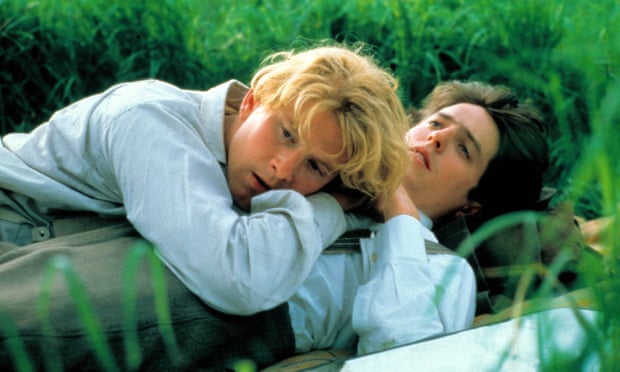
Pictured: James Wilby and Hugh Grant in Maurice. The film is available to stream on Kanopy and The Criterion Channel.
 Kevin Lally on Film
Leave a comment