I was at Film Journal for less than eight months when the opportunity arose in early 1984 to interview Alain Resnais, one of the pioneers of the French New Wave. At the time, I felt like Mike Myers in Wayne’s World: I’m not worthy! But this daunting intellectual proved to be warm, welcoming, and surprisingly down-to-earth.
I also have fond memories of the interview setting: the Upper East Side living room of Renee Furst, New York’s queen of art-film publicity, who passed away in 1990. I learned early that Renee always found a way to turn a “No” or “Maybe” into a “Yes” when pitching a film; fortunately, her clients and movie accounts were invariably worth covering. I once attended one of Renee’s parties, and she noticed me off in a corner by myself. “Mingle! Mingle!” she insisted. Thanks, Renee, for welcoming me to your world of great auteurs like Alain Resnais.
Although he is somewhat less well known than François Truffaut and Jean-Luc Godard, and although he was never a part of the Cahiers du Cinema circle of critics turned filmmakers, Alain Resnais is a seminal figure in the great French New Wave that revolutionized world cinema in 1959. Resnais’s Hiroshima Mon Amour, which won top prize at the 1959 Cannes Film Festival, is one of that year’s French trio of instant classics—along with Godard’s Breathless and Truffaut’s The 400 Blows—that signaled exciting new possibilities for the language of film. Resnais’s short films—among them the chilling Holocaust documentary essay Night and Fog and the Oscar-winning Van Gogh—had already established him as a filmmaker with a fresh approach to the filmic tools of time, movement, and the juxtaposition of images. His groundbreaking work continued with the strikingly beautiful, maddeningly enigmatic Last Year at Marienbad (1961), in which past, present and future, fiction and reality all merge into one elegant puzzle. Resnais’s experiments with time and nonlinear narratives continued with Muriel (1963), La Guerre est Finie (1966), a critically acclaimed study of an aging Spanish revolutionary, and Je T’Aime, Je T’Aime (1968), a wildly eccentric box-office failure.
Resnais didn’t make another film until five years later, when Stavisky, starring Jean-Paul Belmondo as the 1930s swindler who brought down the entire French cabinet with him, became a popular hit. In 1977 came Providence, his first and only English-language film, with John Gielgud in a tour-de-force performance as a cantankerous old writer who mentally dissects his children (among them, Dirk Bogarde, Ellen Burstyn, and David Warner) during the course of a fitful night. 1980’s Mon Oncle D’Amerique was one of Resnais’s most popular and accessible films, a bright, funny illustration of the deterministic theories of philosopher Henri Laborit.
Resnais’s latest film, Life Is a Bed of Roses, could be described as a lavish musical comedy, but with Resnais, nothing is ever that simple. The film intercuts three different sets of players in three different eras. In the first, set just before World War I, an aristocrat played by opera star Ruggero Raimondi assembles a group of friends at his extravagant castle for a brainwashing experiment designed to purge them of unhappiness. Resnais then shows us the castle today, the site of a rather absurd symposium on new educational methods. Mixed in with these sequences is an operatic medieval pageant as imagined by a group of children visiting the castle. The result is a witty, often deliberately campy sendup of grand utopian schemes.
At 61, Resnais is handsome and distinguished-looking, with a warm smile that reasserts the wry sense of humor that imbues even his most cerebral efforts. Despite his reputation as a maker of difficult, elliptical films, Resnais is self-effacing about his own considerable intellect. He regards himself as an entertainer—though his is entertainment that requires the viewer to put aside their preconceptions about narrative continuity and tune into the director’s playful mind games. Resnais spoke to Film Journal during his New York Film Festival visit, assisted by a skilled translator from New York’s French Film Office, Martine Singer.
Why did you make this film at this particular time? Do you feel this story about people searching for utopia has particular applications now?
I don’t think the screenwriter and I asked ourselves the question. When you write a script, maybe you’re influenced by the time in which you live. It could be said that people are always looking for new ways to find happiness, but it’s not necessarily a function of this time.
Were there any particular groups you were trying to parody with this film?
No, not at all. We tried like any director or screenwriter to entertain the audience for two hours. I wanted above all to make a light and entertaining film in which I could mix singing and spoken dialogue.
Are you amused that some people are looking to find more meaning in the film when, in a sense, that’s what the film is all about?
I’m not amused, I’m happy that people are interested in the film and that they ask questions about it and ask themselves questions, even if they’re questions that I myself never posed.
Should we come away from the film regarding any attempt to bring structure and order to our lives as fruitless?
I don’t think that it’s fruitless, but it’s just very difficult to form a conception of happiness in which you’re not imposing your own ideas on others. It illustrates the difficulty of existence, but nothing more.
Are you ever tempted to spell things out more clearly to the audience, to make the audience’s work simpler?
I try to make my films as simple as possible, but I know that I do have the reputation of making somewhat difficult films, for certain audiences.
When you made Stavisky, did that seem a real departure for you, in terms of a more straightforward narrative?
No, it’s that with each film I try to construct a different dramatic structure, one that flows naturally from the script.
Do you see a connecting link between all the works of your career?
What I’m trying to do is make films as different from one another as possible, not to bore the public. If there are connections between my films, they’re things I can’t control.
Does that mean that you don’t subscribe to the auteur theory of filmmaking?
I’m for the theory, but I don’t consider myself an auteur. I’m a director, and I think a director’s work is important enough not to go looking for more.
Over the years, are you pleased with the reception your films have had in this country?
Yes, I’m pleasantly surprised. I can even say that when I make a film, in my mind I’m thinking as much of the New York audience as the Paris audience, as if I had one foot in each city. Of course, Paris isn’t all of France, as New York isn’t all of America.
Do you have much input into deciding on the distribution of your films outside of France?
I can’t say I really control it, I leave that to the producer. But I’m conscious that I’m making films for more than the audience in France, because my audience in France isn’t big enough to support the film. The film has to be exportable to make a profit. The idea of exploitation is always present.
How would you describe the state of the film industry in France right now?
The big problem is that the price of a ticket hasn’t risen with inflation as other costs have. As it gets more and more expensive to make a film, I need twice as much money now than ten years ago to make the exact same film. In order to compensate for the rising cost of production, I need twice as many spectators because the price of movie tickets hasn’t gone up. It’s a worldwide problem.
Do you find those economic pressures enter your mind as you’re trying to make a film?
It’s for that reason I make so few films. Sometimes it takes more than a year to raise the money for a film, and sometimes you never even find it. So I then have to begin a different project.
Yet it seems you’ve never compromised yourself…
I never really had the opportunity. Maybe I would be ready to compromise if I had the choice, but I haven’t had the choice yet.
I’m sure you’ve been asked this many times, but what American directors do you admire?
The problem is if you name one, you forget three. Among my favorites are Altman, Scorsese, Coppola, Cimino and Herbert Ross.
Do you have any sense of your own influence on American filmmakers in terms of more sophisticated use of time and transitions?
No, I think that when these ideas are in the air, everybody finds them at the same time.
Do you feel there are young film artists in France who are comparable to the great New Wave of French directors?
There are a lot of young directors. There again, if I had a notebook, I could give you a list.
Do you feel their contributions are as valuable as what we in America consider the golden age of Truffaut, Godard, yourself?
(Silence)
Or is that an unfair question?
(Laughter) Yes. Godard is somebody who’s unique, so it’s impossible to have a new Godard. Such an unusual kind of genius that it can’t be followed. But I do think there are ten or so very talented new directors, as talented as the New Wave.
If you had the opportunity, would you do another English-language film?
Yes, it would be a pleasure…on the condition I wouldn’t have to presume to be an American or English director. It would have to be a story that suited a foreign director. I think it would be stupid to accept a western or a thriller that took place in the Bronx. I can imagine, however, doing a story about a French girl discovering Queens or Forest Hills. Either the script has to be a complete fantasy or it has to involve a foreign character.
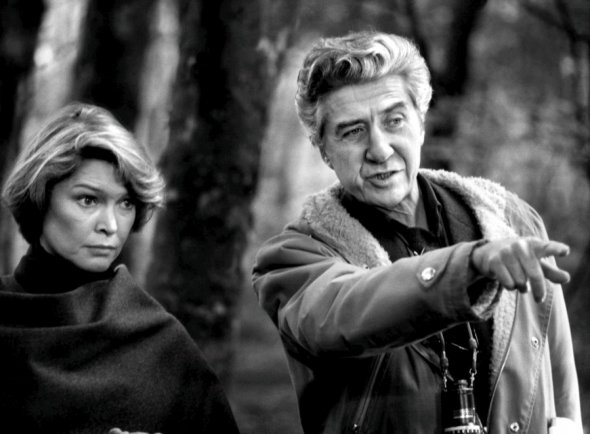
Life Is a Bed of Roses is available to stream on Kanopy. Pictured: Resnais directing Ellen Burstyn in Providence.

 Kevin Lally on Film
Leave a comment