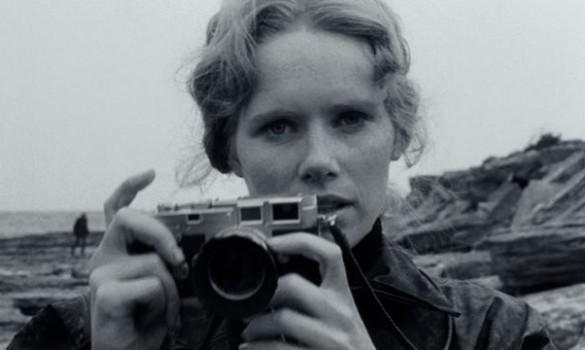
Liv Ullmann, icon of Swedish cinema, once sat at my feet—this interview from 1993 will explain why. It was the thrill of a lifetime to meet one of the greatest actors in screen history, on the occasion of her film directing debut. Ullmann went on to direct four more features (including two scripts by her famed mentor, Ingmar Bergman) and this year received an honorary Oscar from the Motion Picture Academy.
“I feel that everything I can give as an artist somehow comes together in writing and directing.”
Liv Ullmann is talking about the satisfaction she’s gotten from her feature directing debut, Sofie, the story of a young Jewish woman’s struggle for happiness in late-1800s Denmark. But, as you listen to her describe her new vocation, it’s hard not to flash back on what she’s already given as an artist, as one of the world’s most gifted stage and screen actresses. Still radiantly beautiful, with piercing blue eyes, the 53-year-old Norwegian established her place in film history as the muse of Ingmar Bergman in such powerful classics as Persona, Shame, The Passion of Anna, Cries and Whispers, Scenes from a Marriage, and Face to Face. She earned Oscar nominations for both Face to Face and her role as a struggling farm woman new to America in Jan Troell’s The Emigrants. A flirtation with Hollywood stardom in the early 1970s—including the disastrous musical version of Lost Horizon—proved short-lived, but Ullmann has thrived, alternating work in films around the globe, stage work in Norway and Sweden, authorship of two best-selling autobiographies (Changing and Choices), and constant travel on behalf of UNICEF and the International Rescue Committee.
Film Journal was privileged to visit Ullmann in her New York residence, a handsome, spacious apartment near Central Park West. Gracious to a fault, she cautioned that she had just eaten garlic at lunch and seated herself on the floor, away from her interviewer’s perch on the living-room couch. At one point, the star’s small, blond grandchild wandered in and piped a friendly hello, then was summoned into another room. It was a warm, inviting atmosphere for a discussion of Ullmann’s impressive family saga and her views on acting and directing.
Sofie was adapted by Ullmann and co-writer Peter Poulsen from Danish author Henri Nathansen’s 1932 novel Mendel Phillipsen & Son. Ullmann’s version places special emphasis on the film’s title character, a 28-year-old Jewish woman in Copenhagen whose family worries that she’ll never find a husband. Then, at an elegant party hosted by her wealthy uncle, Sofie meets Hojby, a debonair artist who wants to paint a portrait of the woman’s charming parents. Sofie and the painter find themselves powerfully attracted, but her family views Hojby, a Christian, as an unacceptable suitor. Eventually, she agrees to wed her plain, well-meaning cousin Jonas, but their passionless marriage leads them both toward psychological disintegration. Karen-Lise Mynster, one of Denmark’s top stage actresses, is Sofie, and her parents are winningly played by Danish veteran Ghita Norby and Ullmann’s frequent co-star back in Sweden, Erland Josephson.
“The novel goes in many directions,” Ullmann explains, “and this is a very distilled part of it. The writer is wonderful—he uses wonderful imagery… Reading the book was such a thrill and so inspiring, because he really gives color and smell to that time, and to [the experience of] being Jewish at that time.”
The novice writer-director always kept a copy of the novel at her side as a reference source. “When I look at it today, God, it’s so worn and I have notes on every page. It’s very strange—now the picture has kind of left me, and other people are handling it. But at one time, it was only mine, and all that is in that book, all those notes. Seeing it now, I remember. That was the best time.”
Ullmann says she not only identified with the title heroine, but with nearly every character in the film. “I must say I identified with her husband. [He reminded me of] all the times I’d seen other people become invisible—and the times I had been invisible, not a part of things. I also identified very much with Sofie’s father. My father died when I was young, and I always had this image of a father and mother who were so happy in love, and they look at each other at the end of their lives and it’s still the two of them.”
Sofie is also close to Ullmann’s heart because it addresses the issue of Jewish identity and assimilation, a theme that touches on her own marriage to a Jewish man. “I think all of us need to have an identity,” she urges, “whether we are Muslim or Chinese or Norwegian or what we are. That’s why I dedicated the film both to my grandchild, who is Christian, and my husband’s grandchild, who is Jewish, because I hope they grow up and feel proud of where they come from, but that they celebrate the difference. That they see that the other is great because of all the differences they can learn about.”
Ullmann speaks with glowing enthusiasm about her cast and craftspeople. “I had the best actors—they were all theater actors. One thing I knew before I started was to surround myself with the best talent I could. There are some directors who a bit stupidly surround themselves with new people, so that they will not be found out, that they don’t have all the answers. But I did the opposite. I thought: They’ll just give me the best, and I can pick and choose. And the costume designer [Jette Termann]—her research and her work were such a thrill. And the set designer [Peter Hoimark]—you can freeze the film anywhere and there are so many details, which also inspired the actors tremendously.”
Ullmann confesses, however, that as a woman, an actress, and a first-time director, it wasn’t easy at first to assert authority with her crew. “The pre-production was easy, because I worked individually with the actors, the costume and makeup people, the art director. All that went fine. But the first day on the set, meeting a full crew who want you to prove yourself before they will give you any respect, that was tough. Because I’m so used to pleasing people and hoping they will be happy. I’m not used to the fact that sometimes you have to give up friendship, you cannot be liked by everybody, and everybody cannot be happy. The next time, I will make sure who everybody is in the crew, and I will meet with them in pre-production, too, and make sure that they know from the first day who calls the shots, so that we don’t have to have a power struggle for the first week.”
Asked what lessons in directing she might have learned from all those years of working with one of the screen’s great masters, Ullmann responds, “Actually, a better lesson is from the worst directors I worked with—knowing what not to do, knowing not to invade somebody else’s fantasy with elephant feet. From Ingmar, I learned love and trust, and to surround yourself with the best. If you make actors feel loved and admired, they are there and they want to give… And if something is wrong, it’s most probably not their fault—maybe they’ve been given the wrong blocking. Don’t say, ‘Try to make it work’—change your concept of what you want them to do.”
Ullmann has strong opinions about what constitutes good and bad screen acting. “I hate watching those actors who are so ‘natural,’ in a way nobody in life is natural. They do so many things with their fingers, and coughing, whatever. It’s so phony, and I hate it. On the other hand, when you see a real, wonderful, honest performance which is observed life…like, I just love Al Pacino in Scent of a Woman. It’s a theatrical performance, but that doesn’t matter. It’s clean and pure—he doesn’t do ten things, he does one thing at a time. And people love it and laugh at it because they recognize it.”
The veteran actress also places a high premium on stage experience, contending that “very few actors in film who never had theater experience can ever get to the absolute top.” As a performer, she says the most fulfilling times come “when you’re least aware but still everything functions and you can let yourself go in the moment. Yet you are so tuned into what you do, you’re always on the outside knowing: Now she does this and this and this.” She equates the experience to “the violinist becoming the violin, the Weaver becoming the cloth.”
One week after this interview, Ullmann left for South Africa to do work for UNICEF and meet with Nelson Mandela—and be present for that country’s premiere of Sofie. A month later, she was scheduled to leave for Australia, to talk about the plight of refugees and again appear with Sofie. She notes, pragmatically, “Someone pays my fare, and I can combine the two—and one lends itself to the other. I didn’t make Rambo, so it’s not like I have to keep them apart.”
Ullmann has absolutely no regrets about her failed Hollywood career. “I’ve worked steadily, playing big parts in small pictures, in Argentina, Australia, France, Italy, England, that millions haven’t seen—but I’ve had a wonderful time. And played in movies about real women, reacting to what is happening in the world. A Soviet refusenik, a mother from the Plaza de Mayo, a lawyer in a Nazi concentration-camp trial—all these wonderful things, which I wouldn’t have done if I was a Hollywood film star. And, if I had been beautiful and lived in Hollywood, I would have been 20 years past getting parts because, I’ve heard them say, after you’re 35 or 40, it’s almost impossible. And I’ve had my best things happen, almost, after I was 40… If it had gone fantastic, it might have been all over. Maybe I wouldn’t have written my books, maybe I wouldn’t have worked for the UN, maybe I wouldn’t have gotten to direct my picture. This is my life now, and I feel very fortunate. It’s been so rich and exciting.”
Sadly, Sofie is not available for streaming in the United States.
 Kevin Lally on Film
Leave a comment