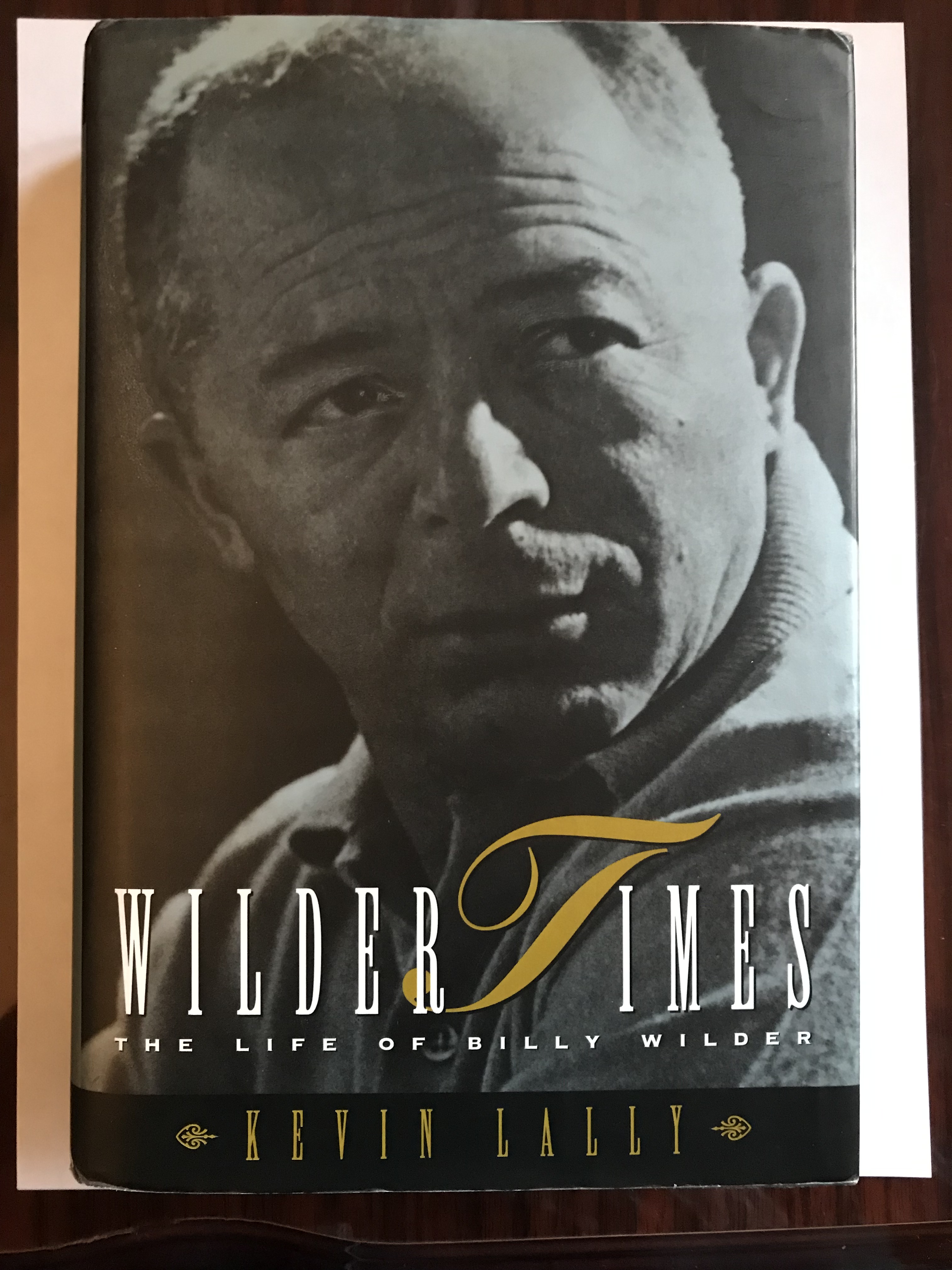
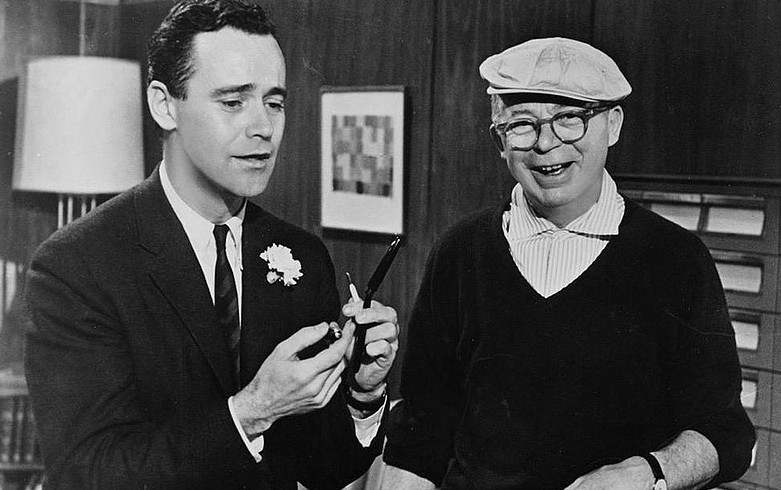
Apart from my conversations with legendary writer-director Billy Wilder for my book Wilder Times, I cherish the memory of my 1993 phone interview with his frequent leading man Jack Lemmon. The Oscar-nominated star of Some Like It Hot and The Apartment was completely generous with his time and insights, an invaluable resource for my project. At the end of our interview, I told him I was having trouble reaching his friend and acting partner Walter Matthau. “Tell you what,” he said, “I’ll reach out to Walter and ask him to give you a call.” The very next day, my office receptionist buzzed me with the news that Matthau was on the line. “What the hell do you want?” he asked with his patented comic gruffness. Thanks, Mr. Lemmon, for being such a mensch. Here’s the full transcript of our conversation.
Kevin Lally: One of the reasons I’m doing this book is because I feel Billy Wilder hasn’t gotten enough credit for being a groundbreaker in Hollywood, going all the way back to Ninotchka and through films like Double Indemnity and The Lost Weekend—you know the list. When you first started working with him, apart from having very good scripts, was there a sense of excitement about the kinds of themes you were dealing with, about pushing the envelope a little bit?
Jack Lemmon: Yes. As a matter of fact, on the first two films, Some Like It Hot and The Apartment, everybody thought Billy was crazy. And if it were not Billy Wilder, most people in the industry felt the pictures would not get made, if not for him and his reputation. Billy has always, and I do too, credited the Mirisch Corporation for being around at that particular time. The reason that they were so popular with Billy and a number of other great filmmakers and writer-directors was because they would gamble on the talent who came to them with a project, and once they had done that, they’d leave them alone. That’s the reason they attracted him and others of his ilk. And they proved to be more often right than wrong in their decisions.
But with Some Like It Hot, boy, we were really pushing an envelope, because there wasn’t anybody who didn’t think he was crazy. The film was considered to be very expensive and the subject completely risky, putting your two leading men in drag for over 80 percent of the film and taking a five-minute burlesque sketch, in the opinion of most people, and trying to stretch it into a two-hour farce. They didn’t think it would work, and they were damn near right, because the first preview was a disaster. Of all the films that I’ve done, including the rotten ones, that had the worst preview of any film of mine that I was at. Why? Who knows?
But the interesting thing was standing in the lobby afterwards and just watching Billy surrounded by all of the Miri—all of the brothers—offering suggestions, not saying do this or do that, but offering suggestions, They were all saying it’s much too long, it can’t hold, you’ve got to cut 10, 15 minutes out because they’re leaving in droves, etc. Billy just listened very politely, didn’t have much to say, which is unusual for him, and went back and took exactly one short scene out. That was a scene of me in the upper berth that came at the end of the train sequence. After the last scene you see there of the party with the girls in my upper bunk, with a little of the joy juice in me I’m now so enamored of Marilyn that I go back and jump up in her bunk—only she’s switched with Tony. I spill my guts and say, “I’m a man, I can’t stand it, I’m nuts about you,” and I take my wig off and she turns over and it’s Tony. I grab the wig, put it on my head, and say, “You wouldn’t hit a girl, would you?” It was one long monologue, a beauty. It was a very good scene, but Billy felt it was just one scene too many in that sequence. Other than that, he didn’t touch the film. He was smart enough to go on his own instincts rather than the reaction of that particular audience. It previewed again in Westwood the next week, over the Mirisches’ collective dead bodies, and you couldn’t hear the lines, the people were screaming [so much]. It was a smash.
He seems to have a great instinct for where the fat is in a film.
Yeah. It’s an interesting thing, to just pick something totally unrelated to Billy. After I made Save the Tiger, which was a very big critical hit and certainly very important to me, we were over [in Italy] shooting Avanti! When they got the final cut of the film, John Avildsen, the director, and Steve Shagan, the writer-producer, brought the print over for me to see in Rome. And of course, I asked Billy: Do you want to see this with Felicia and me? So we did. Billy was very taken with the film. And we were all sitting back in the hotel bar having a cocktail and talking about it afterwards in the late afternoon and there wasn’t anybody else around—the Grand Hotel, I think it was. Anyway, Billy looked distracted, he kept getting up from the table and walking back and forth. Then finally, he sat back down and said, “You know, for what it’s worth, it’s none of my damn business…”—except everybody was pumping him, naturally. He said, “I would do only one thing with this picture. I think it is a wonderful film, and I don’t think there is anything in the editing; even though this is your first edit, I wouldn’t touch it. I wouldn’t trim here or cut this word or change this line, I would do only one thing—I would take one scene totally out of the film. And quite frankly, I think it was the best scene I was ever in. It was a scene in the beginning of the film where I stop off to see my mistress on the way to work. It is the only time we ever relate in the film that I ever saw another girl regularly (I pick a girl up later in the film). But this was a fairly long scene, wonderfully acted, and then I went from there to the office. And he said: “The problem is you start your story and then you go down a side avenue, and you stop and you inspect a building and then you go back to the main street and go to the office and our story starts. Why are you doing this? What does it have to do with your real problem?” Nothing—except a beautiful scene. Well, we did take it out, and nobody has ever seen it. It’s as good a scene as I’ve ever been in, but Billy was right. And we would never have thought of taking it out, because the scene was so good. But it did slow the picture down—it stopped it from starting. It delayed the real start, which was me getting in and talking to my partner and saying we’re going to have to burn this fucker down, because we’re going out of business. And the picture gets started. Billy was smart enough to realize that.
Along the lines of pushing the envelope, I admire the social criticism in The Apartment. Could you put that in context for me? I don’t think there were too many other films at the time that were as critical of…
I forget who first made the statement—a number of people alluded to it—but the sense was if this was three or four years earlier, this film would not be made. Nobody would make it. The second thing was: What the hell is a film doing called The Apartment? What apartment? What does that mean? Who cares about an apartment? It brings out the old adage, as Billy pointed out: “If a picture works, the title is great. If the picture doesn’t work, that’s the first excuse people find for why it didn’t work.” It’s never the title.
But in general, I always like to say that what Billy did so successfully was to grow a rose in a garbage pail, because he told a romance, he made you care about these two people, with their flaws—it’s interesting that both of them are flawed. And he made you care about them. At the same time, he made a hell of a lot of personal comment about our business society and our mores and behavior—and made the best picture of the year.
You have to take some of the credit for that. Baxter [Lemmon’s character] is a patsy, a schnook, he’s not sympathetic at all, yet with you playing him, he’s likeable from the very beginning.
I think many actors are attracted to characters that are flawed, because we all are. It’s interesting, in Glengarry Glen Ross last year, the guy is a real son of a bitch, there’s no question about it, but—it’s built in—you cannot help but find a certain sympathy for him. Because he is put in a situation—he can’t pay the bills for his daughter in the hospital and all of this madness—which is only just slightly alluded to by David Mamet, it’s not dwelled on, so you’re not looking for sympathy. But somehow, after it was over, people were saying, Christ, I felt so sorry for this guy. And I thought: God, that’s amazing—I did everything in the world not to get sympathy. Because he’s a shit—he would sell his daughter’s soul in order to get a name on a contract, to get up on the board, as we say. He’d lie like a trouper—he’d sell marshland that was no good, he’d do anything to make a sale. He’s a fucking crook. And yet somehow there is some sympathy there. You can do it, but you’d better have a very good writer.
Did you and Mr. Wilder talk about Baxter before the film and, pardon the pun, try to find a key to the character?
Not to a great extent. One thing Billy does not do is rehearse a great deal. That I purely think is habit, because in the old days, when Billy was already firmly established, they never rehearsed. They never rehearsed for the simple reason that the studios, unlike the theatre which they had nothing to do with, the studios saw no sense in putting actors or anybody else on salary before you have to. At least this is what I’m told. So as a result, you’d walk on the set and you could be meeting your leading lady for the first time, saying, “Hello, how are you? My name is George. I love you, darling.” It’s kind of funny. I think they have found out since that you will not only get a better film but you can save money by rehearsals, if you have blocked scenes. Billy’s scripts, if he had chosen to, do lend themselves to rehearsal because the man writes good, literate dialogue with great scenes—they can be transferred to the stage very easily, as has been done three times at least, Sunset Boulevard being the latest. Some films, no, it wouldn’t work, because they are much more action-oriented, with short sequences and a million cuts, etc. Billy probably uses fewer cuts than any director I’ve ever worked with. He does long setups, with just one or two cuts within a scene. He takes a long time getting his initial setup and then just lets it go, which is great for the actor too, because you really get a chance to get rolling.
What Billy did do was give you ample time to work the scene in rehearsal and on camera, without any feeling of push or rush to get the print, but he did not rehearse beforehand. Also, we would discuss the character—I’d pop into the office any time I got an idea, and Billy would think about it and he’d smile a little and he’d say, “Wait and show me.” Whenever I had an idea, he’d always stop me from telling it and say, “Don’t tell me. I might misunderstand. No. Show me.” And he was always wide open. Even though he was the writer and the director and there was no gray area of misinterpretation, he would always let any actor show him or bring whatever they had to offer, and very he often would accept it. I have seen him take suggestions for a scene—that had nothing to do with the props—from a prop man, and say, “Hey, that’s a good idea,” and he’d use it. Which is really amazing. What it shows, interestingly enough, is great security. I have been very lucky over the 40 years that I have been doing features to work with some great directors, and the ones that are the really fine directors are wide open, they do not come on the set saying I know exactly what I want. They do know, but they don’t irnpose it. They don’t make the actor feel at all like, “Shit, I wish he’d give me a chance to show him something that I think is terrific.” You betcha he’ll let you. And if he says no, at least you had the opportunity to try this great idea that you had, and that is all that an actor can ask for.
When you hear about these, quote unquote, artistic-difference fights, where an actor says I cannot get along with a director, you’ve got an ego problem. Either that, or one or the other is awful. And it’s possible—an actor can get stuck, but why in the fuck did he take the picture if he thought the guy was lousy in the first place? If he’s playing a major part, he certainly must consider who the director is. Usually what’s happening is that the actor doesn’t realize that the most he can ask for is to be listened to and to try. If the director, with good reason, says “No, try it this way,” then you’ve got to give in finally, even if you don’t like it. Or you’re going to have a picture that is going to be a failure—usually. Usually those pictures don’t work out where you’ve had big problems between a lead actor and a director.
You don’t see that in Some Like It Hot—
No. [With that film], there were problems, but they could be handled. The problems were not artistic there. It was not a matter of interpretation, it was a matter of Marilyn’s [Monroe’s] incredible lateness, which was just driving Billy and Tony [Curtis] especially up the wall. Which is understandable. It was not intentional. Marilyn was totally screwed up and very unhappy, which she did not tell us. She had also had a miscarriage, and then had another one right after the film. But we didn’t know that she was not feeling well—she didn’t tell anybody. But she would just sit in [her dressing room], sometimes for an hour and a half or two hours while you’re just sitting on the set waiting. Well, you can imagine, Billy’s just going up and down the walls, and I don’t think he was totally thrilled with the idea that Mrs. Strasberg [Paula Strasberg, Monroe’s acting coach] was there, although he didn’t let her become a distraction to him. The very fact that Marilyn would look to her for approval is not easy for a director to put up with. It’s not exactly a total slap in the face, and yet it is. Marilyn certainly respected Billy, there’s no question about that, it’s just that she had this thing about her guru.
There’s a story that on the first day of shooting, he turned to her and said, “Was that all right for you, Paula?”
Yeah, I believe that’s true. I saw that repeated in Tony’s book. I think he’s right. I think it was true. It sounds so much like Billy, too. That sort of shut her up. [laughs]
In retrospect, do you think there’s any way Marilyn could have been handled differently during the film?
No. It was a thing that Marilyn couldn’t help and that Billy and everybody had to adjust to. I made an adjustment where I said I’m not going to let this get to me, or it will bother me. But it was easier for me to do because, in the second half of the film especially, Tony has the majority of the scenes with Sugar, with Marilyn, and I’m off with a rose in my mouth dancing with Joe E. Brown and having fun. So I didn’t have the problem of long scenes with her—I had very short scenes with her, and scenes with Tony, and those all went great. So Tony had that problem. And he did let it get to him. I suppose, if anything, we could have said: “Tony, you should try to make an adjustment, just for your own peace of mind.” I don’t think it hurt his performance at all—the performance was terrific.
You’d never know watching the film what was going on behind the scenes.
Yeah, you’d never know. It was just purely the frustration of Marilyn’s…whatever her problems were. She was not happy, obviously. And she just could not come out and face the camera until she felt ready, even though she was fully made up and ready. And that’s frustrating as hell.
Everybody talks about the scenes in drag, but I’m just as fond of the early scenes with Joe and Jerry. There’s a real comedy-team dynamic between the two of you.
Yeah, very good. Two weeks into that film, I remember saying to myself: “Jesus, I may be crazy, but I could be in a classic.” While everybody else was saying Wilder’s gone nuts, I thought this has a good chance of being a classic.
Was it fun working with Joe E. Brown?
Oh yeah. With all the guys. The feeling on the set, with the exception of the problems with Marilyn, which were not constant, was absolutely marvelous. Just breaking up and people really enjoying themselves. There was a physical discomfort—our legs and feet were killing us in the damn high heels—but that was nothing. And the makeup took a while. But, all in all, it was a tremendous experience.
I heard the story about how Mr. Wilder approached you in Dominick’s Restaurant about doing the film [noting that Lemmon would have to spend a huge portion of the running time in drag]. Was that the first time you met?
No. We had met, but only hello, how are you. Only socially. I met him with George Axelrod, whom I had worked with. He was doing Seven Year Itch with George and Marilyn. I walked in to see George and I met Billy—we chatted for a few minutes. And when I was in London doing something or other, he came to see me one Sunday about the possibility of doing Witness for the Prosecution, which Ty Power did, I guess. They then went older, but he came over to speak to me about it. But I didn’t know Billy well, and I didn’t socialize with him until after we started working together. I respected him immensely. There’s no question that if anybody other than Billy Wilder had approached me in Dominick’s with that spiel and said, “Do you want to do it?”—not “Do you want to read it?” but “Do you want to do it?”—I wouldn’t have said yes. I don’t know who was crazier, me or him.
You’d been in films about six years at that point. Were there things you learned about the craft of film acting from Billy Wilder?
Yes. Definitely. Mainly not from things he would say to me, but just by watching him direct, watching what he would print. I became really fascinated watching him as a director, more than thinking about myself as an actor. It was interesting, because of the long time he would take discussing the scenes with Doane Harrison, who was his editor. He had Doane on the set all day long, and he would make Doane an associate producer and pay him more money. He said, “Doane is worth more than I pay him, just in what I don’t shoot by saving me time and effort with setups.” They would talk for a long time about that one setup. Then he’d shoot the whole damn scene in that one, and then there would be a few cuts. But in general, Billy would cover it in one—he’d move the people in the camera, and very often just eliminate cuts, so that the audience wouldn’t even think about it. He’d just keep that camera wherever he felt the audience’s eye should be at that moment. I believe that we go deep, deep into the film, all the way into the train sequence, before there’s a single closeup of me on the screen. And then, when he does suddenly cut to a closeup, the audience doesn’t know why but it knocks them on their ass—and that’s me looking out of the upper berth as all the girls are walking back and forth in their little nighties. And I’ve got my hands under my chin and my fingers drumming my cheeks and a grin from ear to ear, and I look like I’ve just been locked in a candy shop. And the audience goes bananas. Until then, he didn’t use a closeup. As he once said to me, a closeup should really mean something—it’s like a hit in the solar plexus.
From the descriptions I’ve heard of a Wilder set, it’s almost a paradox: He believes in strict adherence to the script, yet at the same time it sounds like a very loose, genial atmosphere.
Oh yeah. Very. And in rushes. Anybody off the street can walk into the rushes, anybody off the street can walk in while he’s shooting. But as far as the script itself goes, I’ve done seven films with Billy, and I have never heard one actor, in any part, ever even ask to change a word. Not only because Billy would probably say no, but you don’t have to. One of the many things I learned from him about really good writing is it’s not just what you write, it’s what you don’t write. There is not one extra syllable in Billy’s scripts, especially the better ones, where he’s really on his stick. Which is a credit to Billy and, in my history with Billy, to Izzy Diamond. God, I love that crack, which I’m sure you’ve heard. The A.L. doesn’t stand for anything. Izzy was a writer on a paper in Buffalo, New York, and the guy said “I. Diamond is no byline and Isidore is too long. Add something to it.” So he put I. A. L. Diamond, and the editor said, “Fine. What the hell is the A.L.?” And he says, “Abraham Lincoln, who knows?” So from then on, it was I.A.L. Diamond.
Anyway, Izzy would sit all day long just holding the bible. Izzy was a sweet, wonderful guy, a lot of fun, but with a dry sense of humor and very, very quiet. Very often he’d be thinking of things that were probably terribly funny, because I’d see him sitting alone on the stool, smiling from ear to ear, but not talking to anybody, not telling them what he was laughing at. Izzy would sit and watch, and at the end of every take, Billy would turn to Izzy, because very often the actors are flowing along and they might have dropped a line or something, and very often did without realizing it. And Izzy would say, bzzzz bzzzz bzzzz, and Billy would say, “Once more! We forgot ‘Hello, how are you?’” Or one word.
Now, the first day of shooting on The Apartment, Billy got one thing very straight with Shirley [MacLaine], because Shirley was very used to getting a little loose with the dialogue. There’s nothing unprofessional about that, because with other writers every actor does that, in film and very often in the theatre. Actors used to do it in the theatre, and that’s why they made the law that you can’t make a change without the approval of the author. They don’t have that in film, unless the individual writer has it in his contract. And all too often the writers don’t even come to the set. She liked the feeling of spontaneity, and not necessarily saying the lines word for word. The first scene that Shirley had was when she was in an elevator, early on in the film going up and down, doors are opening and closing, people are getting on and off, and it’s a pretty long, complicated scene for her—which she did beautifully. However, she was not saying the lines at first. And she didn’t know about Billy, this was her first time. And Billy kept saying, “Say the words.” And she says, “You mean exactly?” “Exactly!” Sweat’s beginning to fly, because she’s got a million of them, two full pages of stuff. And finally, when she did get a good take, all the way through, Billy turned to Izzy and Izzy whispered something to Billy, and Billy said, “Let’s do it just once more—you forgot the word ‘and’ on the second page.” And he really made her do it again. And then he gave her a kiss. But, by God, she never came in and started to ad-lib or drop any words from that day on. She came to me afterwards and I said, “Hot dog! You learned! It’s just with Billy, you don’t do it.” And she said, “God, I wish somebody had told me.”
She has said, and confirmed with me, that Wilder is very precise and scientific about pacing. He’ll do a scene and then say, “Let’s do it again—but this time in 17 seconds.”
Yes. It’s a good idea, and he once told me why he did it. Billy is the only guy I know—there may be other directors, but he’s the only one I’ve ever worked with or heard of who has his script clerk time the scene with a stopwatch, from the first rehearsal on. Now here’s what happens. As you keep rehearsing a scene and finding a little more, that may be fine. But now as you begin to lock it up, and for various reasons you start to repeat the scene on film—you may go eight takes, you may go ten takes, that’s nothing unusual, and you think you’re really barreling along in the scene and it’s terrific and you’ve got a lot of energy—Billy will turn in front of the actors and say, “What was the timing on this last take?” And she’ll say, “Two minutes, six seconds.” And he’ll say, “What was the timing on the third take?” She’ll say, “One minute, 50 seconds.” You think you’re doing the same thing but you’re losing the energy, and he’ll say pick the pace up. That’s the reason: It’s because the scene is beginning to get a little dissipated, but the actor doesn’t realize it.
But Billy is also very good at knowing when the pace should be picked up and when it shouldn’t. In all of the films that come to mind as Billy’s greatest, it’s not Billy the director, it’s Billy the picture-maker that really has come to the fore. He’s one of the all-time great picture-makers, à la Fellini, etc. I think Ollie Stone is on the way to being one. I think Altman is one. They are people that know how to string the pearls together and make a handsome necklace; they know how big that individual pearl should be, how dominant, and how fast, how slow, how the scene should be played in the first place, to fit in with the other scenes. Not just let’s pick the pace up in every scene. That Billy is very, very good at.
You’ve been friends with him for 35 years now, and you’ve seen him through ups and downs, through things that critics have said about him. What do you think is the biggest misconception about him?
If there is a misconception about Billy, I think it’s—and they especially used to refer to it when he was more prolific, when he was younger—the acid tongue, the bitter humor, etc. I have always felt that he’s the biggest softie that ever walked. The reason that Billy is called an acid tongue is because he is so sensitive to human behavior and so perceptive that he notices things that other people just don’t notice. And he is able to point them out with a personal barb. The Apartment, for instance. That kind of behavior wouldn’t occur to most writers to make a film about, at that time especially. They would accept what is the norm; Billy would not. He will notice things and point them out. In other words, I think in order to satirize with that acid tongue, you have to be sensitive to notice it in the first place and to care about it. And I think Billy notices those things in what is called ordinary, everyday behavior to a greater extent than the average person.
I want to ask you about that period when Kiss Me, Stupid came out. Were you witness to that depressing time?
Yeah, especially because Felicia [Farr, Lemmon’s wife] was in it. I think what happened was, again, Billy was ahead of his time. In general, the thing that’s remarkable about Billy’s career is, of course, the length of it, from Ninotchka to recent years. And Billy has not only been able to do what most writers and directors can’t do, which is to keep changing with the times, but also to cause the changes, to be ahead of them. He was ahead of his time with that film. I think what the film did suffer from—this is my personal opinion, Billy might disagree—is that when Peter [Sellers] got ill, got his heart attack and now Peter’s gone (it was written for him) and when Ray [Walston] had to take over—and it isn’t that Ray isn’t a hell of an actor, it became a different film. Who knows what would have happened? But it was written with Peter’s particular genius in mind, and I think you would have had a vastly different film. Who knows, it might have been eminently more successful. We’ll never know.
I remember after the first preview. It hadn’t gone well and he knew it. He shrugged his shoulders—we were in the back of the theatre—and he said, “Trust me. Within several years, they will be making films that we would now call pornographic.” He was right.
I and a lot of people I know think Kiss Me, Stupid is an extremely underrated film.
Another one is Ace in the Hole. I remember once, Tony and Billy and I were in San Francisco plugging Some Like It Hot on a radio show, and the gal asked a question. She said, “Billy, Ace in the Hole has become a kind of cult film, and vastly appreciated to an extent far greater than when it first came out. How do you feel about it?” And Billy smiled and said, “You always love your crippled children most.” It was one of his favorites, but that doesn’t necessarily have anything to do with how successful a film is with the public.
Do you think some of your later films with him are underrated?
Yeah, it’s interesting. Some people will take Avanti!, for instance, and say, “Of all the films you did with Wilder, that’s my favorite. I keep getting fan mail like this. It’s not one of my favorites. I think it’s a good film, but by the very nature of the film itself and the subject, I don’t think it’s on a level of The Apartment, let’s say. Fortune Cookie, in a way, did not achieve what I thought it could. It almost was another Apartment in its own right, but not quite. The Apartment was the best single blend of comedy and drama that I’ve yet read in a script or certainly been part of, and I’ve been lucky—because that’s what I’m always looking for. I’ve been lucky to be in a number of films that combined both. The Apartment does it better than any I’ve ever known. By the same token, for pure comedy, I have never read a script by anybody—including three, four or five or whatever I’ve done with Neil Simon (whom I adore), Larry Gelbart (whom I think is one of our better writers), etc.—I have never read a comedy script as good as Some Like It Hot. Ever. I think it should be a required text for all students in every university who are studying film writing. And it probably is. You just can’t surpass it.
Did you sense that Wilder was aware that he had such a hard act to follow after that peak period around 1959, 1960?
I think probably. I think he’d have to be. I never met him personally, but I know that James Jones after he wrote From Here to Eternity, I wish I had a nickel for every time in the ensuing years when he brought up, “Now what do I do?” The same with Joe Heller after Catch-22—whom I did get to know, he’s a heck of a guy. I remember him saying the same thing. It’s so elating and so wonderful when you have a really, really big hit—not just with the public but with the critics. And then you are faced with the task of, okay, sit down and start writing again. What the hell are you going to do? Now Billy reached his peak [in the early ’60s], despite the enormous body of work that he already had of comedies and dramas—and nobody else, no great filmmaker has had the range in the history of film and the influence that Billy has, including Lubitsch, who was his idol. But I think there the student surpassed the teacher. Billy would have to be aware, during Some Like It Hot, followed by The Apartment, Jesus Christ, and then Irma La Douce, his biggest hit—maybe artistically it was not the level of those two, but it was an enormous hit. Boom, boom, boom—three years in a row. That’s awfully tough to follow. But he did follow it with The Fortune Cookie. I will say this. I did get the feeling after Fortune Cookie, starting around Avanti! and in Buddy Buddy, that Billy was pushing a little more. I may be wrong, but I felt that Billy was getting a little more didactic in his staging, trying to be a little more exact in what he wanted out of each scene, that there was a little less freedom for the actors. Whether that was conscious or unconscious, because he was trying to make it exactly right, I don’t know—it may be this is only in my mind. But I felt it a little bit, and I think that Walter felt it. Certainly, there was the pressure of wanting to have another hit.
When you made Buddy Buddy, did you have a sense of how much was at stake with that film, that he’d never make another film?
No, we didn’t. Not at all.
Are you angry that he hasn’t been able to make another film?
Yeah, I wish he would. For years, I have wanted him to do a tight little melodrama, not a comedy. It had been so long that it would be really interesting to see him do another film à la Sunset or more along the lines of Double Indemnity, because he was so wonderful at that too.
After Buddy Buddy, did the two of you try to get anything off the ground?
No. Not unless Billy had some ideas and they never quite panned out or something. Very often he’d have a couple of things on the back burner, but he would never say anything until he really was beginning to go with something. Before Izzy got sick, I don’t know what they were working on, to tell you the truth. I know Izzy would be in the office, so they were doing something. But whether they actually had settled on something…very often they’d have two or three different balls floating in the air. There was always something sitting on the back burner. For all I know, Billy’s got something cooking back there now. I don’t know—he won’t say anything, and I see him all the time.
He told me he still hopes to make another one.
Well, that’s awful good news. I hope so. I hope someone’s smart enough to let him do it.
How did you feel about the idea of remaking The Front Page, after a classic like His Girl Friday?
It didn’t bother me, any more than doing Irma La Douce as a non-musical, for instance. A lot of people criticized it before we did it, saying that, yes, [André] Previn wrote some incidental music but there were only one or two songs at most in it, as opposed to it being a musical. Billy wanted it to be more lifelike, to have more reality, rather than do a musical, which is sort of like a fairytale on screen. I agree with Billy.
I felt if Billy wants to do The Front Page, he’s got a good reason. Frankly, The Front Page is not one of my favorites. Now this is just me: I wished that Billy had been a little looser as the writer and let us overlap and charge it more, and screw the lines. But Billy the writer, I know, does not like to have any of his words not heard. I would have liked to have seen all of the guys overlapping to the point where you lost some of the dialogue.
Which is right there in the original play.
Yeah. But that’s very difficult for Billy to do. If I have to fault Billy at all, I would fault him on that minor level only. I did a stage version of Long Day’s Journey which Jonathan Miller directed. Jonathan directed it like it was an opera, which he directs a lot of. It was wonderful. We overlapped like mad, and as a result it was almost 40 minutes shorter than the usual three and a half or four hours that Long Day’s Journey usually takes. It was really a family fighting with each other—when you are a family fighting within the confines of your own home and screaming at each other, you don’t stop and listen to every word someone says and then speak. But that’s the way O’Neill had always been performed before, with too much awe, too much respect. And not only that, in his writing he was very repetitious—he keeps repeating, beautiful language, but he keeps repeating things that the characters say over and over. So we were convinced that he knew all along this is the way it should be done—that’s why he did repeat them. You didn’t lose anything, really, but you got the feeling of people that were not only getting drunk but not listening to each other enough and hollering at each other. A few critics took exception and said, “I couldn’t understand some of the words.” Well, fuck ’em, they weren’t supposed to. It’s just that over-reverence to the written word—I think that Billy had a bit of a concern about whether they would hear every damn word [in The Front Page]. So we would bite the cues, but we wouldn’t overlap them, and we should have. l’m certainly not faulting him as a director, I just would have…because when we did start to instinctively overlap, he’d say, “Wait a minute, I’m losing it here. It’s too much. Don’t do that.” And I knew what was happening—the writer takes over.
But that’s understandable, because Billy has always considered himself primarily a writer, not a director. I’m sure you’ve heard his statement that when he finishes his final draft, 90 percent of the film is done as far as he is concerned. The 10 percent left is the drudgery of putting it on the screen. The reason he began directing was only so that he could get what he wrote on the screen the way he intended it. I’m sure that’s the motivation of every single writer who becomes a director—they don’t want that gray area of misinterpretation. Ollie Stone sees something when he writes it, and he wants to get it there the way he saw it. That doesn’t mean the actor can’t bring something, but basically he’s getting the scene the way he saw it.
Wilder was a pioneer in that area. I think only Preston Sturges and John Huston came before him.
Exactly. Even then, they didn’t know what the hell to do with his first one, the one with Ray Milland…
Oh, The Major and the Minor.
No. The alcoholic.
The Lost Weekend.
The Lost Weekend. They sort of sneaked it out quietly in Boston, and suddenly the figures went bananas. And they said, “Holy moly.” So then they began to change the whole release pattern, and Billy was now welcomed with open arms at Paramount as a writer-director. But they were sort of patting him on the back and giving him a little weenie with the first one.
Actually, the first one was The Major and the Minor with Ginger Rogers and Ray Milland, which turned out to be a hit, very unexpectedly.
Was that the first one? Well, they also didn’t think that this one [The Lost Weekend] was going to be a hit, according to Billy. He said it’s a miracle that it got released the way it did.
I’m curious about how Avanti! came together. How did Wilder light on this particular project?
I don’t know. I do remember, only vaguely, one conversation about something both Billy and I believed, that it was not a great play at all. [Samuel] Taylor was a very talented playwright, but Billy did not consider this to be a terrific play—and I don’t think it was received as a terrific play. But he did feel, as is so often the case, that it could make a better film than it did a play. And it’s often the case that you take a good play and it makes a lousy movie because when you “open it up”, you fuck it up. The tendency is to overdo that, I tell you from my personal experience, David Mamet is a genius at taking his work, which is usually very confined on a stage, maybe only one set; when he opens it up in a screenplay, he does it so gently and so correctly, just enough. It’s a difficult tendency to resist, because there are no limits with film.
Correct me if I’m wrong, but the character you played in Avanti! seemed to be kind of a stretch. I don’t recall you playing such a cold character.
Again, most of my characters are flawed, which is great—and it gives them a chance to grow and to learn. They may already be mature men, but I know very, very few mature men, if I know them well enough, that don’t have an area that could be developed, where they could learn a little more about human behavior and change their own for the better. Certainly, this guy was a rich, snotty prig in many ways—I’m exaggerating slightly only to make the point. And, as [Juliet Mills’ character] aptly pointed out, it was very unattractive. He might have been a decent-looking guy and civil and so forth, but he definitely had delusions of grandeur and, socially at least, was very class-conscious for an American. He felt that he was above people, that money counted, etc., and one behaved a certain way or that was it. In a peculiar way, there were characteristics that were similar, of all people, to my character in Missing, who was this sweet, gentle, contained man, but also had very, very strong attitudes about what one behaved like and what one did not behave like to meet his standards—and hated his daughter-in-law because of that. He had to grow and learn. In a totally different—my god, totally different—way, yet with the same faults, the guy in Avanti! did, too. She was just nothing but a future charwoman, the young English girl, as far as he was concerned.
I suspect what might have attracted Wilder to Avanti! was the theme of the clash of American and European values.
Yes. No question that had something to do with it.
Because he himself is such an American, yet he’ll always be a European.
You know, the interesting thing about Billy…I think that one of the reasons that Billy is probably the best and most literate writer in the last 30 and 40 years of film, maybe more, in my opinion, is because he is not an American. This is Lemmon’s theory, but I think that if someone has to come over to this country and learn this language and it’s not his native tongue, and he is not a kid but a grown man or woman, then he really learns the language. We do not. We are brought up with it, and we just accept it. We hear it from our parents and our peers all day and all night, and we use words without even thinking. But every time that Billy Wilder uses one single word, he learned it and learned what it really meant. He says, “I learned it from listening to baseball programs.” Well, I’m gonna tell you—whoever those announcers were, they studied Shakespeare, for Christ’s sake. He didn’t learn any English listening to baseball games. He might have learned the rudiments of it, but this man really learned this language and the value… He has great respect for the English language, he won’t use a word unless it really is the right word and if it’s necessary. He doesn’t just throw the words down just to get the thought over. Every word is exactly the right one.
Yet he still has a little bit of insecurity about all that. Barbara Diamond told me that if he had known at the beginning that Izzy Diamond wasn’t American by birth, they might never have gotten together, because he wanted his collaborator to be a “real” American, someone to lean on.
I think that’s probably why he always has used a collaborator—I think you’re right there. He wanted an American, just in case he started to lapse into…two things: first, the language itself, but also an attitude in thinking of a scene. If he was getting too European as averse to how an American would react.
Did you know Walter Matthau before you started The Fortune Cookie?
Yeah. I knew Walter, but it’s so funny how we never worked together before, because we were thrown together in the same melting pot of actors who came back after the war. We’re approximately the same age—Walt’s a couple of years older—but at any rate we were in the same boat. We came back from the war, I came down to New York, and we were both in the early days of live TV and Broadway, but we never did a show together. I did at least 500 television shows over a period of five or six years, from about ’47 through ’53, and Walter was doing the same thing and appearing on Broadway. I only did one Broadway show, but I played a lead right off the bat, in a revival of Room Service. Walter was supposed to do it with me, and unfortunately he had a conflict. He worked with Felicia before he worked with me, and we knew each other: “Hi, Jack!” “Hi, Walt!”
We never worked together until Fortune Cookie. And Jesus, it worked from the very first morning—first time, crack out of the barrel, it flowed like we were sitting down at breakfast and just talking with each other. It’s that same sort of feeling. It’s just terrific. It’s been a wonderful relationship because I think it’s strengthened by the fact that we not only have an onscreen relationship that works so easily and so well, but personally. And the more that you know someone personally, the easier it is to work with them. The same with our wives, who are like sisters. So as a result, we are extremely close, see each other all the time. And when Walter and I work together, we can change scenes right in the middle, do anything, and the other guy goes along with it.
Clearly, on The Fortune Cookie you knew he had the part that was going to steal the film.
And as I told him. He loves to tell this story, I don’t even remember it, that he said to me, “Why are you doing this picture? I’ve got the part, not you. You always play the lead—why are you doing this?” And I said to him, “Well, it’s about time, isn’t it?” And I did feel that. There’s no question. I have always felt, to this day, that Walter hasn’t been tapped. I don’t care how wonderful he’s been and everybody adores him—I still don’t think that they have really started to stretch Walter. When I saw him on the stage in The Odd Couple, that was the single best comedy performance I’d ever seen in my life, in my opinion. And the astounding thing is that Paramount wanted me to play his part—they assumed that’s what I would want to do. I came back and said, “I’ll do the film, but I will not do it unless Walter plays that part. I will play the other part.” The studio said, “We cannot use Art Carney because Art does not have a name in film.” And I said, “Okay, then I’m not grabbing the part from him. I’ll play that part, but I will not do the film unless Walter plays Oscar. It’s a crime to let somebody else play Walter’s part because they have a name. I won’t do it.” And they said okay. At that time, I had enough clout to be [the one star] in a film. That’s how that all happened.
Prior to that, Billy had wanted to use him in Seven Year Itch and wrote the adaptation with him in mind. Again, Tom Ewell had done it on the stage, and Tom is a great actor, but Tom also had more of a name, and that’s why Walter didn’t get the part. So this time, knowing I was going to do it, Billy wrote the part for Walter. And that did it for him, and rightfully so, because Walter had done a million pictures and a million Broadway shows up until then, won 85,000 Tonys—he was just a wonderful actor that never got the big break, and it was about damn time he did.
I read that Carol Matthau kept the production of The Fortune Cookie going somewhat by underplaying Walter’s condition after his heart attack.
Yeah, I think she did it automatically: “Oh, he’s coming along fine. He’s just dandy.” But, boy, he had a ripper, and you couldn’t see him for a long time. My favorite story is that he sent word to me immediately, with an envelope, and he said, “I want you to meet Jaime at ten o’clock tomorrow morning across from the entrance to the Goldwyn Studios,” where we were shooting. “He’ll be in a beat-up old Dodge. He’ll come across the street. He’ll just look at you and he won’t say one word. Hand him the envelope.” The envelope was filled with money that he owed to the bookie, and he was afraid of being in the hospital and not being able to tell them, “I can’t pay you off.” He thought, “Christ, maybe they’re going to come kill me. They’ll grab Carol.” Jesus, he was funny. So I did, and I wanna tell you, this funny little fireplug of a guy, about five foot zip, came out of an old Dodge, crossed the street, just looked up at me and raised his eyebrows, did not say a word. I pulled the envelope out and said, “Jaime?” and he nodded. I gave it to him, and he said thank you as he was walking away—he didn’t count it, the envelope was sealed.
One last, very general question. Have you ever stopped to analyze why you and Billy Wilder hit it off so well?
God, I don’t know. Well, first of all I love his sense of humor. I can tell you, this man, to this day, is still as funny as he was when he was 20 years old. His mind is really brittle. He’s starting to forget, between you and me—he’s beginning to forget a couple of things. I sat at lunch the other day with a guy for an hour and a half, and we were wondering where Billy was. We went upstairs to his office around the corner and he says, “What are you doing here?” He forgot. He thought it was Monday and it was Tuesday. He says, “Today is Monday.” I said, “Billy, today is Tuesday.” He says, “Nooo. Let’s check.” He looked at his calendar and said, “Son of a bitch, you’re right.”
Anyway, I think it’s the joy of being around this enormous talent. Once I started working with him, it went beyond just admiring someone whose work I had seen. In other words, if I had seen all the exhibitions of Picasso to date while he was alive, and admired him immensely—or Van Gogh, whoever you want—but then had the opportunity suddenly to be with them every day in their studio, there would be a different feeling of great admiration, and the idea of being friends and getting along so well with someone whose talent was just now being displayed in front of me, and I was becoming part of it. I wasn’t just in awe—l was now an integral part of his life. When we were going to New York and showing the first screening of Some Like It Hot at Bill Paley’s house in Long Island, in the car on the way out, Billy started talking to me about The Apartment. So here I am, I’ve just finished one film that has not been seen, and Billy is already saying he wants me to play the lead in the next film, and he’s telling me about it. Well, Jesus, that’s sensational. So the idea that I could be that close to someone I admired and loved that much was just terrific. What Billy saw in me, I don’t know—but that’s what I saw in him. It was a wonderful thing to not only be able to work with him professionally, because I admired him so immensely, but also to be a close friend. That was really the icing on the cake. He really is like an older brother and a father—part father, part older brother. What I’ve learned from him goes so far beyond just film or acting or writing and directing—it’s just about living, about values, about art. I mean, this man has interests! He reminds me in a way of Jimmy Cagney—he’s got antennae out for everything under the sun, not just his work. He’s broadened my horizons a great deal, far beyond just film.
(Photo ©United Artists Corp.)
 Kevin Lally on Film
Leave a comment