How lucky was I to visit Jim Henson’s whimsical headquarters in Manhattan in the summer of 1986. But this wasn’t my first encounter with The Muppets. Eleven years earlier, I was working a summer job as a doorman in a building off Riverside Drive whose residents included Shelley Winters and the voice and soul of Miss Piggy, Frank Oz. One day, much to my delight, Oz invited me to come to the “Sesame Street” studio and watch the Muppeteers at work. It was an enthralling experience.
Jim Henson died four years after my interview, at the shockingly young age of 53. But more than 30 years later, his Muppets remain beloved by a worldwide audience, and the cult around his movie Labyrinth has only grown.
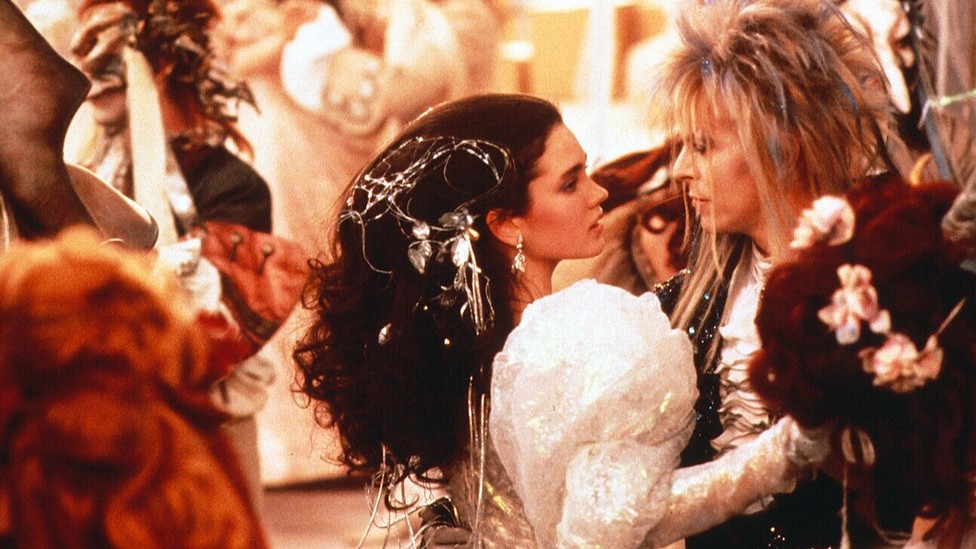
Kermit the Frog is probably green with envy and Miss Piggy is surely in a pique—after all, Jim Henson, creator of the phenomenally successful Muppets, is traveling with some fast company these days. For his lavish Tri-Star fantasy Labyrinth, Henson has teamed with the force behind the Star Wars trilogy, George Lucas, who serves as executive producer. And starring in Labyrinth and contributing five new songs is one of rock music’s most charismatic, elusive and durable figures, David Bowie.
Henson’s headquarters on Manhattan’s Upper East Side reflects his success while maintaining a spirit of fun. The elegant beige and cream décor is interrupted by a line of red theatre seats for visitors, behind which a mural depicts familiar Muppet characters cavorting in identical rows of red chairs. The building’s centerpiece is a handsome spiral staircase housing an elaborate, three-story mobile consisting of hot air balloons and miniature Muppets clinging to rope ladders. Truly, this is The House That Kermit Built.
Just as his career has progressed in stages from a five-minute TV show (“Sam and Friends”) through “Sesame Street,” “The Muppet Show,” “Fraggle Rock” and three Muppet movies to big-scale film projects, Henson says his innovations in puppetry have been the result of slow and steady growth. Refinements in remote-control radio operation and his colleagues’ artistry make the myriad creatures of Labyrinth, in Henson’s words, “the most sophisticated characters we’ve ever built.” When asked to elaborate on his new techniques, however, the puppet magnate simply responds, “Everything always has the next generation of development—everything is just the next step better, more advanced, more complicated. And then there’s stuff that’s so complicated it’s not worth bothering to explain.”
Surprisingly, collaborating with optical effects master Lucas did not appreciably change Henson’s working methods. “Virtually everything is live. Most of the effects are done in the studio—I like to work that way. The ‘Fire Gang’ number is the only large section of the film that is made with opticals. Sometimes I don’t like the surprise of opticals, where you shoot something and don’t really know what it’s going to look like until several months later, and by that time you’re heading towards an answer print. Robert Watts, one of George’s vice presidents, looked at the very first assembling of the film and was knocked out by how many things which they normally would have done afterward optically were already done.
“ILM [Industrial Light & Magic, Lucas’ visual effects company] did a few paintings for us, a few glass mattes, but basically they were not heavily involved with the special effects… Most of George’s work on the film related to the script and the story—George is very good at all of that. Another area that he is particularly good at is the editing and post-production. I think the area he’s probably least interested in is the actual studio shooting, and that’s the area I like the most. Our likes and preferences balance very nicely.”
With deliberated echoes of children’s classics like Alice’s Adventures in Wonderland and The Wizard of Oz, Labyrinth concerns, as Henson says, “a girl at the point between child and woman, at that time of transition—it’s really about the maturing process.” That process involves the young girl Sarah’s quest to retrieve her infant brother whom, in a moment of weakness, she has wished away to her imaginary world of goblins and other odd creatures. Sarah (played by Jennifer Connelly) must wend her way through a massive labyrinth which includes such startling sights as a tunnel occupied by hundreds of human hands and the dreaded “Bog of Eternal Stench,” all ruled by a devious monarch played by Bowie.
Henson says, “The idea of the labyrinth came from Brian Froud [the fanciful British illustrator whose work also inspired Henson’s 1982 film The Dark Crystal]. Then, Brian, Dennis Lee and I—and sometimes a couple of other people—sat around and slowly cooked up the first story outline together. We wanted to do something a good deal lighter—we wanted to work more with comedy. Dark Crystal got a little heavier than we intended, in retrospect. It became more of an epic than we had in mind when we started it. We wanted to do something a little smaller, working more with personalities of characters, something that had a lot of fun in it.”
The Labyrinth screenplay was written by “Monty Python” member Terry Jones, director of Monty Python’s Life of Brian and Monty Python’s Meaning of Life and a successful author of offbeat children’s books. “Terry did a book called Erik the Viking that came out right as we were reading scripts and looking for who would be a good writer for this picture,” Henson recalls. “It’s a delightful children’s book—it has such great fantasy images. So we decided to call Terry and see if he was interested, and out of pure, strange coincidence he was calling me to see if I would be interested in working on a film version of Erik the Viking. We got together, and we did mine first.
“Terry has a fascinating way of working,” Henson continues. “We came to him with a pretty complete story outline. Brian Froud had done pages and pages of sketches and characters and ideas and plots for this movie that had nothing to do with anything. Terry would thumb through these things and find a drawing that he really liked, and he would give it a personality and write a whole scene. The Fire Gang definitely came out of that, and number of sequences in the film.”
Henson notes that “we had David Bowie in mind almost from the beginning. We wrote that part for him. He’s very, very professional, and he brings a whole creative inspiration and design to his work. His songs would catch me by surprise. I’d have to think, ‘Does this really work?’ and then I would realize that he had done just wonderful things—I love each piece of music that he did.”
Henson says directing human actors and directing puppet characters each offer different challenges. “Puppetry is always a problem,” he observes, “because it’s a complicated thing to shoot action with puppets and figure out how to make it all happen. People can just generally do all the things that you ask them to do. But in directing people, you have to get much more subtlety of what this scene is about and what their attitude is and how it ties in to what you’ve done before. Basically, the puppet’s attitude is already set—it’s almost always correct.”
 Kevin Lally on Film
Leave a comment