In 2003, I had the pleasure of meeting one of Canada’s most original and distinctive filmmakers, Guy Maddin.
Guy Maddin has put Winnipeg on the international filmmaking map, but it’s a Winnipeg no one will recognize from the Canadian travel brochures. Working in a resourcefully hands-on fashion on soundstages often housed in empty factories, the 48-year-old director creates peculiar, hermetic, expressionistic worlds, captured in a deliberately archaic style that reinvents the language of the silent-film era. Maddin found a midnight cult audience in 1988 with Tales from the Gimli Hospital, a surreal melodrama about a turn-of-the-century smallpox epidemic. Archangel (1990), a tale of amnesiac lovers set in World War I Russia, won him the National Society of Film Critics Award for Best Experimental Film, while the acclaimed Careful (1994) replicated the two-strip Technicolor look to tell the hilariously straight-faced story of a repressed Alpine community where the slightest noise can set off an avalanche. Maddin earned unanimous raves (and another National Society of Film Critics nod) in 2000 for The Heart of the World, a delirious six-minute explosion of Soviet-style silent-movie conventions, followed in 2002 by a dazzling, spooky and International Emmy-winning collaboration with the Royal Winnipeg Ballet, Dracula: Pages from a Virgin’s Diary.
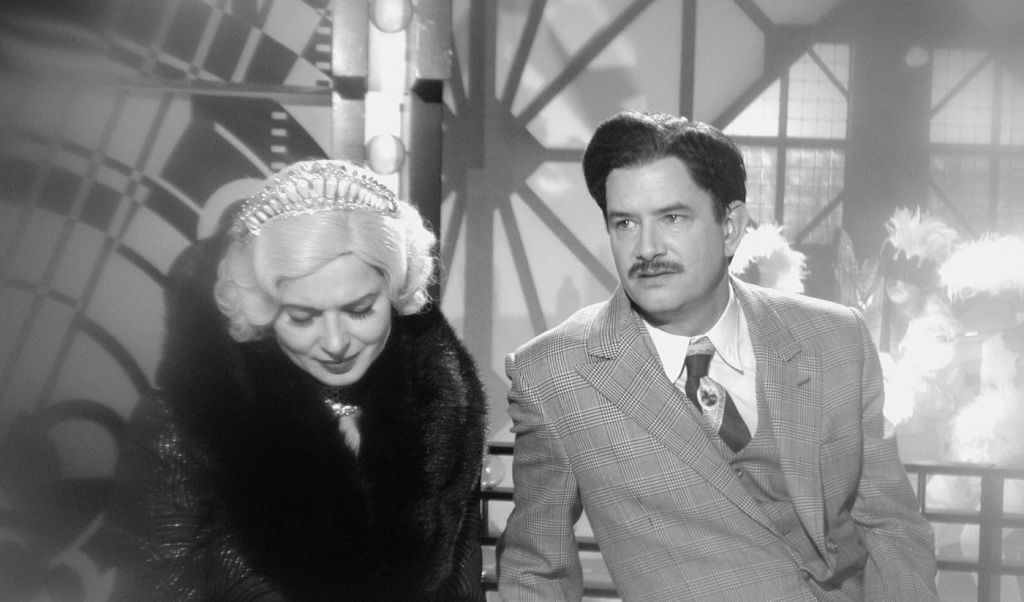
With the IFC release The Saddest Music in the World, Maddin is poised to reach the largest audience of his career. This extraordinarily wacky melodrama stars Isabella Rossellini as Lady Port-Huntly, a Winnipeg beer baroness with no legs, who sponsors a contest to honor the globe’s most melancholy music. Mark McKinney plays Port-Huntly’s former lover Chester, a sleazy Broadway entrepreneur representing America, while Chester’s alcoholic ex-surgeon father (repping Canada) and brooding older brother (the entry from Serbia) scheme in the background. The movie, which also stars Maria de Medeiros, includes such familiar Maddin themes as amnesia, silbing rivalry, romantic treachery, and absurd tricks of fate, all while various ethnic ensembles face off in a wild clash of musical styles. Filmed in murky black-and-white, with a few sequences in two-strip-style color, this is another one-of-a-kind Maddin madhouse, with dollops of droll humor amidst the purple passion and foolish tragedy.
Visiting New York for the premiere of Saddest Music as the opening-night attraction of the Museum of Modern Art’s “Canadian Front” series, Maddin in person is as engagingly offbeat as his films—a passionate movie lover with a sharp, self-deprecating wit. When this writer brings up Waiting for Twilight, a documentary shot during the making of his ill-fated Twilight of the Ice Nymphs (1997), Maddin responds, “I’ve never seen it. I’m too scared to watch it. I told the director, ‘You can make this movie, and I’m sure you’ll do a fine job, but I’m never gonna watch it.’ I don’t like watching myself, and I know I did a lot of complaining during that time. I sort of ask people about it every now and then, the way a partier might ask how he behaved the night before: ‘I wasn’t too out of line last night, was I?’”
Saddest Music began life as a screenplay by acclaimed novelest Kazuo Ishiguro (The Remains of the Day)—a seemingly unlikely source for a Maddin project. The director explains, “Rhombus Media owns the movie rights to Ish’s first novel, A Pale View of Hills, and they produced Heart of the World. Niv Fichman of Rhombus threw this script my way. It’s a script that had been kicking around for a few years, and Ish had gotten a bit discouraged, and he finally asked Niv if he could find an auteur director who was willing to dismantle it and reconstruct it as much as an auteur thought he would have to do to get it made. So Niv said, ‘Read this and Guy Maddinize it, and see if you can get into it.’ I worked on it with my screenwriting collaborator George Toles, and we came up with some stuff we were very enthusiastic about, and eventually came to an agreement with Ish. I never in a million years thought he would accept, but he came around on the changes we made—some of them were so drastic and felt disrespectful. But he and Niv made sure the spirit of the original was there.”
The Ishiguro screenplay took place in London in the mid-1980s, with the contest exploiting the new business opportunities in Eastern Europe. “Chief among Ish’s concerns,” Maddin says, “was the irony that on top of actually needing help, Third World nations would have to pretend to need even more help. The way Ethiopia won in the mid-’80s with its slam-dunk drought, and managed to get all those pop stars to sing songs about it. It was kind of sexy to support that charity for a while, and literally that was the saddest song in the world that year.
“As long as we kept people losing their dignity faking privation on top of their genuine privation, it was still his script,” Maddin notes, praising Ishiguro’s template as “an excellent backdrop” for his own trademark family-melodrama obsessions.
Surprisingly, Maddin had no trouble casting his eclectic assortment of international musicians from the talent pool in Winnipeg. “We were always looking for ways to save money on this picture, and there were a certain number of ethnic musicians that play in this annual pageant called Folkarama, where there are different pavilions for different countries, and you can go watch highland bagpipers eat haggis out of a Styrofoam cup, and then go over to the Norwegian pavilion and eat some herring and listen to a Norwegian ballad to deer on an accordion. We tended to cast people who had their own costumes, and who had the best traditional songs which were in the public domain. We also wanted to present the most variety, with the oddest clashes, [such as] an Asian bumbershoot flutist playing against a Mexican mariachi band.”
Maddin notes that “Winnipeg is the coldest [large] city in the world. And a lot of people just find themselves transplanted there. My favorite people on the shoot were these Sudanese drummers—they’d gone from +45 to -45 degrees Celsius in three weeks. And they were wearing the same thing basically, exposed skin everywhere, without complaining, no shivering. Those guys are hardy!”
It didn’t help matters that Maddin filmed Saddest Music in a huge bridge-works factory that was impossible to heat. “We did have heaters,” he recalls. “But you could literally stick your face right into the flames, and the flames would go shooting up into the cold rafters. So we just dressed as warmly as possible, and it sort of unified us. The cold was the common enemy instead of the director. It was ultimately very good for me. It kept the actors thinking of survival.”
Having come far from her native Portugal, de Medeiros (who plays McKinney’s amnesiac girlfriend) was especially unaccustomed to the chilly circumstances. “I’ve since come to know her at the Venice Film Festival, where it was hot,” Maddin confides, “and her beauty and likeability and zest, all that stuff, is directly proportionate to the temperature. You can just see the life ebbing out of her in the movie when it’s getting cold. She wore five layers of long underwear, with hot shots, those chemical packs you can squeeze which produce a thermal reaction. They look like a little stick of dynamite—she had them strapped there and she looked like a suicide bomber. She even had some around her head, underneath a big fur hat. And then she wore a costume which was all furs and boots, and she was still shivering.”
Maddin contrasts de Medeiros’ anguish with the arrival of Rossellini. “Her Scandinavian side kicked in. She showed up after Maria, and we warned her, ‘Maria finds this pretty impossible.’ So she strode onto the set with her coat open: ‘It’s not so cold in here!’ She’s not a complainer.”
Rossellini is also a good sport, Maddin attests, taking on a role that at one point calls for her to perch on top of prosthetic legs made of glass and filled with beer. “She likes to humiliate herself on film, she wants to make herself look bad. I’ve heard her speak about her long career as a model, and in spite of the million and one looks a fashion photographer can give a model, there’s still the same objective—glamour. Whereas with acting, there’s a million objectives, so she likes to explore those.”
Rounding out Maddin’s unusual star trio is Mark McKinney, veteran of the antic Canadian comedy troupe The Kids in the Hall. “I’ve got a lot of funny friends who get me through the day, but Mark is major-league funny,” Maddin declares. “He’s got a completely unpredictable view on things—you never know what point of the compass he’s going to come at a subject from. And then when he does decide to explode with a concatenation of shtick, it comes out in one big fluid piece. He’s got an incredible verbal reservoir, not just to siphon things off, but to blast a fireman’s hose full of extemporaneous riffs….He wants to make a serious acting career mixed in with comedy, and he stands a really good chance, ’cause he’s really smart.”
In a Guy Maddin film, the soundtrack—often overlaid with static, hisses, overdubs and sudden silences evoking a movie dredged from some cobweb-shrouded vault—is as important as the distressed visuals. “It’s probably not surprising to you that I listen to a lot of 78s,” he says. “I buy them up, half the time just for the ambience, the crackle. And if I happen to eventually learn to like the music that’s inculcating me from beneath all the ambient crackle, that’s fine.”
Maddin, who created dissonant layers of Mahler for his Dracula movie, also took liberties with the musicians in his new film, and he’s a little apprehensive about their reaction. “We took this Spanish flamenco group which was fiercely proud and purist, and ironically has not one Spaniard in it—the lead dancer is a Mtis woman, which is half French-Canadian and half First Nations (half aboriginal), and there’s a Ukrainian guitarist and a South Asian palmas clapper. They were fiercely protective of the purity of the flamenco dance, and we dubbed in all sorts of castanets and foot stomps into their performance to bring in some atonality. I have a hunch that flamenco dancer is going to stomp on my nuts after seeing their performance.”
Now that Saddest Music is wafting into theatres, Winnipeg’s most celebrated filmmaker is planning a change of scenery. “I’d like to come to New York for about a year,” he says, “and do something really independent and low-budget, my New York story. Although I’d probably find a warehouse and film a fake New York there.”
 Kevin Lally on Film
Leave a comment